Milevsko Monastery: A Premonstratensian Monastery in Czechia


Site at a Glance
- Rating
- 4.7
- Popularity
- Low
- Country
- Czechia
- Primary era
- Medieval
- External website
- Open
- Eras represented
- Medieval, Early Modern, Modern
- Civilizations
- Holy Roman Empire, Kingdom of Bohemia
- Site type
- Religious
- Remains
- Monastery
On this page18 sections
History
Milevsko Monastery is a Premonstratensian monastery in Czechia, founded between 1184 and 1187 by Jiří of Milevsko in the Romanesque period. It is the oldest monastery in South Bohemia. Premonstratensians, members of a Roman Catholic order whose communities combine communal religious life with pastoral service, came from Želiv, while the monastery’s mother institution was the Royal Premonstratensian Canonry at Strahov in Prague.
Foundation and medieval prosperity
Jarloch, a monk from the Rhineland and a pupil of Gottschalk, the abbot of Želiv, became Milevsko’s first abbot. He took part in the construction of the monastery with his religious community. A fire destroyed the monastery in 1191, but rebuilding followed, and the complex was consecrated on 1 October 1201. Jarloch died at Milevsko in 1228 and was first buried there.
The community eventually numbered as many as 30 religious members. Alongside pastoral duties, the monks cultivated grapes, grain, and hops, and managed a broad economic base. The monastery reached its greatest prosperity in the fourteenth century, when its possessions included more than 60 villages. A Latin school was also established, adding an educational role to the monastery’s religious and economic functions.
Milevsko served as a mother institution for the Premonstratensian monastery at Schlägl. On 13 February 1257, a papal document issued at the Lateran granted an indulgence to people who supported the abbot of Milevsko in rebuilding Schlägl. The relationship was formally recognized in 1307 as a confraternity and prayer association, a bond through which religious communities shared prayers and spiritual support.
Hussite destruction and secular administration
On 23 April 1420, during the Hussite Wars, the military campaigns of followers of the religious reform movement associated with Jan Hus, Milevsko Monastery was attacked and destroyed or severely devastated by Hussite forces reportedly led by Jan Žižka. The abbot had hidden the monastery’s valuables at Příběnice Castle, but they were destroyed after the castle was captured. The monks carried Jarloch’s remains to Zvíkov, where he was reburied in an unknown location. Some members of the community withdrew to the monastery’s provostship at Toužim, while Abbot Svatomir is recorded as fleeing to Klingenberg.
During the fifteenth century, the monastery’s possessions passed to the Rosenbergs and later to the Lords of Schwanberg. The monastery was abolished and sold in 1575. By the late sixteenth century, the Milevsko estate and monastery had passed to the Lords of Hodějov. Under their administration, parts of the complex were repaired, the pond dam was rebuilt and strengthened, and new ditches and walls were constructed. The former monastery was converted into a summer residence.
Restoration under Strahov
The Battle of White Mountain in 1620 ended the Bohemian Revolt, defeating the Protestant estates and strengthening Habsburg rule in Bohemia. After the battle, the Hodějov estates were confiscated. The monastery and surrounding villages were devastated and abandoned. An imperial decision transferred the monastery to Strahov in 1622, following the initiative of Strahov Abbot Kaspar of Questenberg. In 1623, he appointed Kryšpín Fuk, the provost of Doksany, as titular abbot of Milevsko.
Restoration then began under Strahov, and the monastery was fully restored by 1683. The monastery church received Baroque alterations during this period. The Premonstratensians were later expelled to Prague during the ecclesiastical reforms introduced by Emperor Joseph II in the 1780s. The monastery was abolished in 1785, but Strahov Abbot Václav Josef Mayer secured its reassignment to Strahov in 1786. Strahov retained the Milevsko estate until patrimonial administration was abolished in 1848.
Recovery and modern religious life
After the political changes of 1989, the Premonstratensians recovered the surviving monastery buildings. Three religious members now live and work at Milevsko, providing pastoral service for nine parishes and eleven churches. Their activities include worship, religious instruction, and spiritual retreats, continuing the monastery’s religious and cultural role.
Archaeological work in 2020 revealed a concealed passage and chamber in the Church of Saint Giles. Fragments of a gilded reliquary containing a purported nail relic of the Cross of Christ were found there. The relic remains in the custody of Strahov and has been lent for exhibitions at Milevsko. The monastery complex, the Basilica of the Visitation of the Virgin Mary, and the Cemetery Church of Saint Giles are protected cultural monuments. Repairs carried out through the national architectural-heritage rescue program between 1995 and 2014 contributed to the conservation of the complex.
Remains
The monastery complex brings together the Basilica of the Visitation of the Virgin Mary, the former convent, the deanery, the Cemetery Church of Saint Giles, the former Latin school, two courtyards, former industrial and agricultural buildings, and remnants of earlier fortifications. The surviving buildings represent several phases of construction and alteration, from the Romanesque foundation of the late twelfth century through Gothic rebuilding, Baroque changes, and nineteenth-century Neo-Romanesque work.
Entrance and first courtyard
Gate and defensive remains
The present entrance gate dates from 1885. Together with the adjoining defensive wall, it preserves parts of the monastery’s former defensive system. A fountain made in 1855 originally stood on Milevsko’s main square before being moved to the monastery courtyard in 2008.
Former Latin school
The former Latin school stands beside the entrance to the first courtyard. It is the oldest school in the region and is documented from 1543. Its lower part now contains a café, while the large hall on the first floor is used for lectures and exhibitions. Another room contains a permanent display of a Baroque library, with books loaned from Strahov.
Basilica and convent
Basilica of the Visitation of the Virgin Mary
The basilica began as a small Romanesque church founded in 1187, when the monastery was established. Much of its original construction took place under Abbot Jarloch. The church was rebuilt in the Gothic period, although its Romanesque entrance survived. By the end of the thirteenth century, it had been enlarged with a transept, the cross arm of a church, and a five-sided choir. A nineteenth-century rebuilding gave the basilica its present Neo-Romanesque character.
The basilica has a slender facade with two prominent towers built from granite blocks. It is approximately 56 metres long, more than 17 metres wide, and 14 metres high from the floor to the vault. Inside, pillars support the arcade that separates the nave from the side aisles. A sacristy, a room used for clergy and liturgical objects, is attached to the eastern end. Built in 1187, it initially served as a church while the main church was under construction. The Chapel of Saint Margaret adjoins the western end.
Former convent
The southern side of the basilica is organically connected with the buildings of the old convent. The convent buildings, sacristy, and parts of the cloisters have Neo-Romanesque features. The convent encloses a square former paradise garden. Archaeological finds from Milevsko and the monastery, together with period currency, were formerly exhibited within the complex.
Second courtyard and former administrative buildings
Industrial and agricultural buildings
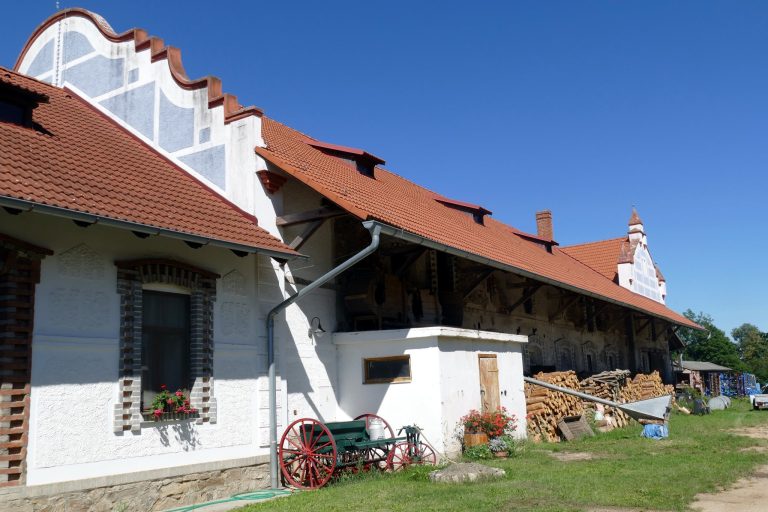
The second courtyard formerly contained a brewery, a sugar refinery, and agricultural buildings. Abbot Vít Seipel built the brewery in 1691 on the site of an earlier brewery, and it operated until it closed in 1907. Seipel also completed the agricultural buildings, which form part of the complex’s later economic and administrative fabric.
Former Baroque prelature
The former Baroque prelature, the residence and administrative area of the abbot, consists of four rooms and an abbot’s chapel. It now houses a local-history museum.
Cemetery Church of Saint Giles
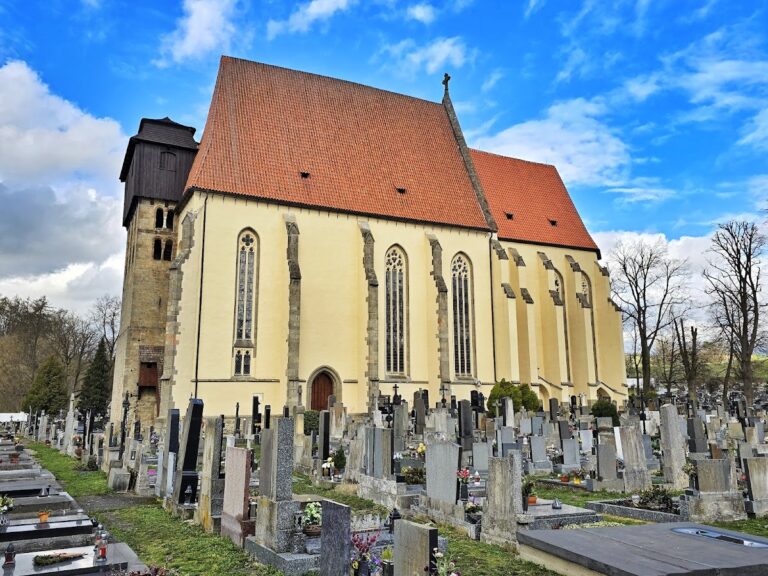
Romanesque and Gothic church
The Romanesque Church of Saint Giles stands at the centre of the present monastery cemetery. Archaeological research places its foundation in the last third of the twelfth century. Before the monastery was founded, it was the proprietary church controlled by Jiří of Milevsko. After the foundation, it served as the parish church, while the basilica served the religious community.
The church was substantially rebuilt in the Gothic period around 1400, when much of the Romanesque structure was demolished. Its architecturally important net vault, whose ribs form a network-like pattern, belongs to the “Milevsko type” and later served as a model for the Church of Saint Vitus in Český Krumlov. Externally, the clearly visible surviving part of the original Romanesque church is the western tower, built from dressed granite blocks and covered by a wooden roof. The church measures more than 23 metres in length, more than 11 metres in width, and 15.5 metres in height.
Cemetery and concealed treasury chamber
The cemetery surrounds Saint Giles’s Church. It was last enlarged and reconsecrated in 1899, and the church has served as a funeral hall since the 1980s.
In 2020, archaeologists found a passage within the church’s massive northern wall, constructed from dressed stone blocks. The passage ends in an enlarged room on the eastern side and has been interpreted as a concealed route leading to a treasury chamber. Fragments of a rare gilded reliquary and a purported nail relic were found in the space. Oak associated with the discovery was radiocarbon-dated to 260–416, while larch remains dated to 1290–1394 suggest that the relic may have been hidden before the Hussite Wars.