Příběnice: A Gothic Rožmberk Castle in Czechia


Site at a Glance
- Rating
- 4.4
- Popularity
- Low
- Country
- Czechia
- Primary era
- Medieval
- Eras represented
- Medieval
- Civilizations
- Holy Roman Empire, Kingdom of Bohemia
- Site type
- Military
- Remains
- Castle
On this page12 sections
History
Příběnice in Czechia is a Gothic castle founded before or during the first half of the thirteenth century by members of the Witigonen dynasty, the powerful medieval noble family that included the Rožmberks. Its first written mention dates to 1243, when Vítek V of Příběnice was associated with the castle. The fortress became the centre of a lordship and later played an important military role during the Hussite Wars.
Foundation and Rožmberk administration
The founders were probably Vítek V of Příběnice and his brother Vok I of Rožmberk. After Vítek died in the mid-thirteenth century, Příběnice passed to Vok. Following Vok’s death in 1262, it remained within the Rožmberk family, eventually passing to Jindřich I of Rožmberk and then to his son Petr I. A castellan, the lord’s appointed castle governor, appears at Příběnice in 1281.
Příběnice governed a lordship that included the smaller castle of Příběničky on the opposite bank of the Lužnice, nearby villages, and surrounding estates. The two castles formed one lordship until 1374. After the division of the Rožmberk lands, the Příběnice lordship, comprising 34 villages, went to Oldřich I of Rožmberk. He reunited the family’s possessions in 1389. Other castellans who served at Příběnice included Přibík of Vyšetice, Mrakeš of Petrovice, Matěj, and Jan Smrčka of Mních.
Political conflict and royal imprisonment
Příběnice also became involved in the political struggles of late-fourteenth-century Bohemia. Jindřich III of Rožmberk belonged to the Lords’ Union, an aristocratic league formed against King Wenceslas IV. In 1394, he held the king prisoner at Příběnice for a short time before Wenceslas was transferred elsewhere and eventually taken to Český Krumlov.
The Hussite Wars
The Hussite Wars were religious and political conflicts in Bohemia from 1419 to 1434, arising from the reform movement associated with Jan Hus. During these wars, Příběnice became the principal stronghold of Oldřich II of Rožmberk in his conflict with the nearby Taborite community. The Taborites were the radical military and religious faction centred on Tábor. Together with Příběničky, the castle controlled movement along the Lužnice and the routes beside the river between Tábor and northern Bohemia.
Oldřich II used Příběnice as a prison for captured Hussite preachers. Some prisoners were tortured or killed there. In 1420, when the forces of Jan Žižka approached, the abbot of Milevsko monastery hid the monastery’s valuables at the castle. In early September, the Taborite preacher Václav Koranda was captured and imprisoned at Příběnice with other Taborites.
During the night of 13 November 1420, Koranda and his companions escaped, seized a tower and its guards, and released other prisoners. They alerted Tábor, allowing Taborite forces under Zbyněk of Buchov to capture Příběnice. The garrison at Příběničky surrendered later that day. The Taborites obtained valuables that secular and ecclesiastical lords had deposited at the two castles for safekeeping. Among the prisoners connected with the capture was Heřman of Mindelheim, the titular bishop of Nicopolis. He was killed after reaching the bank of the Lužnice, where he was thrown into the river and struck with stones.
After its capture, Příběnice served as a Taborite base and prison. Bohuslav of Švamberk and Menhart II of Hradec were among the noble prisoners held there in 1421. An Adamite religious community also established itself near the castle that year. Jan Žižka suppressed the community, and many of its members were burned after refusing to renounce their beliefs.
Destruction and later status
Fighting between Catholic and Hussite forces repeatedly affected the castle’s surroundings from 1422 to 1427. The settlement below Příběnice was burned in 1428. After the Battle of Lipany in 1434, the Taborites came under increasing pressure from the Rožmberks. A peace agreement reached in 1437 required the return and demolition of Příběnice, Příběničky, and the settlement below the castle. Příběnice was destroyed that year, and its stone was dismantled for reuse.
The former Příběnice lordship remained Rožmberk property and was later incorporated administratively into the Choustník lordship. By the late seventeenth century, the castle and settlement appeared in land registers as ruined or deserted. Příběnice and the associated complex, including Příběničky, the settlement, ruins, and archaeological traces, are protected together as a cultural monument.
Remains
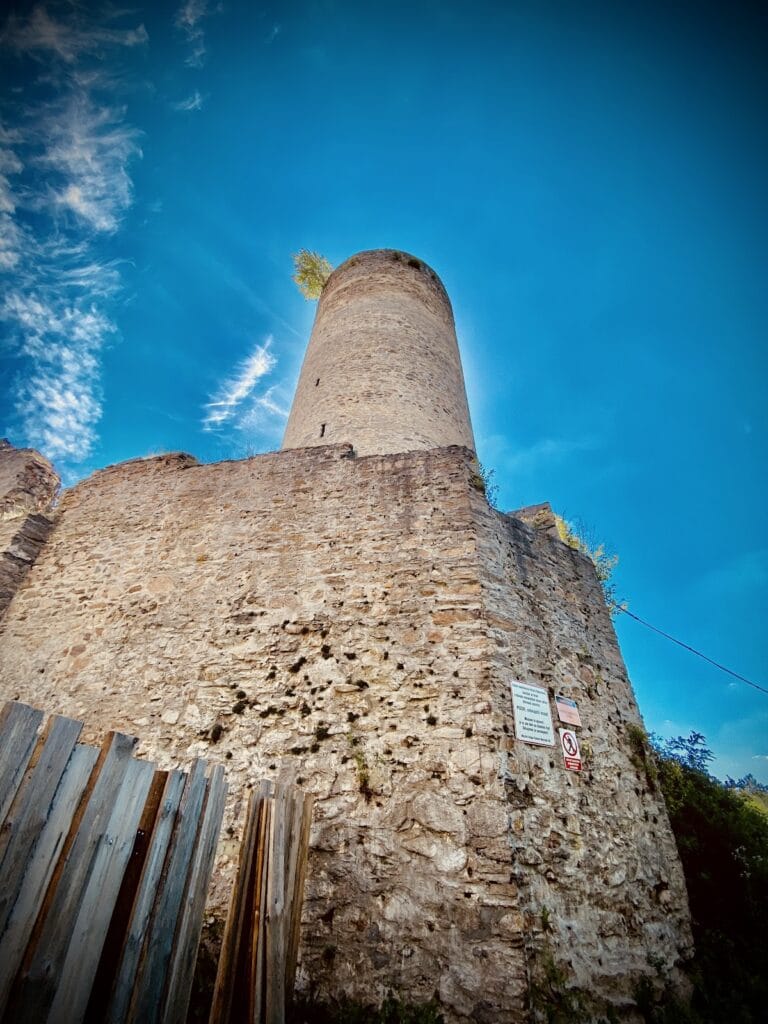
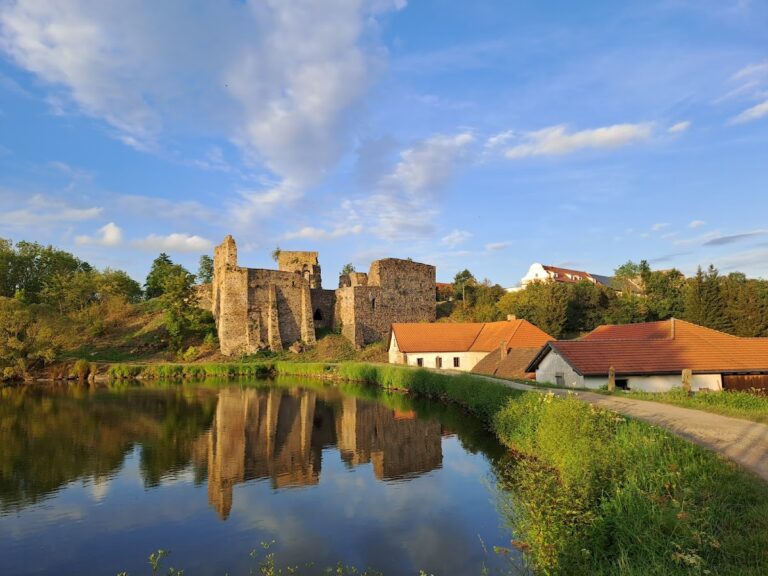
Příběnice occupies an elongated rocky spur on the left bank of the Lužnice, surrounded by a river meander at an elevation of about 410 metres. The complex consisted of a forecourt, the fortified castle core, the lower settlement or latrán, meaning a fortified settlement beneath a castle, and Příběničky on the opposite bank. The two castles were linked by a stone bridge, traces of which were found on the riverbed during investigations in 2009. Forest now extensively covers the ruins, but the overall castle plan remains recognizable.
Approach and outer defenses
The former approach came from the southeast, reportedly from the direction of Slapy. It first crossed a forecourt protected by a ditch and rampart. Entry into the castle core continued through a narrow corridor along the southwestern side and then through the area below the first courtyard. A long outer defensive space, or zwinger, ran along the western side. The approach turned approximately 180 degrees before reaching the inner courtyard through a passage in the palace.
The lower fortifications of the latrán joined the corridor on the southwestern side of the castle. The settlement occupied the southwestern part of the rocky spur, where the remains of houses, defenses, and a mill survive. On the steep northeastern side of the palace district, two rectangular defensive towers connected by a zwinger were added during the fifteenth century.
Castle core
The core was divided into four parts. Its southeastern end stood at the edge of the spur above an almost vertical slope of amphibolite, a dark, hard metamorphic rock. A broad ditch and substantial rampart protected the northeastern side. The first courtyard retained the remains of a quadrangular tower, while the entrance sequence led onward toward the central palace complex.
Octagonal tower
A freestanding octagonal tower occupied the southwestern part of the core. It was a partially preserved bergfried, a major defensive tower intended chiefly for military protection rather than permanent residence. A small courtyard lay behind it, forming one of the distinct spaces within the castle’s defensive arrangement.
Palace complex
The central area contained a large palace complex arranged around a narrow inner courtyard. A passage in the northern palace wing provided access to this courtyard. The southwestern wing was partly excavated during the first half of the twentieth century, and buttresses on its courtyard side may have supported a gallery. The castle chapel was built during the first half of the fourteenth century and was destroyed with the rest of the castle in 1437.
Northeastern tower
A rectangular tower stood in the northeastern part of the core. It measured approximately 12 by 8 metres and formed part of the castle’s defensive system on the side protected by the broad ditch and rampart.
Settlement and surviving landscape
The remains of the castle, its courtyards, towers, palace wings, outer defenses, and lower settlement form a connected ruin landscape on the rocky spur. The surviving houses and fortifications of the latrán, together with the mill remains and archaeological traces, preserve the relationship between the stronghold and the community that developed below it.