Malchow Abbey: A Medieval Convent and Noblewomen’s Foundation in Germany


Site at a Glance
- Rating
- 4.3
- Popularity
- Low
- Country
- Germany
- Primary era
- Modern
- External website
- Open
- Eras represented
- Medieval, Modern
- Civilizations
- German
- Site type
- Religious
- Remains
- Monastery
On this page8 sections
History
Malchow Abbey is a former convent and noblewomen’s foundation in Germany, established in the medieval period at Alt Malchow on the shore of Lake Malchow. Its history encompasses a community of Magdalene penitents, a later Cistercian identity, and its transformation after the Reformation into one of Mecklenburg’s state convents for noblewomen.
From Neu Röbel to Alt Malchow
A convent of Magdalene penitents, a medieval female religious community devoted to penitence and Mary Magdalene, existed at Neu Röbel on the Müritz before 1274. Between 21 May and 2 June 1298, Bishop Gottfried I of Havelberg transferred the community to Alt Malchow in the Waren archdeaconry. The former convent buildings at Röbel passed to Dominicans, while the Malchow community occupied the premises of an earlier Magdalene community.
In 1298, Nicholas II, ruler of the medieval principality of Werle, granted the convent the patronage of the churches at Alt Malchow, Neu Malchow, and Lexow with the consent of his mother, Sophia. By the fifteenth century, the community was regarded as Cistercian, an association with a Western Christian order that followed the Rule of Saint Benedict and emphasized disciplined communal religious life.
Reformation and the noblewomen’s foundation
After the Reformation, Article 4 of the Sternberg Assurance of 2 July 1572 changed the monastery into a Damenstift, a collegiate foundation for noblewomen rather than an enclosed nunnery. Administration passed to the united Mecklenburg estates, and Malchow became one of the three state convents of the Mecklenburg nobility, alongside Dobbertin and Ribnitz.
Entry requirements reflected the foundation’s aristocratic character. Applicants needed proof of noble ancestry, an ancestral certificate, virginity, Christian faith, and documented native ancestry. Only families belonging to the local and formally recognized nobility could enroll their daughters. Families commonly placed their eldest daughter at Dobbertin, their second at Malchow, and their third at Ribnitz. Vacancies were so limited that waiting periods of 40 to 50 years were customary.
Transformation and dissolution
Most of the complex remained intact until major alterations in 1722, 1729, and 1730, although its furnishings had already been adapted to changing needs. The 1918 Revolution abolished the Mecklenburg estates as a corporation. The state convents initially came under state supervision and were then abolished by the constitution of the Free State of Mecklenburg-Schwerin and its implementing law of 17 May 1920. Existing registrations at the foundation were not affected, so the noblewomen’s institution continued in practice into the 1920s. Its administrative business was conducted by Herr von Lücken.
The former abbey church later became a concert hall and organ museum. The Mecklenburg Organ Museum presents the history of organ building in Mecklenburg and is described as the first museum of its kind in the eastern federal states of Germany.
Remains
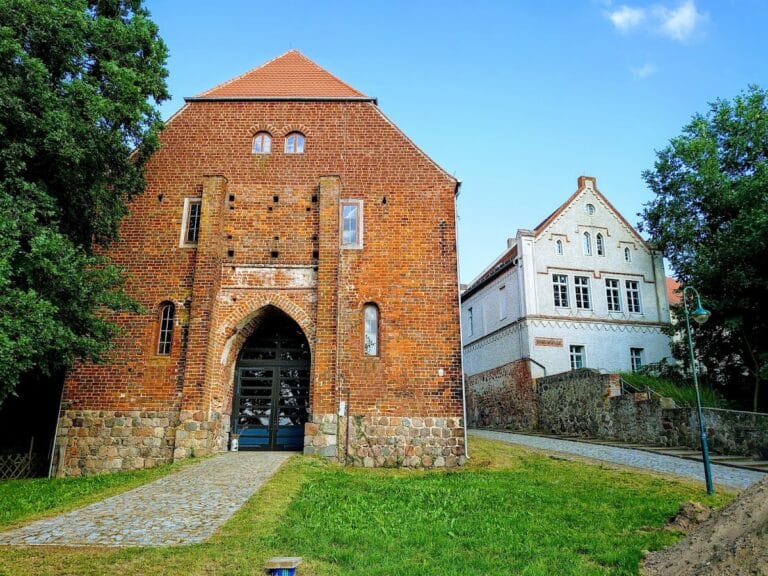
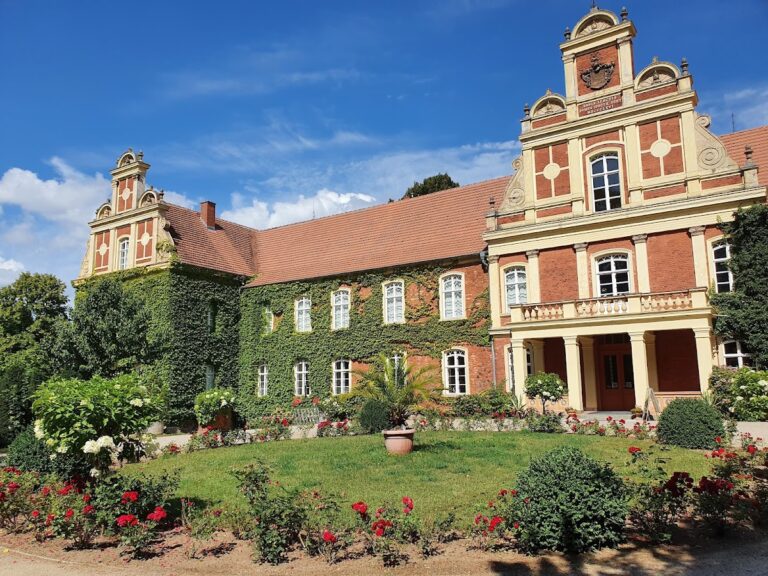
The surviving abbey complex lies in Alt Malchow on the eastern shore of Lake Malchow, opposite the town of Malchow, which stands on an island. The church dominates the site, while the cemetery, Engelsche Garden, sections of the medieval cloister, and former enclosure buildings preserve the layout of the former religious foundation. Some ancillary buildings now serve residential purposes.
The abbey church
Before 1844, the abbey church was a simple stone building. A new church was constructed between 1844 and 1849 to plans by Friedrich Wilhelm Buttel. Its west front received a square brick tower 52 metres high, crowned by an octagonal upper structure. The foundation stone was laid on 3 April 1844 during a special ceremonial programme. After the tower was added, the nave was renewed between 1847 and 1849 because its earlier appearance was considered unsuitable beside the new tower.
A fire in 1888 brought another comprehensive rebuilding, carried out between 1888 and 1890 to plans by Georg Daniel. The work gave the church its Gothic Revival appearance, a nineteenth-century style that revived medieval Gothic forms, and included the addition of vaulting. The building now houses the permanent exhibition of the Mecklenburg Organ Museum as well as serving as a concert hall. Its organ was made by Friedrich Friese III, a nineteenth-century German organ builder.
Cloister and enclosure
Parts of the medieval cloister and the former monastic enclosure survive within the complex. A cloister is a covered passage arranged around an enclosed courtyard and used to connect the principal buildings of a monastery or convent. The surviving enclosure buildings, together with ancillary structures now used as residences, retain elements of the former convent’s built setting.
Engelsche Garden and museum buildings
The Engelsche Garden was laid out during the tenure of kitchen master Johann Jacob Christian Engel, who served from 1786 to 1818, and takes its name from him. It was completed in 1855 and 1856. The nearby former parsonage forms part of the organ museum complex, which is housed in both that building and the former church.
Nearby sites