Lutheran Church in Pasym: A Late-Gothic Teutonic Order Church


Site at a Glance
- Rating
- 4.8
- Popularity
- Very Low
- Country
- Poland
- Primary era
- Medieval
- External website
- Open
- Eras represented
- Medieval, Early Modern
- Civilizations
- Teutonic Order
- Site type
- Religious
- Remains
- Church
On this page9 sections
History
The Lutheran Church in Pasym, Poland, is a late-Gothic brick church associated with the Teutonic Order and dating in its present form to the second half of the fifteenth century. Its foundations are traditionally placed around 1350, while an earlier church was reportedly completed in 1391. Probably dedicated to Saint Barbara, it is regarded as the oldest surviving church of the Teutonic Order.
From Teutonic church to Lutheran parish
Pasym was historically known by its German name, Passenheim. Before the Reformation, the church belonged to the Archpresbyterate of Bischofsburg, an ecclesiastical district overseen by a senior priest. In 1525, the pastors of Passenheim adopted the Lutheran Reformation, the sixteenth-century movement associated with Martin Luther that led to churches distinct from Roman Catholic authority. The building consequently became Protestant, and two clergy served the parish at the same time.
Until 1945, the parish formed part of the East Prussian ecclesiastical province and the Ortelsburg church district. In 1916, the large district was divided between the newly established Passenheim superintendent district and the Ortelsburg superintendent district. The Passenheim district received 26,900 members and ten pastors, while the Ortelsburg district received 36,380 members and eleven pastors. In 1925, the Passenheim parish had about 5,200 members in 28, or nearly 30, localities.
Fires, warfare, and rebuilding
The church survived the Passenheim town fire of 1583, which destroyed much of the town but left the church, nine houses, and the Teutonic Order castle standing. It also escaped damage during the Tatar incursion of 19 December 1657. This survival was associated with a wall painting. The pastor at the time was Andreas Hartknoch, the father of the historian Christoph Hartknoch.
A further town fire on 23 June 1751 badly damaged the top of the tower. Repairs continued through the 1750s and 1770s because of financial difficulties. Decayed timber was replaced, one storey was removed from the tower, and the surviving curved roof was installed in 1770. The nave interior was remodeled, and the southern porch was rebuilt during the same period.
The congregation after 1945
After the Second World War, Passenheim became part of Poland. Much of the predominantly Protestant population fled or was expelled, while the Catholic population grew through resettlement. Unlike most former Protestant churches in the region, the church at Pasym remained with its small Lutheran congregation.
The roof and interior furnishings were repaired or restored during the 1990s. A German and Polish gathering marked the church’s six-hundredth anniversary in 1991. Between 2009 and 2016, the exterior underwent comprehensive restoration, the roof tiles were renewed, and lightning protection was installed. The work was completed for the church’s six-hundred-and-twenty-fifth anniversary in 2016.
Today, the congregation has about 200 members. It belongs to the Masurian Diocese of the Evangelical-Augsburg Church in Poland, the Lutheran tradition identified with the Augsburg Confession. The Pasym parish also includes filial churches at Dźwierzuty and Jedwabno. The church is a registered historic monument of Pasym and has been protected under Poland’s heritage register since 12 September 1956.
Remains
Late-Gothic structure and tower
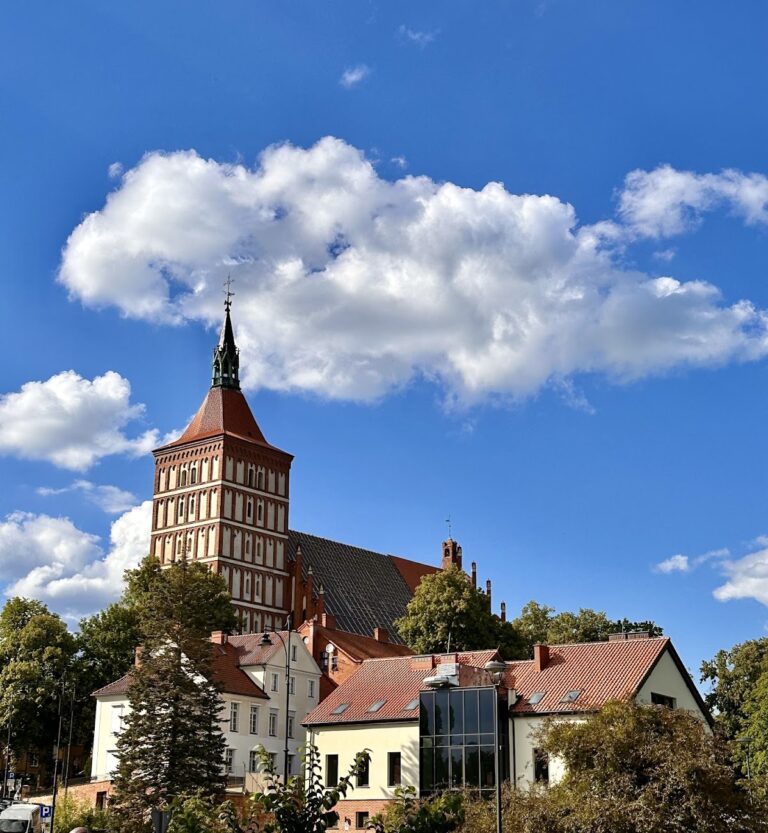
The church is a broad, single-nave building with a rectangular plan and a hall-like interior. Built of brick on a fieldstone foundation or plinth, it has no separate choir. Buttressed walls and pointed-arch windows express its late-Gothic character. The western end is occupied by a broad, massive brick bell tower set on fieldstone. Although the tower originally had four storeys, one was removed during the eighteenth-century repairs. Its present crown is a curved, domed Baroque roof with a funnel-shaped finial, covered with shingles in 1770.
Vaults, porch, and sacristy
The nave is covered by a wooden barrel vault, while the side areas have flat ceilings. The sacristy on the north side contains a prominent star vault, a ribbed vault whose intersecting ribs create a star-like pattern. Original masonry vaulting that once extended over the nave can still be seen in the sacristy. The southern porch was rebuilt after 1750, and its inner door has carved decoration dated 1773.
Altarpiece and historic furnishings
The Mannerist high altar dates from 1673. Its central section contains a relief of the Holy Trinity, the Christian doctrine of God as Father, Son, and Holy Spirit. Figures of the four Evangelists stand at the sides, with a Last Supper scene below. C. Helmke painted the polychrome decoration in 1713, and large figures of Moses and Aaron stand near the altar. Behind the altar area are surviving sections of late-fifteenth-century Gothic choir stalls. Three seventeenth-century grave slabs and a large crucifix are also preserved in the church.
A Baroque pulpit from 1680 has a stucco base decorated with angels’ heads. The baptismal font has a chalice-shaped form, with masks and fittings dating from the early seventeenth century. In the centre of the church hangs a deer-head chandelier dated 1608, commemorating a cholera epidemic. Another chandelier in the nave, in front of the altar area, bears the inscription “From the citizens of the municipality of Bassenheim.” It was donated for the six-hundredth anniversary by Bassenheim, Pasym’s partner municipality. Former Passenheim residents also donated ten wall lights.
Organ, books, and memorials
The organ retains a Baroque case dating from 1705, made by Johann Josua Mosengel. The original instrument had 13 stops and twelve registers. Carl Novak installed a new organ work with 20 voices in 1902, and in 1998 the Zych workshop placed another new organ work behind the old case. The present instrument has mechanical action, meaning that physical linkages connect the keys with the valves controlling the pipes, and has 23 registers. The case had been restored in 1744, and the organ is also used for organ and chamber-music concerts.
The church preserves historically valuable Bibles published in Nuremberg in 1708, in Gdańsk in Polish in 1726, in Lüneburg in 1650, and in 1756. Wall panels record participants in the campaigns of 1813 and 1815, those killed in the wars of 1866 and 1870 to 1871, and soldiers and civilians who died in the First World War. An epitaph commemorates Christoph Hartknoch, who died in 1687, while other memorial inscriptions commemorate members of the congregation killed in the Napoleonic Wars, the Franco-Prussian War of 1871, and the First World War.
The church formerly possessed eight bells dated 1774, 1785, and 1845.