Tartu Cathedral: A Ruined Medieval Cathedral and University Museum in Estonia


Site at a Glance
- Rating
- 4.7
- Popularity
- Low
- Country
- Estonia
- Primary era
- Medieval
- Eras represented
- Medieval, Modern
- Civilizations
- Crusader, Russian
- Site type
- Religious
- Remains
- Cathedral
On this page13 sections
History
Tartu Cathedral is a ruined medieval Roman Catholic cathedral in Tartu, Estonia. Dedicated to Saints Peter and Paul, the city’s patron saints, it served as the seat of the Bishopric of Dorpat and was regarded as one of the largest religious buildings in Eastern Europe. Built in the Brick Gothic style, the cathedral developed over several centuries on Toomemägi, the hill beside the Emajõgi River.
Stronghold and Episcopal Centre
Before the cathedral was built, Toomemägi was one of the largest strongholds of the pagan Estonians. Christian forces of Livonia destroyed the stronghold in 1224 and began constructing the episcopal fortress Castrum Tarbatae on the strategic site. Excavations have revealed parts of walls belonging to earlier structures. The cathedral and the bishop’s fortified residence later formed the ecclesiastical centre of Tartu, while houses for members of the cathedral chapter occupied the surrounding precinct.
Construction of the Cathedral
Work on the Gothic cathedral probably began on the northern side of the hill during the second half of the thirteenth century. Its early quire and nave were already in use by 1299. The original plan called for a basilica, a church with a higher central nave and lower side aisles, but the later addition of a three-aisled quire gave the building the character of a hall church.
The high quire, including its pillars and arches, was completed around 1470. Construction continued until the late fifteenth century, when two massive western towers were added. These fortress-like towers completed the imposing western front of the cathedral.
Reformation, War, and Decline
The Reformation reached Tartu in the mid-1520s. Protestant iconoclasts, who destroyed or removed religious images and furnishings, severely damaged the cathedral on 10 January 1525. It then fell progressively into decay. After Hermann Wesel, the last Roman Catholic Bishop of Dorpat, was deported to Russia, the cathedral was abandoned. Wesel had served as bishop from 1554 to 1558 and died in 1563.
Russian troops devastated Tartu during the Livonian War, fought from 1558 to 1583. After the city came under Polish rule in 1582, its Roman Catholic rulers planned to rebuild the cathedral, but those plans were abandoned during the Polish-Swedish War of 1600 to 1611. A fire in 1624 caused further damage. Tartu came under Swedish rule in 1629, after which neglect accelerated the ruin of the church. Burials continued in the graveyard into the eighteenth century, while the main body of the cathedral was used as a barn.
In the 1760s, both towers were reduced from 66 metres to 22 metres, approximately the level of the nave roof, and converted into cannon platforms. The main portal was walled up at the same time. These changes altered the surviving structure from a functioning cathedral into a partly military and agricultural ruin.
University Use and Conservation
When Alexander I re-established the German-speaking Imperial University of Dorpat in 1802, the Baltic German architect Johann Wilhelm Krause was commissioned to build a university library among the cathedral ruins. Constructed between 1804 and 1807, the library gave part of the abandoned complex a new institutional purpose. Krause also proposed placing an observatory in one of the old cathedral towers, but the plan was not carried out. The Dorpat Observatory was built as a separate structure in 1811.
The library was expanded and fitted with central heating in the 1960s. After a new university library replaced it in 1981, the building became the historical museum of the University of Tartu. A major conversion in 1985 largely restored its nineteenth-century interior. Until the end of the 1990s, the renovated building also housed offices of the university’s History Department, the art department, and worship by the Tartu University congregation of the Estonian Evangelical Lutheran Church.
The renovated section now houses the University of Tartu Historical Museum, while the university uses its premises for major receptions. Tartu Cathedral is registered as an Estonian architectural monument. Its partially ruined condition was assessed as satisfactory during an inspection on 16 June 2023. Toomemägi was landscaped as a park in the nineteenth century, creating a wider university and cultural setting around the cathedral ruins.
Remains
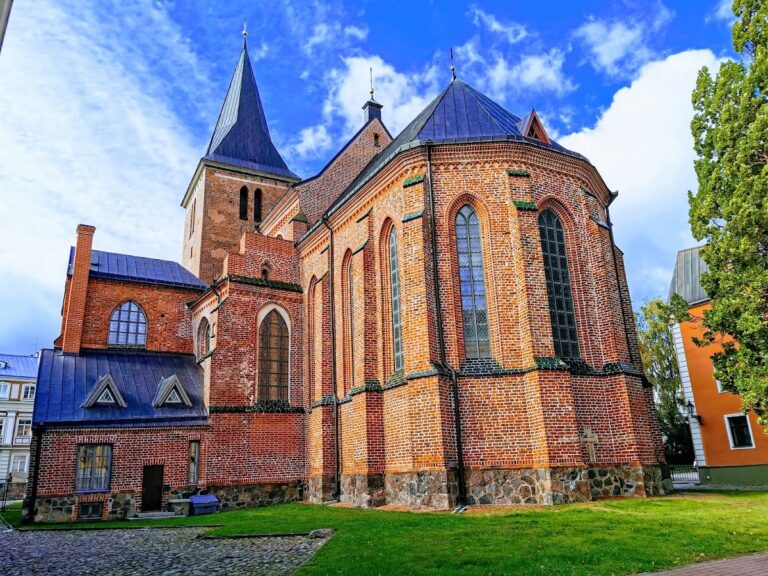
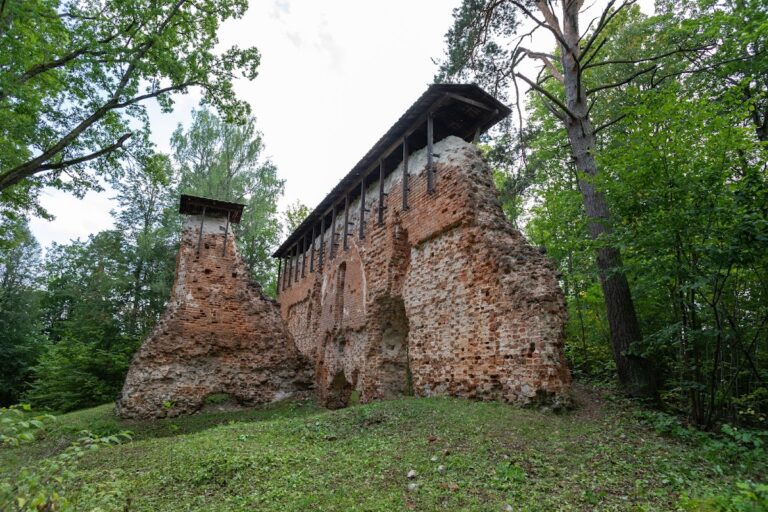
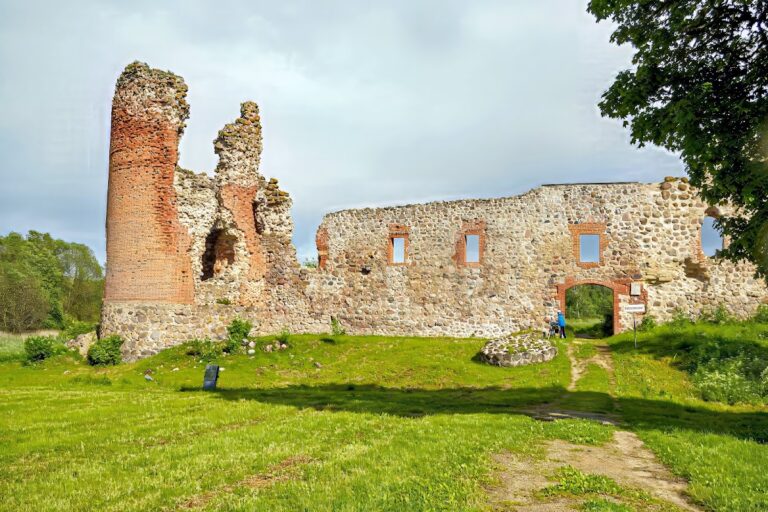
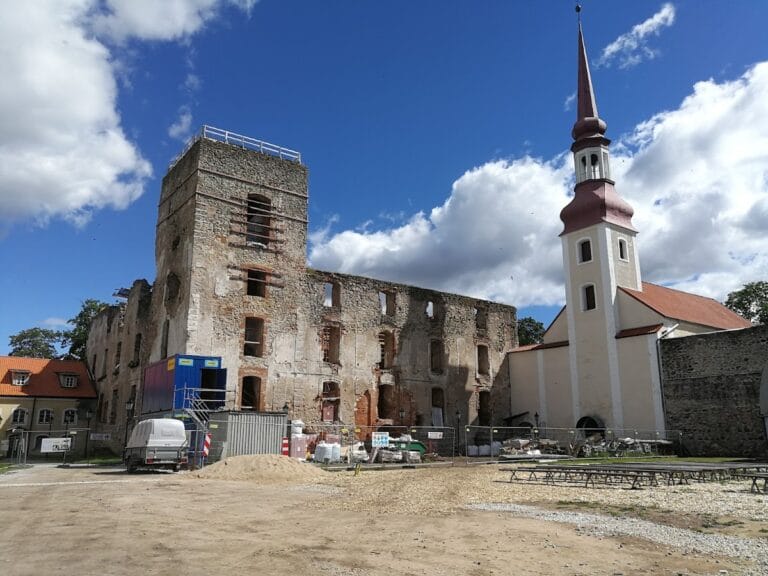
Tartu Cathedral survives as an imposing brick ruin on the northern side of Toomemägi. The former church was surrounded by a graveyard and chapter houses, and a wall separated the cathedral grounds and the bishop’s fortified residence from the lower town. About one-third of the cathedral has been renovated for museum use, while the remaining ruins and the external walls of the quire have been structurally secured and consolidated.
Cathedral Structure
Quire and Nave
The building’s surviving form reflects its change from a planned basilica into a hall church with a three-aisled quire. The high quire, completed around 1470, retains its pillars and arches. Its external walls remain part of the consolidated ruin, while the nave belongs to the larger fragmentary body of the former church.
Western Towers
The two western towers were built of brick and stone and completed in the late fifteenth century. Their stone sections originally rose 66 metres without the spires. The exact height with the spires is unknown, although the French traveller and writer Aubry de La Mottraye wrote after visiting Tartu in 1726 that the towers were at least as high as those of Notre-Dame de Paris. The towers were reduced to 22 metres in the 1760s and adapted as cannon platforms. The northern tower later became a water tower, and the main entrance was blocked during the same eighteenth-century alterations.
University Library
The former university library is a three-storey building constructed within the cathedral ruins between 1804 and 1807 to designs by Johann Wilhelm Krause. Its restored section contains the University of Tartu Historical Museum, with exhibitions of university-history objects, scientific instruments, and rare books. The building’s nineteenth-century interior was largely restored during the 1985 conversion.
Cathedral Hill Landscape
Angel Bridge
The Inglisild, or Angel Bridge, spans the path toward the lower town. Built between 1814 and 1816, it carries a central portrait relief of Georg Friedrich Parrot, the physicist and first rector of the re-founded university. The relief bears the inscription Otium reficit vires, meaning “Leisure renews the powers.”
Monuments and University Buildings
The park surrounding the cathedral contains monuments to Karl Ernst von Baer, Kristjan Jaak Peterson, Nikolay Pirogov, and Friedrich Robert Faehlmann. Their commemorations represent the hill’s documented scientific and literary associations. Other surviving buildings on Toomemägi include the seat of the Estonian Supreme Court, the Dorpat Observatory, university classrooms, and the university’s old anatomy theatre.