Gandersheim Abbey: An Ottonian Imperial Foundation in Germany


Site at a Glance
- Rating
- 4.5
- Popularity
- Low
- Country
- Germany
- Primary era
- Medieval
- External website
- Open
- Eras represented
- Medieval
- Civilizations
- Holy Roman Empire
- Site type
- Religious
- Remains
- Church
On this page15 sections
History
Gandersheim Abbey is a former imperial women’s foundation in Bad Gandersheim, Germany, founded by the Saxon count Liudolf and his wife, Oda, in 852. The founders belonged to the Liudolfing, or Ottonian, dynasty, the ruling house descended from Liudolf that supplied several German kings and emperors. The abbey’s church, dedicated to Saints Anastasius and Innocentius, became an Ottonian burial place and an important family institution in Saxony.
Foundation and Ottonian patronage
During a pilgrimage to Rome around 845–846, Liudolf and Oda obtained permission from Pope Sergius II to establish the foundation. They also received relics associated with Popes Anastasius and Innocentius, who became patrons of the abbey church. The community was first established at Brunshausen, where the founders’ daughter Hathumod became its first abbess. Two of her younger sisters followed her in the office. After the Gandersheim church was dedicated in 881, the community moved to the new site.
In 877, King Louis the Younger placed the foundation under imperial protection. This gave Gandersheim extensive independence, including freedom from the authority of the Bishopric of Hildesheim. King Henry I confirmed its imperial immediacy in 919. This constitutional status placed the abbey directly under the king or emperor rather than under a territorial prince or bishop. Gandersheim was consequently expected to accommodate German kings and their entourages as they travelled.
The richly endowed foundation was among the most important Ottonian family establishments in Saxony until the foundation of Quedlinburg Abbey in 936. Its church served as a burial place for members of the dynasty and its associated families. Recorded burials include Liudolf, Sophia I, Abbess of Gandersheim, and Agnes of Brunswick-Grubenhagen.
Canonesses, education, and literary culture
Gandersheim was a secular women’s foundation, a religious community whose members followed a devotional life without taking permanent monastic vows. Its canonesses came from high-nobility families, could own private property, and were free to leave the foundation. Their responsibilities included memorial services for the founding family and the education of aristocratic girls, who were not required to become canonesses. Until 973, the community may also have included canonesses following the Rule of Saint Augustine alongside nuns following the Rule of Saint Benedict.
In 940, the abbess founded the subordinate Marienkloster. The repeated stays of Ottonian and Salian kings, the later ruling dynasty whose last king died in 1125, connected Gandersheim closely with the political world. Its community was therefore not an enclosed institution separated from court life. Around 950–970, the canoness Hrotsvit, also known as Roswitha of Gandersheim, produced religious works, historical poetry, and Latin dramas. Her Gesta Ottonis expressed admiration for Emperor Otto I and described the activities of his family and government.
Jurisdictional conflict and territorial pressure
A dispute known as the Great Gandersheim Conflict developed around the turn of the tenth and eleventh centuries. The Bishop of Hildesheim asserted jurisdiction over the abbey and its estates, while the boundary between the dioceses of Hildesheim and Mainz remained unclear. The conflict continued into the reign of Emperor Conrad II. On 22 June 1206, Pope Innocent III issued a privilege that finally exempted Gandersheim from the claims of Hildesheim. The abbesses were also permitted to use the title of imperial princesses, a rank that carried high political standing within the Holy Roman Empire.
After the death of the last Salian king in 1125, Gandersheim’s political importance declined and the foundation became increasingly exposed to territorial rulers. The Welfs attempted to extend their influence, while the abbey could not establish an independent territorial lordship. By the mid-1270s, the Dukes of Brunswick had secured the abbey’s bailiwick, the protective jurisdiction exercised by a territorial lord over an institution. They built a castle at Gandersheim in the late thirteenth century. In 1402, their influence increased when Sophia III, Princess of Brunswick-Lüneburg, was elected the first abbess from their family.
Reformation and Lutheran rule
In 1542, troops of the Schmalkaldic League occupied the Principality of Brunswick-Wolfenbüttel. The league was an alliance of Protestant princes and cities opposed to the Catholic imperial order during the Reformation, the sixteenth-century movement that established Protestant churches in parts of Europe. The occupiers disregarded Gandersheim’s imperial immediacy and ordered Lutheran worship. The canonesses delayed implementation while the prioress governed for the seven-year-old abbess.
On 13 July 1543, townspeople attacked the abbey church and destroyed images and altars. Duke Henry the Younger later returned the principality to Roman Catholicism, repaired at least part of the damage, and had the church rededicated. Lutheran worship was definitively introduced in 1568 under Duke Julius of Brunswick-Lüneburg. Gandersheim, together with its dependencies at Brunshausen and Clus, became Lutheran, while the Marienkloster and the Franciscan friary were suppressed. Disputes between the abbess and the duke over their respective authority continued until a treaty settled them in 1593.
Later abbesses and dissolution
A renewed period of prosperity followed under Abbesses Henriette Christine of Brunswick-Wolfenbüttel and Elisabeth Ernestine Antonie of Saxe-Meiningen. They promoted the arts and sciences. Elisabeth Ernestine Antonie commissioned the summer palace at Brunshausen, the Baroque wing of the abbey with its Imperial Hall, and work furnishing the church.
In 1802, the abbey surrendered its imperial immediacy to the sovereignty of Brunswick-Wolfenbüttel in an attempt to avoid impending secularization. During the French occupation, Gandersheim belonged to the Kingdom of Westphalia from 1807. With Napoleon’s approval, the former abbess was allowed to return and reside there. After her death on 10 March 1810, no successor was elected and the abbey was dissolved. Its possessions passed to the Westphalian crown domains, and its members received compensation. The Duchy of Brunswick did not restore the foundation after 1813.
The former abbey is now used by the Evangelical Lutheran Collegiate Church of Saints Anastasius and Innocentius, where Sunday worship continues in the Evangelical Lutheran tradition. Restoration work in 1997 revealed parts of the former church treasure, including relics, textiles, and reliquaries. These objects have been exhibited at the Portal to History, a museum and exhibition venue devoted to the history of the Gandersheim area, since March 2006.
Remains
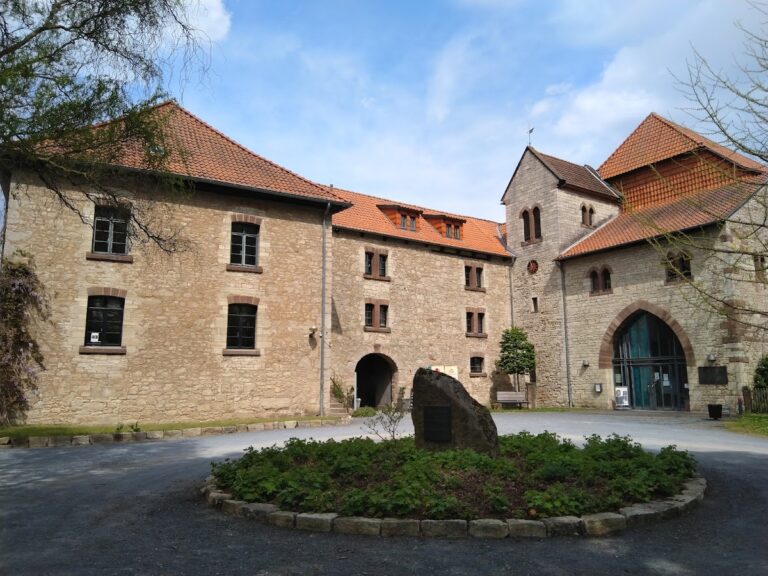
The surviving complex combines a Romanesque collegiate church with Gothic additions and later Baroque buildings. The church is organized as a cruciform basilica, with a central nave, lower side aisles, crossing arms, and a choir extending eastward. Its present form incorporates remains of earlier buildings and was substantially shaped by restoration campaigns in the nineteenth and twentieth centuries.
Collegiate church
Nave, crossing, and choir
Construction of the present church began around 1100, and the building was dedicated in 1168. The nave has a flat roof, while the two side aisles are vaulted. A transversely rectangular crossing joins the nave to approximately square arms, and a rectangular choir bay occupies the eastern end. Beneath the crossing and choir is a hall crypt, a lower sacred or funerary space arranged as a broad chamber. Together, these elements preserve the church’s Romanesque core, while Gothic additions reflect later medieval changes.
Westwork and bells
The western end is formed by a two-towered westwork, a monumental entrance block with towers and upper rooms. The towers are joined by a two-storey connecting structure. The westwork originally included a projecting, two-storey entrance hall known as the Paradise. The church retains eight bells, six used for ringing and two serving as clock bells. The ensemble is among the largest in southern Lower Saxony.
Organ
The church organ was built in 2000 by Manufacture d’Orgues Muhleisen of Strasbourg. It has 50 stops, including seven transmissions from the main division to the pedal and an extended pedal stop. Its key and stop actions are mechanical, with mechanical and pneumatic stop operation also recorded.
Baroque buildings and recovered treasure
Imperial Hall and abbey wing
The former abbey complex includes a Baroque wing with the Imperial Hall. This part of the building belongs to the period of renewed prosperity associated with Abbess Elisabeth Ernestine Antonie of Saxe-Meiningen, who commissioned the wing and work furnishing the church. The Baroque structures remain part of the architectural history of the former foundation.
Brunshausen summer palace
The summer palace at Brunshausen was also built under Elisabeth Ernestine Antonie. Brunshausen had been the location of the community’s first establishment before the move to Gandersheim after the church dedication in 881. The palace therefore belongs to a landscape connected with both the foundation’s beginnings and its later Baroque development.
Church treasure
Restoration in 1997 brought parts of the former church treasure to light. The recovered material includes relics, textiles, and reliquaries, objects associated with the abbey’s religious life and its veneration of sacred remains. Since March 2006, these objects have been exhibited at the Portal to History.