Burg Winzenburg: A Medieval Hilltop Castle in Germany


Site at a Glance
- Rating
- 4.3
- Popularity
- Very Low
- Country
- Germany
- Primary era
- Medieval
- Eras represented
- Medieval
- Civilizations
- Holy Roman Empire
- Site type
- Military
- Remains
- Castle
On this page12 sections
History
Burg Winzenburg is a medieval hilltop spur castle in Germany, probably built in the eleventh century on the Sackwald above present-day Winzenburg near Alfeld. Its early ownership is uncertain, since it may have stood on land held by the Counts of Formbach or on property belonging to the Church of Hildesheim. The castle became an important stronghold and administrative centre of the Bishopric of Hildesheim, an ecclesiastical principality whose bishop exercised both religious and territorial authority.
Formbach rule and destruction
Winzenburg first appears in written records in 1109. In that year, Hermann I of the Counts of Formbach received the castle as a fief, a territorial possession granted by a lord in return for service, from his uncle Udo of Gleichen-Reinhausen, the Bishop of Hildesheim. Hermann adopted Winzenburg as his family name.
In 1130 Hermann quarrelled with his vassal Burchard I of Loccum over the construction of Burchard’s castle. Hermann had Burchard murdered in a churchyard, after which a princely assembly condemned him and stripped him of all his fiefs. Winzenburg consequently reverted to the Bishopric of Hildesheim. Hermann resisted from the castle, and the future Emperor Lothar III destroyed it.
Rebuilding and episcopal administration
With royal permission, Bishop Bernhard I rebuilt Winzenburg. He also used papal mandates in an effort to prevent its return to the Counts of Winzenburg. Pressure from King Conrad III eventually led to the castle being restored in 1150 to Hermann II of Winzenburg.
Hermann II and his wife were murdered at Winzenburg in 1152. The castle then came under the direct administration of the Bishopric of Hildesheim. During the thirteenth century, bishops stayed there frequently, making Winzenburg the bishopric’s most important castle and the seat of its largest administrative district.
Destruction, reuse, and decay
Winzenburg was surrendered in 1522 during the Hildesheim Diocesan Feud, a sixteenth-century conflict between the Bishopric of Hildesheim and neighbouring territorial rulers. The surrender followed the explosion of the castle’s gunpowder supply while it was being besieged by the dukes of Brunswick-Lüneburg.
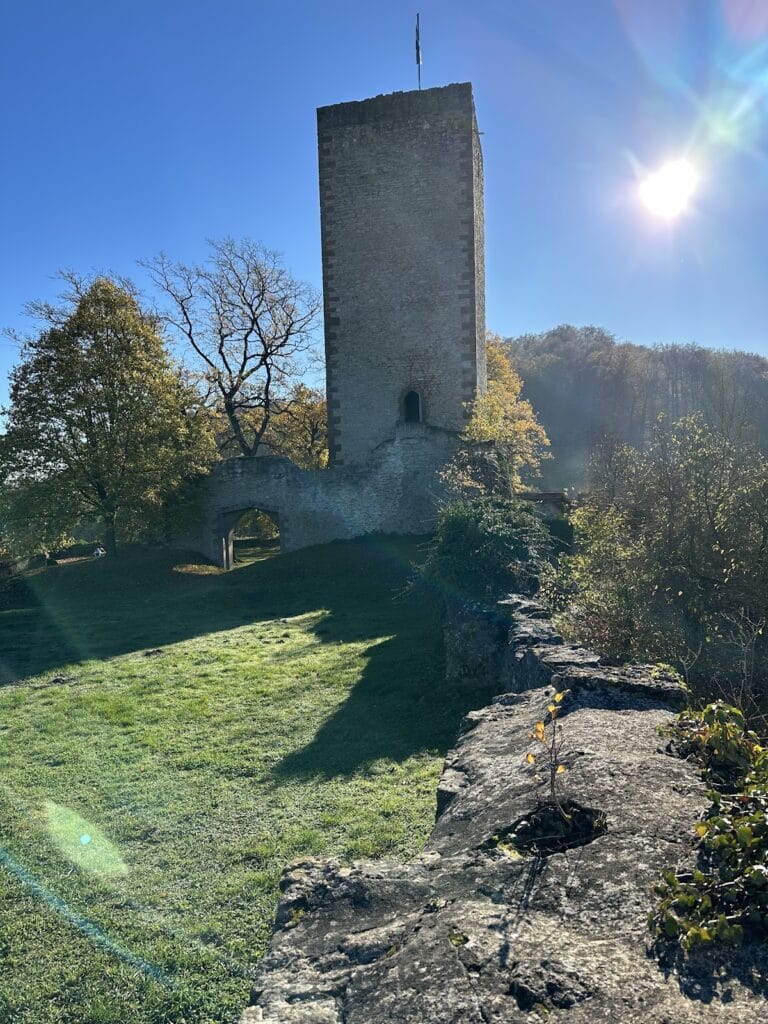
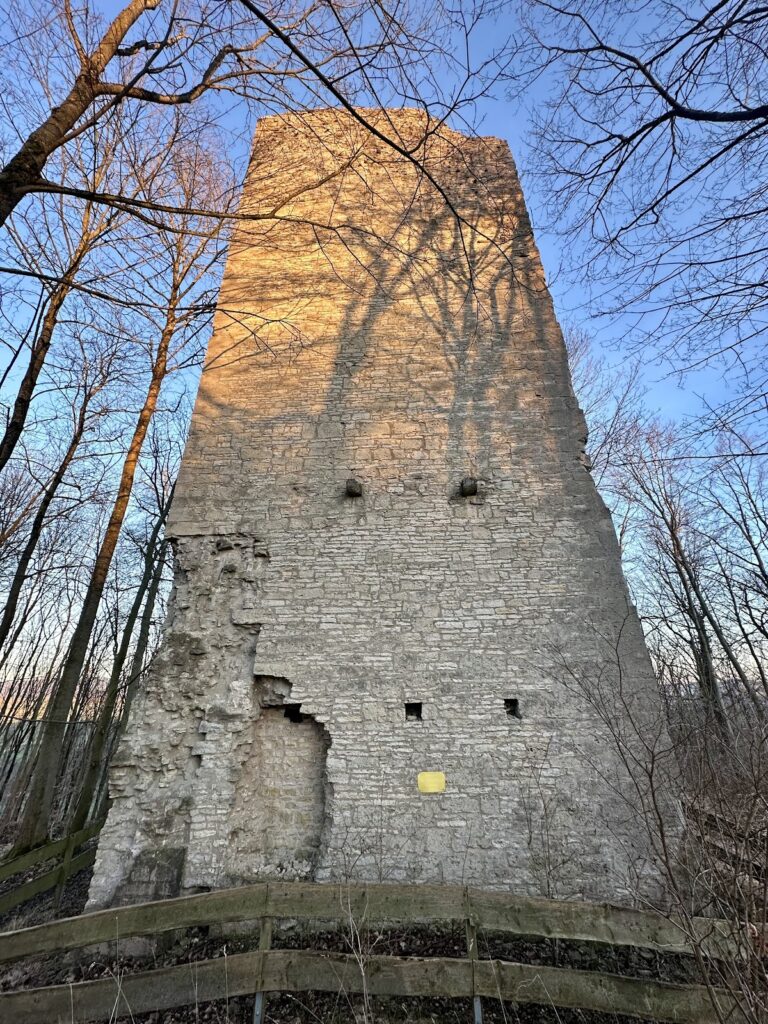
From 1523 to 1643, the ruins belonged to the Principality of Brunswick-Wolfenbüttel. The duke reused stone from the castle to construct an administrative farmstead in the valley near the former village of Hasekenhusen, now Winzenburg. From the middle of the sixteenth century, the castle was left to decay. Its surviving remains now consist chiefly of the pentagonal keep.
Remains
Burg Winzenburg occupies a mountain spur at approximately 270 metres above sea level. The fortress had a pointed-oval plan about 200 metres long and 80 metres wide. Its layout included a main castle on a residential mound, a large bailey, and an outer pentagonal keep. Around 1200, an additional outer bailey was built east of the core castle, approximately 7 metres lower than the main castle.
Core castle and defensive earthworks
Main castle
At the southwestern end of the complex, the main castle covered roughly 40 by 65 metres. It contained a keep, a residential building, and a cistern. The residential mound still contains a reconstructed cistern, preserving evidence of the systems that supported the castle’s occupation.
Bailey and keep
East of the main castle lay a large bailey. At its eastern end, a mound carries the ruin of the pentagonal keep, which survives to a height of about 10 metres. Its masonry is approximately 3 metres thick, making the keep the most substantial surviving part of the ruin.
Neck ditches
A neck ditch, a defensive ditch cut across the narrow approach to a spur or plateau, separated the main castle from an adjoining plateau. This ditch is about 40 metres wide. A second neck ditch bounded the plateau roughly 150 metres farther east, extending the defensive system beyond the central castle area.
Associated features and water supply
Gartenkamp ringwork
About 300 metres farther east is the Gartenkamp, a small ringwork. Its possible connection with Winzenburg remains unestablished.
Springs and ponds
Castle water was carried by donkey from the Apenteich springs below the hill along the Eselssteig. The springs fed the Apenteich ponds, which were created in 1220. The spring area also formed a pagan cult site, where sacrificial offerings approximately 5,000 years old were found.