Burg Greene: A Medieval Spur Castle in Germany


Site at a Glance
- Rating
- 4.4
- Popularity
- Low
- Country
- Germany
- Primary era
- Medieval
- External website
- Open
- Eras represented
- Medieval
- Civilizations
- Holy Roman Empire
- Site type
- Military
- Remains
- Castle
On this page11 sections
History
Origins and Homburg Rule
Burg Greene is a medieval spur castle in Germany, near Greene in Lower Saxony, built by the Homburg nobles in 1308. The castle protected their local estates and an important trading route across the Leine. A predecessor site known as Hüburg stood about 1 kilometre to the south on a spur beside the river, and finds place its use between the tenth and twelfth centuries.
Inheritance and Brunswick Control
When Heinrich VI, the last of the Homburg line, died in 1409, his widow Schonette received widow’s rights to the castle. A contract dated 9 October 1409 assigned Greene by inheritance to Duke Bernhard of Brunswick. This led to a dispute with the Bishop of Hildesheim. In 1414, the Welfs, the German ruling dynasty whose Brunswick line governed territories in northern Germany, surrendered the castle to the bishop for 12,000 Rhenish gulden, a gold currency used in the Rhineland and neighboring parts of the Holy Roman Empire. They retained the right to buy it back.
In 1451, the Bishop of Hildesheim granted Duke Wilhelm the Elder of Brunswick the right to redeem Burg Greene for the agreed pledge sum. The Welfs raised the 12,000 gulden only in 1499, when they recovered Greene and incorporated it into their administration as a district.
Destruction, Administration, and Decline
Vollrad von Mansfeld destroyed Burg Greene in 1553 while pillaging Brunswick territory on the orders of Margrave Albrecht of Brandenburg-Kulmbach. A margrave was originally a military governor of a frontier territory and later became a noble rank. Duke Heinrich the Younger had the castle rebuilt immediately.
The castle suffered further damage during the Thirty Years’ War, the major European conflict of 1618 to 1648 that involved religious and political struggles within the Holy Roman Empire and beyond. After the Battle of Lutter in 1626, a major conflict between Imperial forces and the army of Christian IV of Denmark, Burg Greene passed into Imperial hands. It later served as the seat of the Greene administrative district until a new office building was built elsewhere.
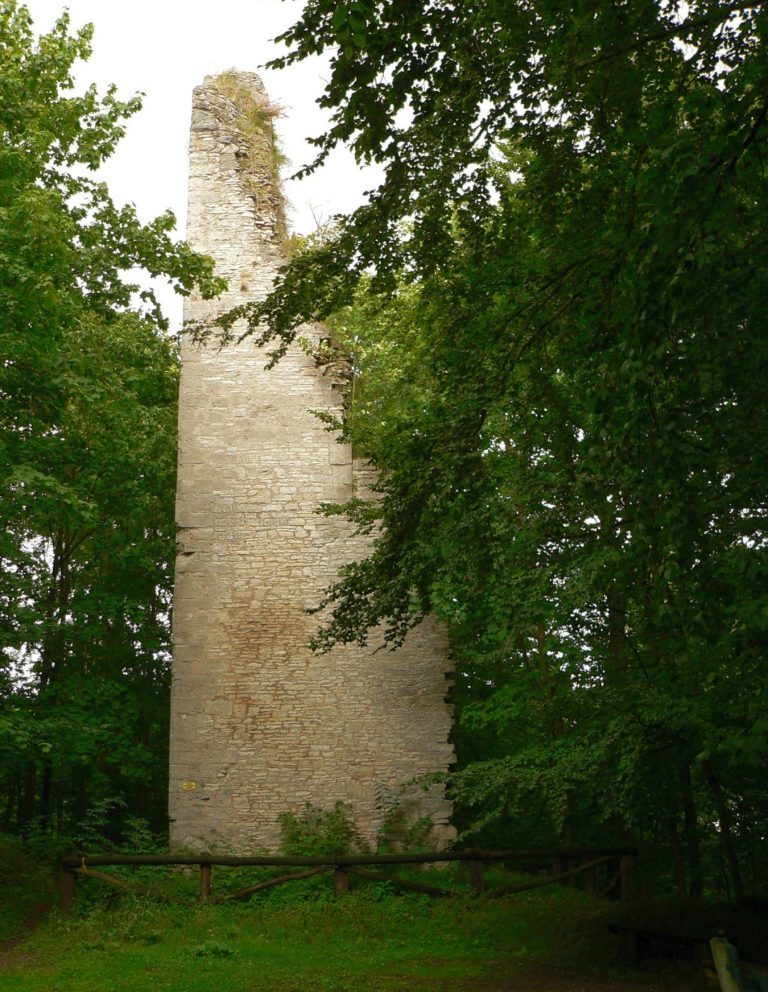
In December 1694, Brunswick dukes Rudolf August and Anton Ulrich ordered the castle abandoned because the old complex could no longer accommodate the administration. From 1704, only day laborers lived there. The buildings gradually deteriorated, and their stones were reused in village construction. By 1757, reports stated that essentially only the tower remained.
Second World War Memorial
In 1953, Burg Greene became the Federal Memorial Site for German prisoners of war from the Second World War. The Kulturwerk Bundesweihestätte Greene association administered the memorial. The keep was designated an honorary tower and housed 7 million signatures until 1961. The signatures had been collected by the Association of Returnees, Prisoners of War and Relatives of Missing Persons in Germany in a petition demanding the release of prisoners of war held in the Soviet Union.
Because the tower had become structurally unsafe, the federal memorial site moved in 1961 to the vicinity of the Imperial Palace of Goslar. Since 1996, the signature lists have been held in the Goslar City Archive.
Remains
Setting and Castle Layout
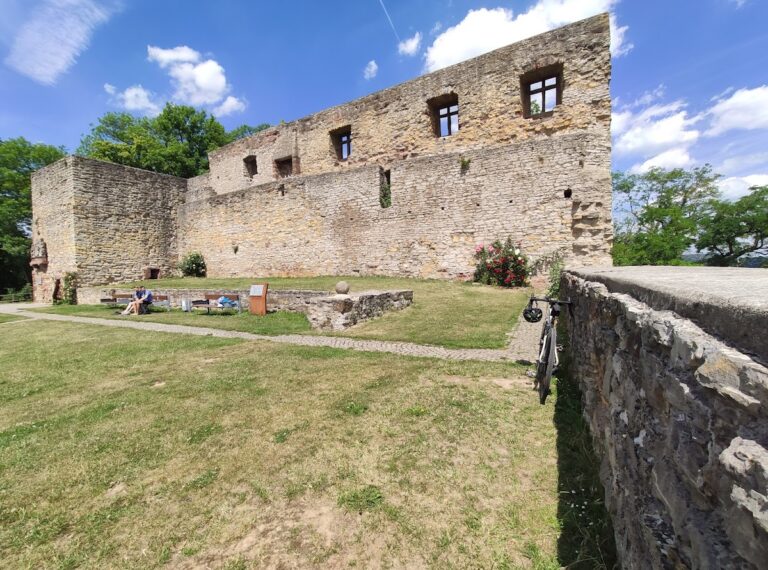
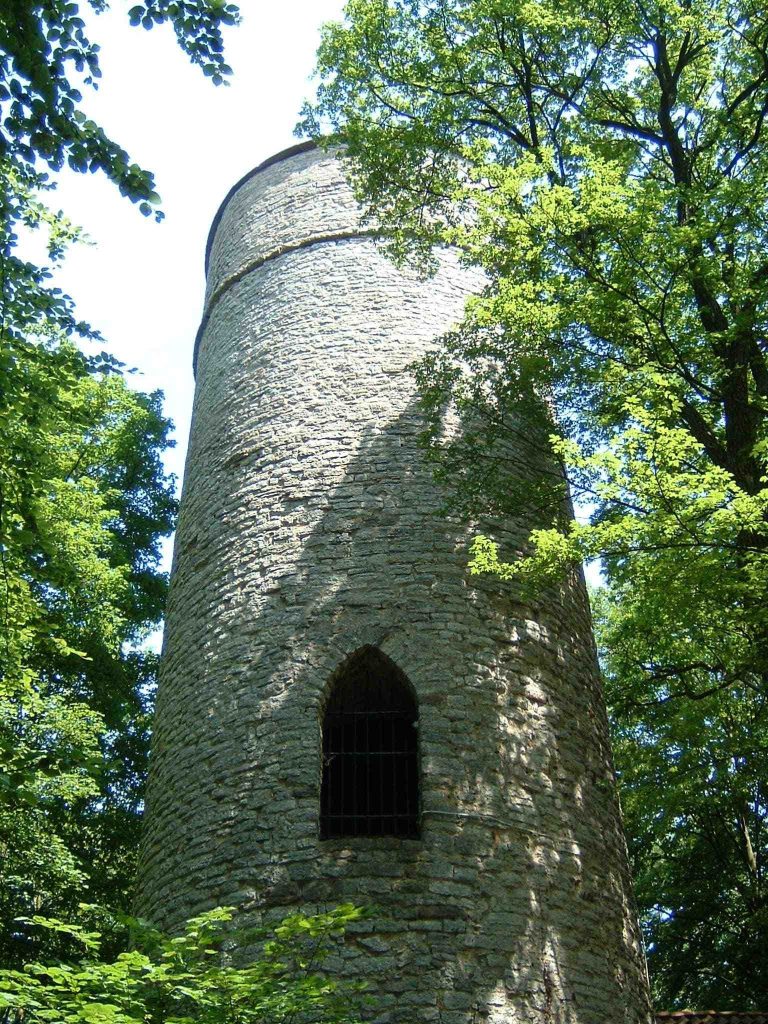
The ruins stand about 181 metres above sea level on a projecting mountain spur above the Leine valley, in park-like surroundings. Burg Greene was divided into an outer bailey and a main bailey, with the latter positioned slightly higher. A 25-metre-high keep still stands on the former dividing wall between the two sections, which was 1.5 metres thick.
Approach from the south crossed a drawbridge over a ditch cut across the neck of the spur and continued through a small gatehouse. The outer bailey had a triangular courtyard and was probably enclosed by buildings, of which several foundation walls survive.
Fortifications and Surviving Buildings
Keep and Main Bailey
The square keep has foundation walls 2.8 metres thick. A keep is the principal fortified tower of a castle. The narrow main bailey contained buildings whose outer walls also formed the castle’s external defensive wall. These structures probably had two masonry storeys, topped by a half-timbered section.
Outer Wall and Gateway
The surviving fabric consists chiefly of sections of the former outer wall, a rebuilt keep, and the arched gateway leading to the upper castle. The keep can be entered and offers a wide view over the Leine valley.
Memorial Features
Inside the keep, wall shrines represent the federal states of the period. A cross and a commemorative plaque are set on the exterior wall, preserving the memorial function established at Burg Greene in the twentieth century.