Vogelsburg: An Iron Age and Early Medieval Hilltop Fortification in Germany
Site at a Glance
- Popularity
- Very Low
- Country
- Germany
- Primary era
- Medieval
- Eras represented
- Iron Age, Medieval
- Civilizations
- Celtic
- Site type
- Military
- Remains
- Fort
On this page7 sections
History
Vogelsburg is a hilltop fortification in Einbeck, Germany. Pottery from the La Tène period, a central European phase of the late Iron Age spanning broadly from the fifth to first centuries BCE, points to an Iron Age origin for the defenses. Settlements of the same period existed in the adjacent Leine valley.
Early medieval phases
In the early Middle Ages, the centuries following the end of the Western Roman Empire, both ring ramparts underwent two building phases. The original wall construction burned and later decayed. Builders subsequently raised the ruined rampart without adding new reinforcement along its front. Radiocarbon dating indicates that the two phases were relatively close in time.
A local legend says that Henry the Fowler, king of East Francia from 919 to 936, stayed at Vogelsburg.
Ulrich Kahrstedt investigated the fortification in 1935–36, and Wolfgang Schlüter excavated it in 1974. Schlüter’s work distinguished the two early medieval building phases in both ring ramparts.
Remains
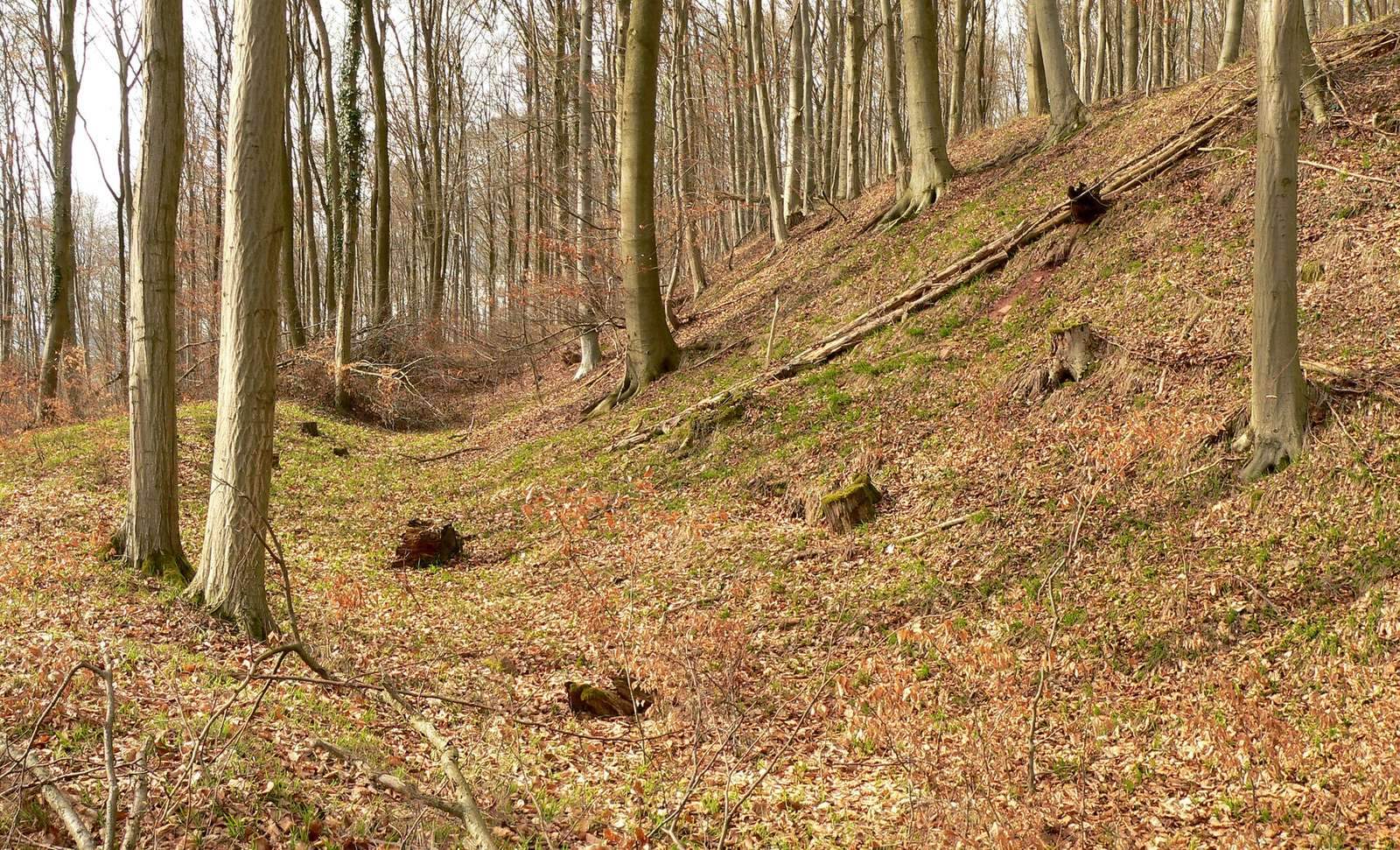
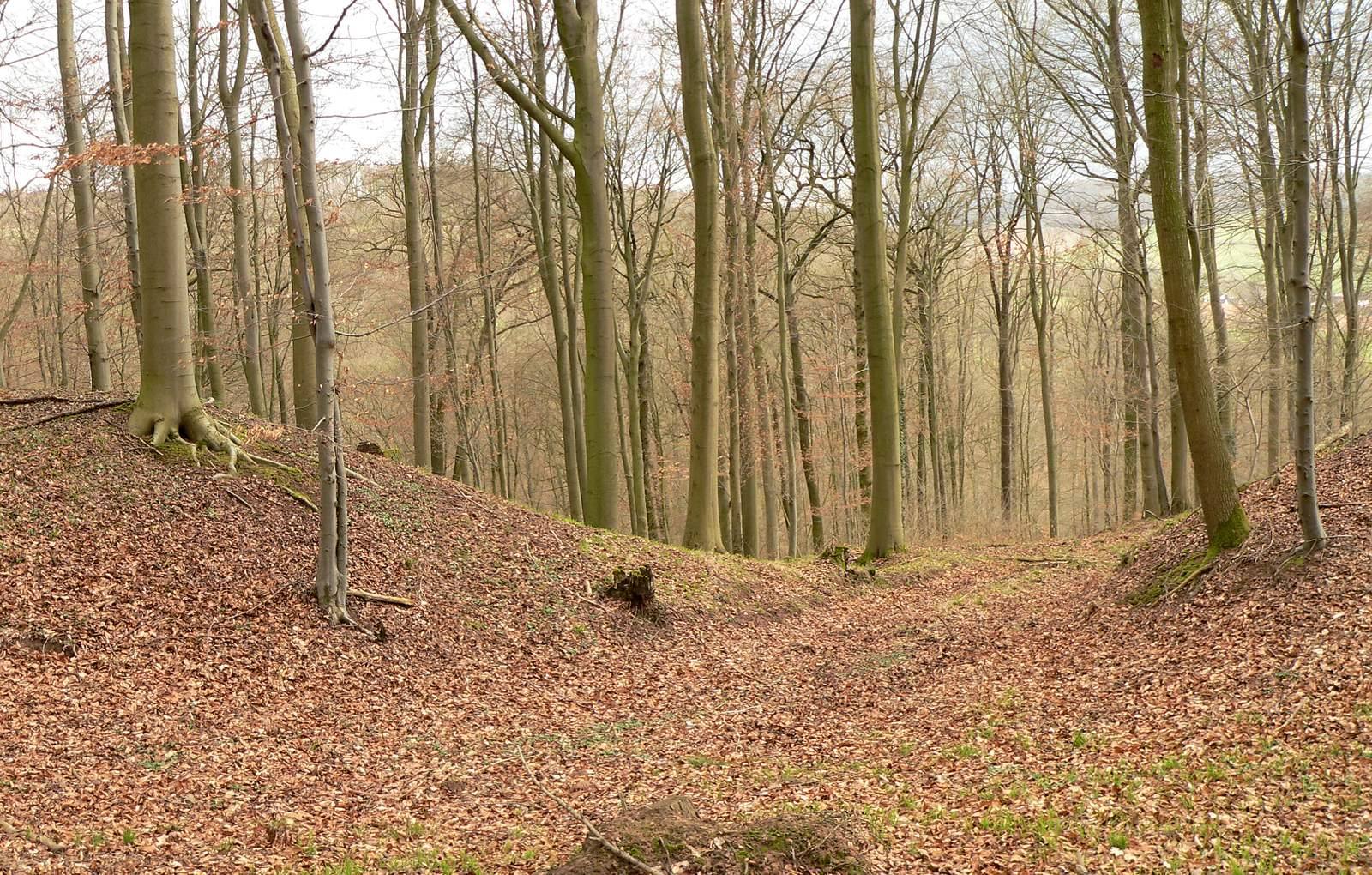
The fortification occupies a wooded hill about 262 metres above sea level, roughly one kilometre north of Vogelbeck on the eastern side of the Einbeck–Markoldendorf basin. Its defenses include inner and outer ring ramparts, meaning enclosing defensive banks, as well as additional banks to the northeast and southwest. The ring ramparts are built of timber and earth with stone facings laid without mortar. Their outer ditches include a pointed-bottom ditch and a flat-bottomed ditch.
Ring ramparts
Inner rampart
The inner rampart encloses an area about 120 by 85 metres. It now stands 2.5 metres high and measures 10 metres across at its base. Entry to the enclosure is from the southeast through a pincer gate, an entrance framed by rampart ends turned inward. A passage through the rampart on the northwest side is also present, though its age is undetermined.
Outer rampart
The outer rampart is 15.5 metres wide at its base and rises 6.5 to 7 metres on its outer face; both ring ramparts are much lower on their inward-facing sides. The outer bank has three entrances. Its northern pincer gate is the only one certainly original; a southeastern pincer gate and a northeastern pincer gate are also identified. The ring ramparts and the outer gate remain clearly visible.
Section ramparts
A 70-metre section rampart blocks access to the hilltop from a distance and contains an old passage. Another rampart follows the southwestern foot of the hilltop. Both are formed from piled sandstone blocks strengthened with timber and stand in front of pointed-bottom ditches.