St. Godehard: A Romanesque Basilica in Hildesheim, Germany


Site at a Glance
- Rating
- 4.6
- Popularity
- Low
- Country
- Germany
- Primary era
- Medieval
- External website
- Open
- Eras represented
- Medieval, Early Modern, Modern
- Civilizations
- Holy Roman Empire
- Site type
- Religious
- Remains
- Basilica
On this page18 sections
History
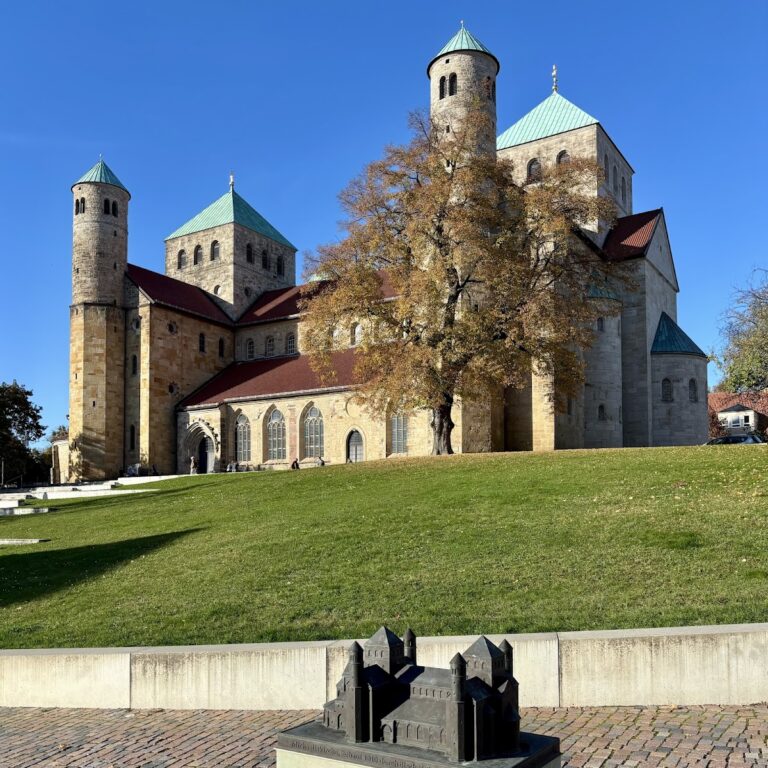
St. Godehard is a Roman Catholic church in Hildesheim, Germany, built as a Romanesque basilica for a Benedictine monastery between 1133 and 1172. Bishop Bernhard of Hildesheim initiated the construction, and Bishop Adelog consecrated the completed church to St. Mary and St. Godehard in 1172. Standing at the southern edge of Hildesheim’s historic center, it became a major religious foundation associated with the city’s medieval pilgrimage tradition.
Foundation and Medieval Pilgrimage
The church and monastery were founded in honor of Godehard of Hildesheim, a Benedictine monk who served as bishop from 1022 to 1038. His canonization took place in 1133, the year construction began. The first monks entered the monastery in 1136, while the church was still being built. Godehard’s relics drew a continuing medieval pilgrimage to Hildesheim and helped establish the foundation’s religious importance.
The Benedictine community remained Catholic during the Reformation, even as Lutheran teaching was adopted by Hildesheim’s parish churches. The monastery controlled substantial property, including 1,325 acres of land. Some of this land had been donated by Bishop Bernhard, whose support had also initiated the building project.
Secularization and Parish Use
Secularization in 1803 brought the monastery to an end. Its possessions were confiscated, and the former convent buildings were converted into a prison. The church remained available to the Catholic community at first, but in 1812 it was designated for use as a warehouse. Catholic worship returned in 1815, and the building passed into the possession of the General Hanoverian Monastery Fund in 1818.
Hermann Gottfried Held, a former conventual who became St. Godehard’s first parish priest after secularization, campaigned personally against the demolition of the basilica. His efforts helped preserve the church, which continued thereafter as a Catholic parish church.
War Damage and Diocesan Role
Hildesheim’s southern historic-center district escaped the large-scale destruction of 22 March 1945, although air raids on 13 and 22 February and on 22 March damaged St. Godehard, particularly its northern aisle. Repairs were completed in 1945, and worship resumed during the same year. St. Godehard was the only church in central Hildesheim to escape major wartime destruction.
From 1945 until the cathedral was restored and rededicated in 1960, St. Godehard served as the church of the diocesan bishop. It fulfilled the same role again while the cathedral was closed for restoration from 2010 to 2014. During that period, pontifical liturgies, which are solemn services celebrated by a bishop, were held at the basilica, and the bishop’s cathedra, or official seat, was installed there.
Modern Religious Status
Pope Paul VI granted St. Godehard the title of Basilica minor in 1963. This is an honorary papal title for a church of particular religious or historical importance and does not make it a cathedral. The church remains a Catholic parish church in the Diocese of Hildesheim and follows the Roman rite.
Benedictine monks returned to St. Godehard between 2003 and 2013, with three monks at a time sent from the Dormition Abbey, a Benedictine monastery on Mount Zion in Jerusalem. The church belonged to the Heilig Kreuz parish from 2004 to 2014. The present St. Godehard parish was established on 1 November 2014. The basilica is regarded as one of Germany’s important Romanesque buildings and has remained largely free of later alterations.
Remains
Plan and Exterior
Basilica and Crossing
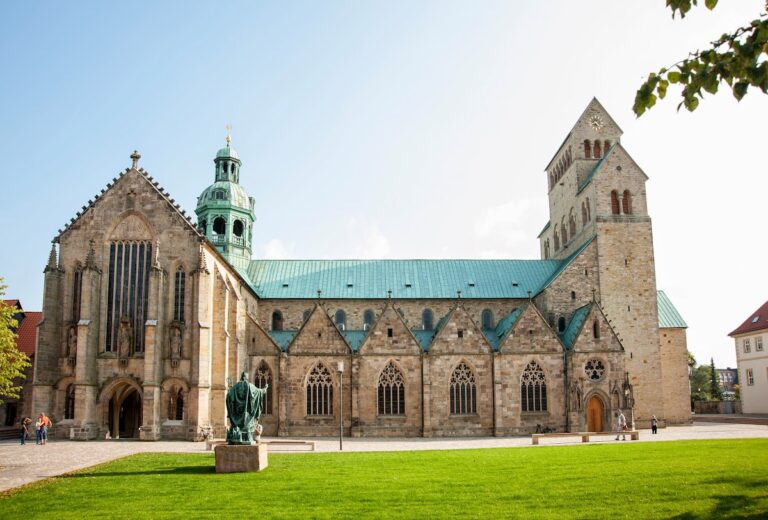
St. Godehard has the elongated plan of a three-aisled basilica, with a central nave rising above its side aisles. A transept forms the cross-arm of the church, while a choir ambulatory, or passage around the sanctuary, leads to three radial chapels. A large octagonal crossing tower rises above the intersection of the nave and transept. Together, these elements create a clearly ordered Romanesque structure built around the longitudinal church and its eastern sanctuary.
Westwork and Portals
The western end is formed by a westwork, a monumental entrance block, with two smaller towers and a western apse. The apse now serves as a baptistery, giving the church a double-apse arrangement. The westwork and the octagonal crossing tower produce three principal towers. On the exterior, pilasters and blind-arcade friezes articulate the walls. The northwestern portal is the most elaborate entrance, with a tympanum showing Christ between the saintly bishops Godehard and Epiphanius.
Nave, Choir, and Furnishings
Nave and Lighting
The nave has a flat roof supported by six piers and twelve columns. Their alternating arrangement follows the Lower Saxon support system. Round-headed windows light the side aisles, the clerestory, which is the upper windowed zone of the nave, and the high choir. These openings and the strongly articulated supports express the massive masonry and rounded-arch forms associated with Romanesque architecture.
Choir and High Altar
The choir contains rich wall paintings made by Michael Welter between 1861 and 1863, together with a high altar from the same period. Above the main altar, in the crossing, hangs a large wheel-shaped chandelier donated by Queen Marie of Hanover in 1864.
Medieval and Baroque Furnishings
Late Gothic furnishings include the choir stalls, a Crucifixion group on the southern transept wall, and a statue of St. Godehard beside the northeastern entrance. The southern transept also contains a late Baroque Benedictine altar with a Gothic central panel, bringing together furnishings from different periods within the Romanesque building.
Organ and Bells
Organ
Furtwängler & Hammer built the organ in 1912 as opus 718. Emil Hammer Orgelbau repaired it and altered its arrangement in 1946. Gebrüder Hillebrand Orgelbau cleaned and rebuilt the instrument in 1971, electrifying the actions, adding a register, and installing a detached console. A further restoration in 2021 and 2022 largely followed the original condition, restored its late-Romantic tonal character, and added a new console with a setter system and additional octave couplers. The organ has three manuals and pedal, with 46 registers and two transmissions.
Church Bells
The towers contain a bronze bell cast in 1926 by Albert Junker of Brilon and four chilled-iron bells made by Ulrich & Weule of Bockenem. The two larger bells hang in the northern and southern west towers. The remaining bells are in the crossing tower, including two small bells used to strike the clock. A historic bronze bell in the nave, tuned to F-sharp, cannot be rung because of serious casting defects.
Former Monastery Library
Medieval Library Room
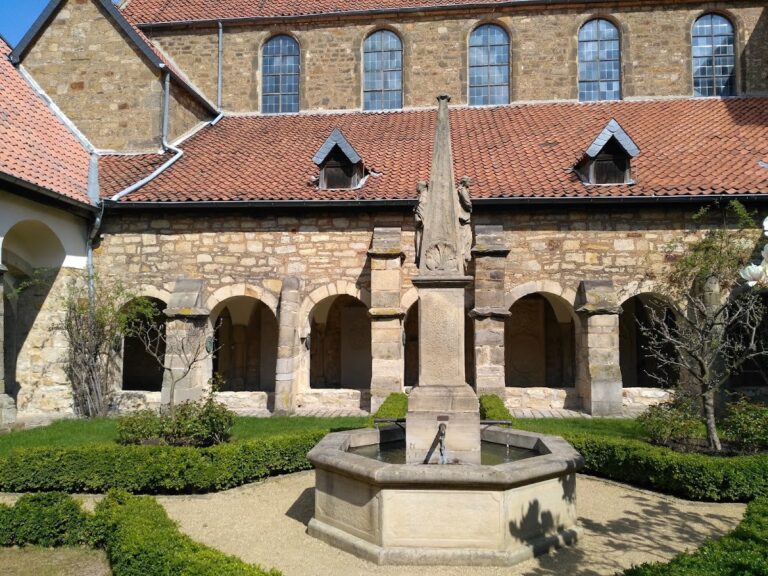
A surviving medieval library room in the former monastery complex now serves as a treasury. Its fifteenth-century wall paintings remain in place. Heraldic shields marked with the letters A through G identify the historical shelf groups, which once corresponded to individual bookcases. Several incunabula, books printed in Europe before 1501 during the earliest period of movable-type printing, are now held in the Hildesheim Cathedral Library. Their covers retain the former shelf-group marks, linking the books to the monastery’s medieval library.