Franciscan Monastery of Hildesheim: A Medieval Friary and Museum Complex
Site at a Glance
- Rating
- 3.8
- Popularity
- Very Low
- Country
- Germany
- Primary era
- Medieval
- External website
- Open
- Eras represented
- Medieval
- Civilizations
- Holy Roman Empire
- Site type
- Religious
- Remains
- Monastery
On this page12 sections
History
The Franciscan Monastery of St. Martin was a Franciscan foundation in Hildesheim, Germany, established in 1223 and developed in the medieval period. The Franciscans, a mendicant religious order founded by Francis of Assisi, combined communal religious life with preaching, pastoral care, and service to urban communities. The monastery remained active until its dissolution during the Reformation in the middle of the sixteenth century, although Franciscan communities later returned to Hildesheim for shorter periods.
Foundation in Hildesheim
The friars reached Hildesheim from Speyer in 1223, making the city their first destination in northern Germany. In the same year they established further houses in Goslar, Brunswick, Magdeburg, and Halberstadt. Bishop Conrad II supported these new communities, including the Dominicans and the Magdalene order, because they offered urban residents newer forms of pastoral care. The Franciscans’ loyalty to the papacy also reinforced the bishop’s position against secular territorial rulers and allowed the friars to mediate in disputes involving leading city families.
Johannes de Plano Carpini, the superior of the friars sent to Germany at Francis of Assisi’s request, preached in Hildesheim in 1223 with Conrad II’s permission. The cathedral chapter initially welcomed the newcomers and provided simple accommodation. This may have been at the Nikolai Hospital near the Godehard Monastery or, according to another interpretation, at the Nikolai Chapel in the Dammstadt.
Around 1240, Conrad II granted the Franciscans a building plot within the cathedral immunity, the legally distinct area around a cathedral that was generally governed by ecclesiastical rather than ordinary urban authorities. The site lay west of the cathedral hill beside the road to the Innerste and near a city gate. A monastery, church, and ancillary buildings were erected there between 1240 and 1246. The community belonged to Saxonia, the Franciscan province responsible for houses in Saxon and related northern German territories, and it already maintained a course of study for members of the order in 1245.
Medieval development and religious life
Hildesheim hosted several provincial chapters, formal meetings concerned with the governance of Saxonia, including gatherings in 1321 and 1402. Members of the convent also held important ecclesiastical positions. Heinrich von Halle became an auxiliary bishop of Hildesheim near the end of the fourteenth century, followed by Johannes Winkelmann in 1436 and Ludwig von Siegen, formerly provincial of Saxonia, from 1502. An auxiliary bishop assisted the diocesan bishop. Guardian Hermann Etzen, who died between 1465 and 1470, had taught theology in Halberstadt, Magdeburg, and Erfurt and became known for his theological writings.
Brother Conrad, a friar noted for caring extensively for the poor, died on 6 October 1261. After his death, legends developed around him, and the people of Hildesheim venerated him as Conradus Sanctus, or “Saint Conrad,” and as pater sanctus, meaning “holy father.” His tomb in the monastery church attracted worshippers. In 1466, Auxiliary Bishop Johannes granted a forty-day indulgence to people who visited the grave. An indulgence was a remission of temporal punishment in medieval Catholic practice, often associated with a specified devotional act such as visiting a revered tomb.
The pilgrimage connected with Conrad’s tomb contributed to the partial replacement of the monastery and church. This rebuilding probably took place in the later fifteenth century, although an earlier reconstruction in the fourteenth century is also possible. The new work retained the earlier cloister, while the church was enlarged with a northern aisle. The convent maintained a cooperative relationship with Hildesheim’s city council, which repeatedly supported construction and maintenance. From the beginning of the fifteenth century, anniversary commemorations, memorial endowments, and other donations also brought the monastery increased income.
Reformation and later Franciscan activity
The convent was dissolved after 1542 during the Reformation, a period when many western European communities adopted Protestant forms of worship and reorganized church institutions. St. Martin’s Church was closed to the public in August 1542, although the friars were initially permitted to continue worship there. After the city council elections of 1543, their rights were restricted further. Friars who would not become Protestant were expelled from Hildesheim in 1544 and went to the Franciscan monastery in Cologne. Eight elderly friars were permitted to remain and received pensions from the council.
After St. John’s Church was destroyed in 1547, St. Martin’s became a Lutheran parish church. Its pastor was Konrad Lüdekke, the monastery’s last guardian, who had converted to Protestantism and married. In 1556, the last two Franciscans transferred the monastery buildings to St. Martin’s parish church rather than retaining them personally, allowing the complex to remain together. Their decision not to assign the property to Saxonia indicates that the province had already largely collapsed as numerous Franciscan houses closed.
Several Franciscans returned in 1632 through the intercession of the cathedral chapter and negotiations with the city council. They left again in 1634 because of the wartime situation, taking with them the recovered bones of Conrad, which had initially been reburied in the church. The church then returned to Lutheran use. The former monastery was subsequently used as an orphanage and a cowshed.
Museum conversion and twentieth-century presence
On the initiative of Hermann Roemer, a Hildesheim politician and collector, a museum was established in the former monastery buildings in 1859. The museum association purchased the complex and adapted it for exhibitions. Some church furnishings remained with the parish and later passed to the museum association, including several paintings from St. Martin’s.
Franciscans of the Silesian Province operated the Antonius School Residence in Hildesheim from 1953 to 1973. They continued working as chaplains in the building on Alfelder Strasse until 1987, and in 1988 three friars served for several years as chaplains at Holy Cross Church. These later activities formed a renewed Franciscan presence in the city after the medieval convent had ceased to exist.
Remains
Monastic layout and surviving buildings
The original complex occupied a plot within the cathedral immunity west of the cathedral hill. It stood along the road toward the Innerste and the nearby city gate, in an area corresponding today to Dammstrasse and extending toward Am Steine. No contemporary description of the first monastery and church survives. Architectural research and comparison with Franciscan monasteries of the period indicate that the complex probably followed a closed four-wing plan arranged around a cloister, with the church and ancillary buildings forming part of the same foundation.
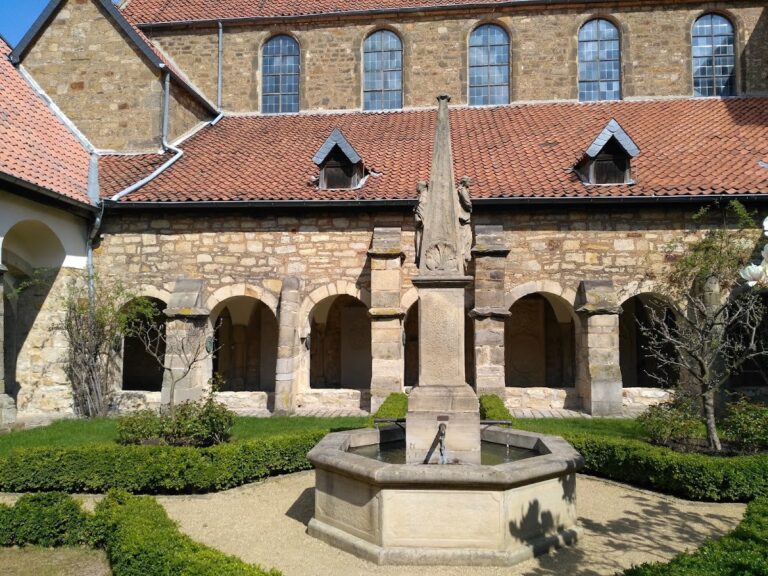
Former monastic buildings
Parts of the former monastic buildings survive on the south side of the church. Two doors there led from the church into two cloister wings, and the sacristy was also located in this area. The later rebuilding retained the earlier cloister, preserving part of the arrangement around which the friars’ communal buildings had been organized. In the nineteenth century, the surviving monastery buildings were adapted for museum exhibitions, and several paintings from the church later entered the museum association’s holdings.
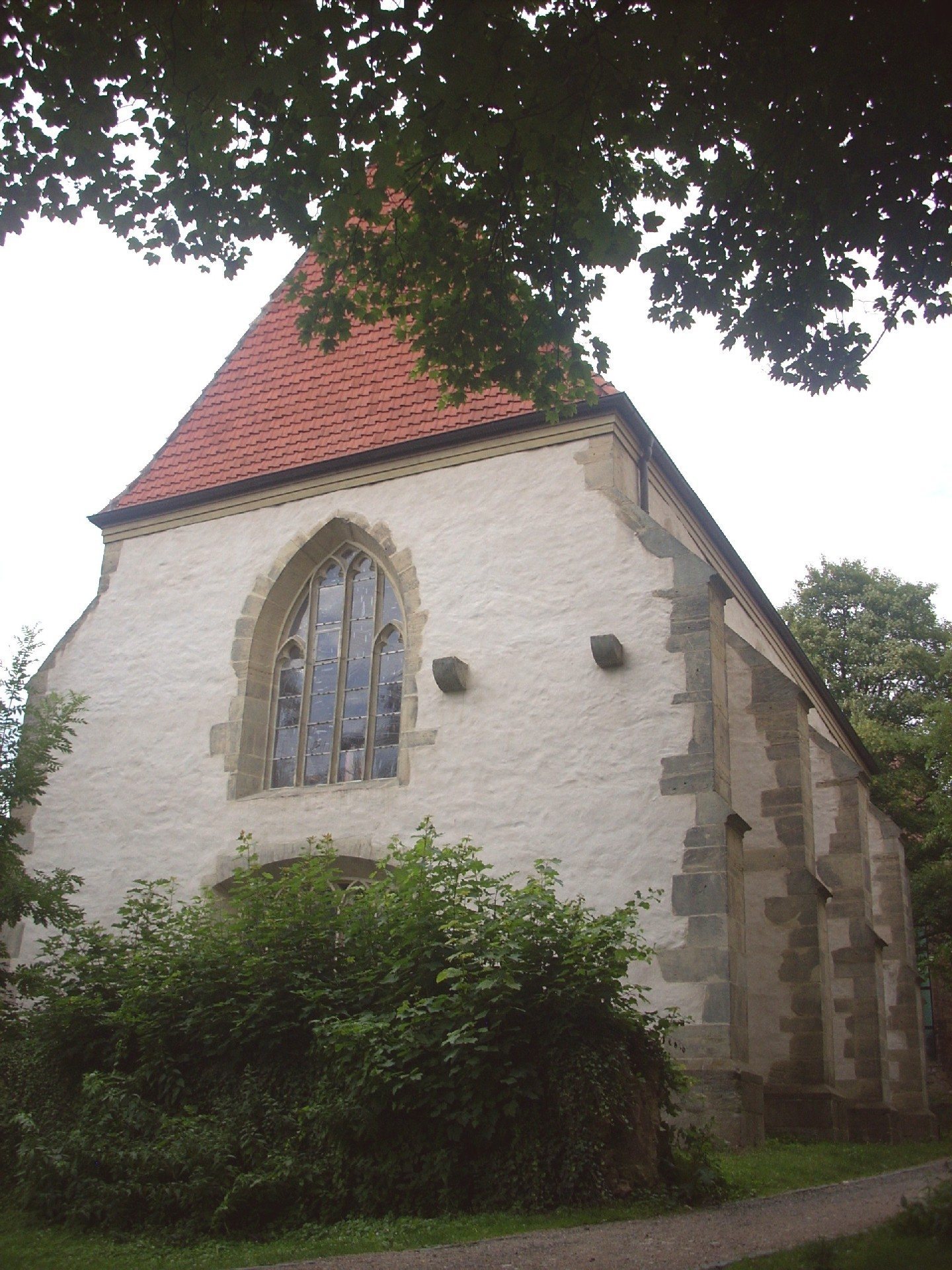
Portiuncula Chapel
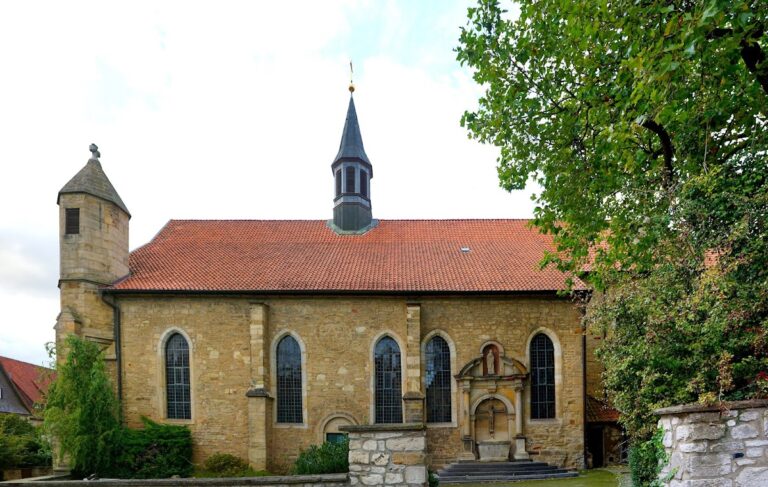
A rectangular Portiuncula Chapel was completed on the east side of the church in 1490. The Portiuncula was a chapel near Assisi closely associated with Francis of Assisi and the early Franciscan movement. The Hildesheim chapel was built in the Gothic style, and its lower level probably served as a mortuary building for the Franciscans. It now forms part of the Roemer and Pelizaeus Museum.
Church and later alterations
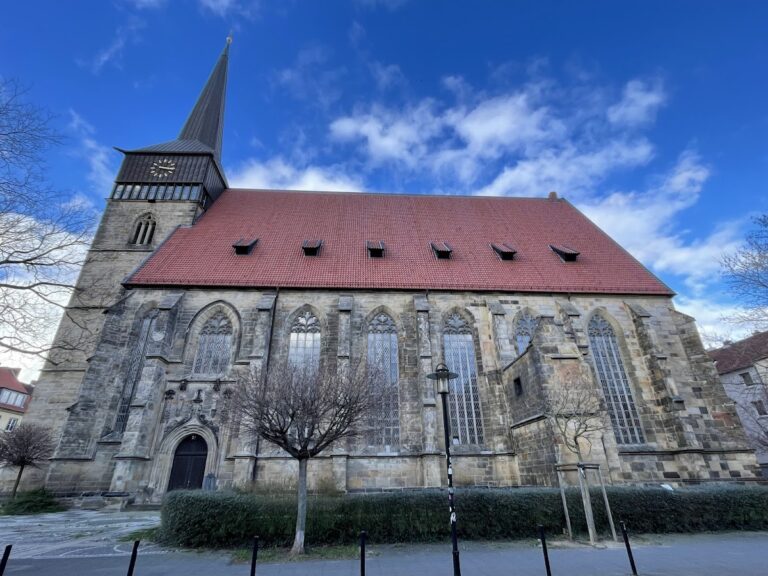
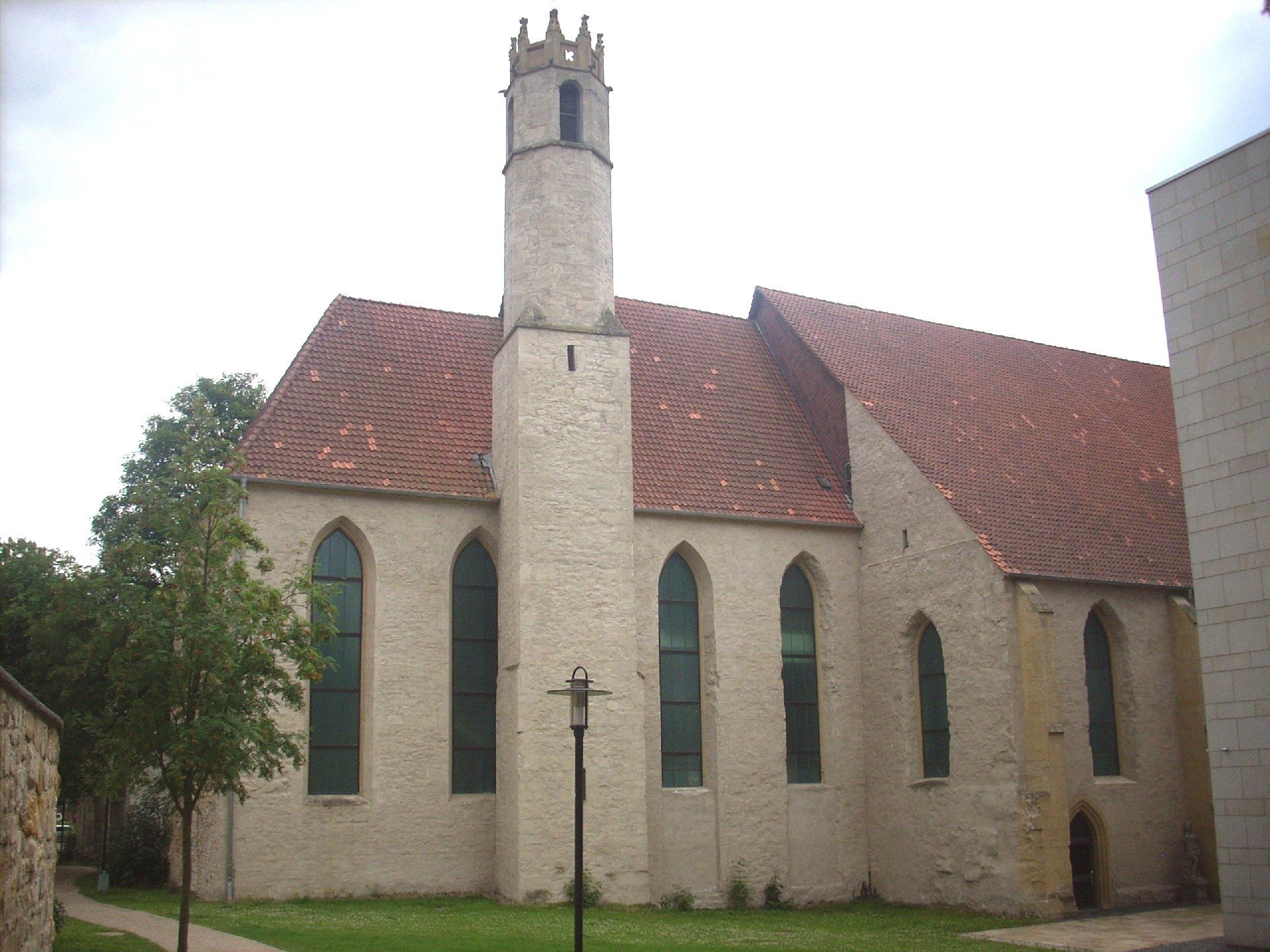
St. Martin’s Church
The church was dedicated to St. Martin and formed part of the original Franciscan foundation. During the rebuilding associated with the pilgrimage to Conrad’s tomb, it was enlarged by a northern side aisle. The date of this addition is placed either in the fourteenth century or in the second half of the fifteenth century. The enlargement therefore belongs to the period when the church was being reshaped around the continuing importance of Conrad’s burial place.
Destroyed furnishings and recovered objects
The tomb of Conradus Sanctus and other artworks in the church were later destroyed and levelled. Numerous chalices, crosses, ornaments, vestments, and other liturgical objects were confiscated and put to use elsewhere. The copper covering on the tower and the church bell were also removed. Several paintings from the church survived through their later transfer to the museum association, while the former church and monastic buildings continued in altered institutional use.