Magdalenenkirche: A Former Monastery Church in Hildesheim


Site at a Glance
- Rating
- 4.6
- Popularity
- Very Low
- Country
- Germany
- Primary era
- Medieval
- External website
- Open
- Eras represented
- Medieval, Early Modern
- Civilizations
- Holy Roman Empire
- Site type
- Religious
- Remains
- Church
On this page10 sections
History
Foundation and Gothic construction
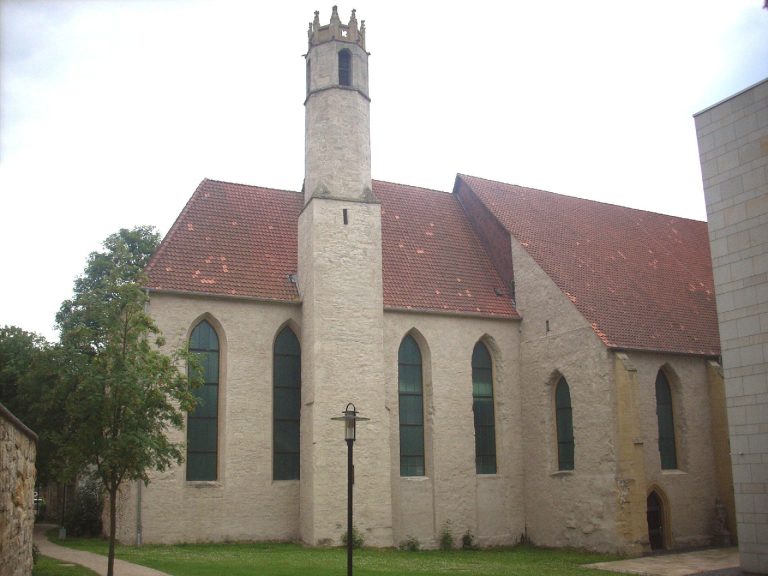
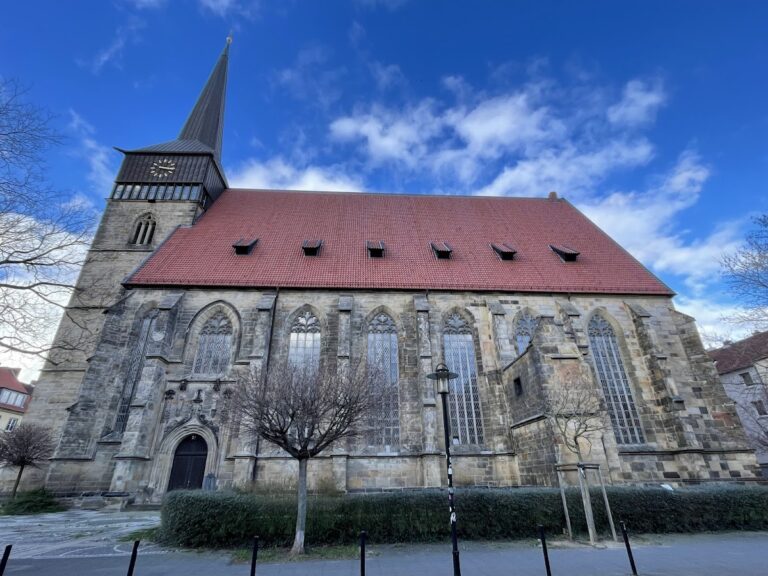
Magdalenenkirche is a former Roman Catholic monastery church in Hildesheim, Germany, founded for the Magdalene nuns and consecrated in 1294 as the city’s first Gothic building. It stands at the edge of the old town on Mühlenstraße, beside the site of the medieval western city wall. Bishop Konrad II established the convent in 1224 on the bank of the Innerste, outside the wall, and a provisional church was later replaced by the present structure.
The Magdalene order was associated with penitential devotion to Mary Magdalene, and this religious character helps explain the church’s restrained architectural impression. When Hildesheim’s council introduced the Reformation, the convents remained under episcopal protection because the bishop was the territorial lord. The Magdalene convent continued until secularization in 1810, when ecclesiastical institutions and property were transferred into secular ownership or administration.
From secularization to the nineteenth century
Since 1810, Magdalenenkirche has been owned by the Hanover Monastery Chamber. After St Michael’s Church, apart from its crypt and monastery buildings, became Lutheran, Magdalenenkirche served as the parish church for Catholics in Hildesheim’s northern old town. The relics of Saint Bernward, the medieval bishop of Hildesheim who is venerated as a saint, were transferred there from St Michael’s.
Francesco Maria Capellini, known as Stechinelli and court banker to the Welf dukes, was buried in 1694 in the vault beneath the choir. The Welfs were a German princely dynasty whose members ruled territories and held influential political positions within the Holy Roman Empire.
Destruction and modern parish history
Magdalenenkirche was severely damaged and burned out during the destruction of Hildesheim on 22 March 1945. Restoration was completed in 1961, partly in simplified form. From 2004 to 2014 the church belonged to the parish of the Holy Cross, during which the St Magdalene parish was dissolved. Since 2014 it has served as a filial church of the St Godehard parish.
Remains
Church fabric and later alterations
Magdalenenkirche is a late Gothic, three-aisled hall church, meaning that the nave and aisles are approximately equal in height and form a unified interior space. It has a roof turret and a rectangular choir. The choir and side aisles are vaulted today, while the nave originally carried a six-part rib vault. Gothic chalice capitals in the nave are associated with the fifteenth-century rebuilding.
The building’s compact, restrained appearance reflects both its thirteenth-century origins and the penitential character of the Magdalene order. The choir was remodelled in the Baroque period between 1794 and 1799. Baroque changes also shaped the exterior, including the west facade, probably dating from the seventeenth century, and the west and south portals, dated 1721. The west portal, dated 1733, is flanked by two low stair towers probably built in the seventeenth century.
Devotional furnishings
Bernward reliquary
A silver shrine for Saint Bernward’s relics was made in Augsburg in 1750 by Wilhelm Rammer. It shows the saint reclining in episcopal vestments, with associated saints and angels placed at the corners in expressive poses. The reliquary forms one of the church’s central devotional furnishings.
Elffen Altar
The high choir contains the late Gothic Elffen Altar, a winged Passion altarpiece with hinged panels that can be opened or closed to show different arrangements of scenes. Probably made around 1515 by the Brunswick woodcarver Levin Storch from limewood, it presents dramatic episodes from Christ’s Passion. Its expressive effect depends on woodcarving rather than coloured paint and follows the manner of Tilman Riemenschneider, a major German late Gothic sculptor and woodcarver.
The altar takes its name from its presumed donors, two brothers from the Michaelis monastery. It was moved to Magdalenenkirche from secularized Michaelis monastery property in 1816, stood in Hildesheim Cathedral from 1843 to 1945, and returned to Magdalenenkirche in 1961.
Organ and medieval city wall
The present organ was built by Orgelbau Romanus Seifert & Sohn in 2009 and 2010, replacing an instrument installed in 1962. It was dedicated on 14 February 2010 by Auxiliary Bishop Hans-Georg Koitz. The organ has 33 stops distributed across three manuals and a pedal, with normal, sub-, and super-couplers. Along Süsternstraße beside the church, a well-preserved section of the medieval city wall survives together with a round tower.