Shrine of Nostra Signora della Guardia: A Marian Pilgrimage Basilica in Italy


Site at a Glance
- Rating
- 4.7
- Popularity
- Medium
- Country
- Italy
- Primary era
- Modern
- External website
- Open
- Eras represented
- Medieval, Modern
- Civilizations
- Genoese, Italian
- Site type
- Religious
- Remains
- Basilica
On this page16 sections
History
The Shrine of Nostra Signora della Guardia is a Roman Catholic Marian pilgrimage shrine in Italy, standing on Monte Figogna in the municipality of Ceranesi near Genoa. Its origins are traditionally linked to an apparition of the Virgin Mary to the shepherd Benedetto Pareto on 29 August 1490, while the present church is a Neo-Renaissance basilica completed in the late nineteenth century. The mountain rises to 804 metres above sea level and was historically used as a strategic observation point for ships and hostile armies, giving the shrine its title, “Our Lady of the Watch.”
The apparition and first chapel
According to tradition, the Virgin Mary appeared to Benedetto Pareto and asked him to build a chapel on Monte Figogna. Some scholars place the apparition in 1487 rather than 1490. Pareto initially kept the event private, but after falling from a tree and suffering grave injuries, he was believed to have been miraculously healed during a subsequent apparition. He then disclosed the visions and sought assistance for the construction of the chapel.
A 1530 notarial record in the historical archive of the Archdiocese of Genoa, known as Memoria del Principio, preserves testimony from people acquainted with Pareto concerning the apparitions. The annual liturgical commemoration remains 29 August. Tradition attributes the first chapel to Pareto, and in 1507 it was entrusted to the parish of Livellato.
Growth of the early shrine
Increasing pilgrimage led to the construction of a larger shrine between 1528 and 1530. The work was financed by the faithful and by the Ghersi family. The building included a bell tower and an adjoining hospice for pilgrims. Members of the Pareto family continued to care for the shrine, first under the parish priest of Livellato and later under a designated provost.
The choir of this first larger shrine was restored in 1631 because of structural instability. At that time, the original Madonna statue was replaced by a larger image, which is now kept in the First Chapel of the Apparition. During the eighteenth century, the interior was altered again. The high altar was replaced, the slate-and-marble floor was reconstructed, and the choir and presbytery were decorated with frescoes.
Pilgrim accommodation and administration
The earliest pilgrim accommodation was a small house beside the church, noted during Bishop Bossio’s pastoral visitation in 1582. It was probably built by the sons of Benedetto Pareto. His nephews sold it to the shrine’s administrators in 1590.
A much larger hospice was begun in 1780 with donations from Marcello and Gerolamo Durazzo. Transporting building materials to the summit prolonged the work. In 1785, the administrators received permission from the Genoese Senate to collect donations throughout the Val Polcevera, and Agostino Ligioli provided an interest-free loan of 8,000 lire. The building opened in 1785 and was completed several years later.
By 1797, the enlarged hospice required four additional administrators. It consisted of two L-shaped wings extending from the church apse and continuing along its western side. The wing parallel to the church was later demolished to make way for the present basilica, while the other was incorporated into later rebuilding.
The nineteenth-century basilica
Until the beginning of the nineteenth century, the shrine mainly served the Val Polcevera and the districts of Genoa. Its reach expanded after the construction of the present shrine, the fifty-year rectorship of Malfatti, and the personal devotion of Pope Benedict XV, who came from Genoa. The cult subsequently spread through churches and shrines in Italy and beyond.
The first plan for a new shrine was prepared by the architect Maurizio Dufour, but it was abandoned because of its high cost. Archbishop Andrea Charvaz laid the foundation stone on 14 June 1857. Work proceeded slowly, and in 1865 the selected location was judged unsuitable. The construction already undertaken was demolished, and a new project by the Milanese engineer Luigi Bisi was chosen in 1866. Preparing the summit required part of the mountain to be levelled, with unpaid labor supplied by inhabitants of the Val Polcevera.
Building work, including the demolition of the old guesthouse, began in 1878 through the efforts of Archbishop Salvatore Magnasco. Local residents contributed alternating periods of unpaid labor. The church was completed in 1889 and inaugurated on 26 May 1890. Bishop Disma Marchese consecrated it on 27 July 1901. A rector was appointed in 1890, and the old church was demolished in 1903 to make room for new hospice and guesthouse facilities.
Twentieth-century development
On 11 March 1915, Pope Benedict XV elevated the shrine to the rank of minor basilica, an honorific title granted by the pope to churches recognized for particular religious, historical, or pastoral importance. He also described it as the principal Marian shrine of Liguria. In 1917, he established a small shrine in the Vatican Gardens containing a statue of Nostra Signora della Guardia given to him by the people of Genoa.
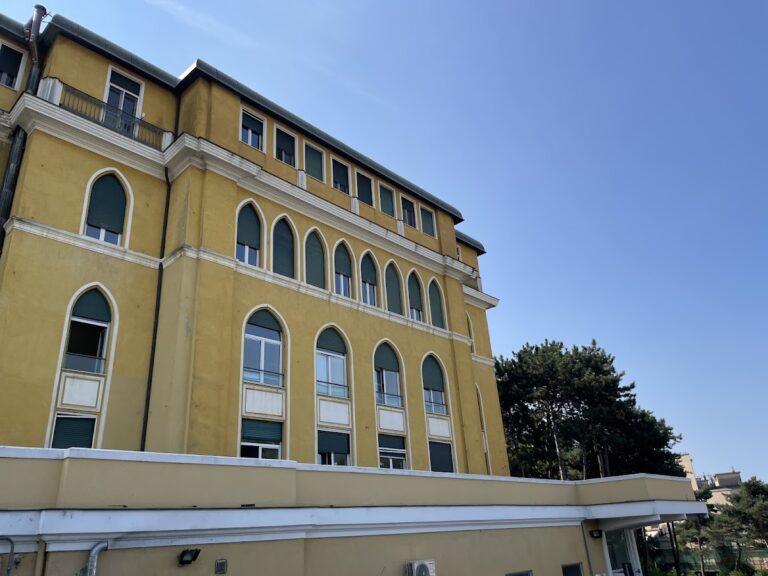
The shrine’s physical setting and connections with pilgrims changed during the twentieth century. The summit was levelled again in 1939 to permit construction of the Casa del Pellegrino, which provided catering and accommodation services. In the same period, the shrine received a renewed floor, and further interior restoration followed in 1942. The Autoguidovia, a guided transport line built to carry pilgrims toward the summit, was completed in 1929. A vehicle road was built from 1963 and paved in 1964. After the road opened, the transport line closed in 1967 because it was considered uneconomical and its public concession had expired.
In 1931, Archbishop Carlo Minoretti established the Compagnia di Nostra Signora della Guardia at the shrine, referring to a similar association that had existed in the seventeenth century. In 1969, Archbishop Giuseppe Siri made the shrine an autonomous parish, ending its former dependence on Livellato. Structural adaptations were also undertaken during preparations for the Jubilee of 2000.
Religious life and continuing devotion
The shrine remains an active pilgrimage center for people from Genoa, throughout Italy, and beyond. Its artistic tradition repeatedly presents the apparition in the same arrangement: Benedetto Pareto kneels on the right, while the standing Virgin, holding the Christ Child on her left arm, points with her right hand toward the place where the chapel should be built.
The municipality of Ceranesi was consecrated to Madonna della Guardia on 29 August 1952. Pope John Paul II visited the shrine on 22 September 1985 and returned in 1990 for the five-hundredth anniversary commemorations. Pope Benedict XVI stayed there overnight during his pastoral visit to Genoa on 17 and 18 May 2008 and presented the shrine with a Golden Rose. Pope Francis visited on 27 May 2017, meeting diocesan youth groups and dining with poor people, prisoners, and refugees.
A diocesan pilgrimage led by the Archbishop of Genoa takes place on the first Saturday of each month, a practice begun in 1995 by Cardinal Dionigi Tettamanzi. In June 2004, the shrine hosted the first Pastoral Conference of the Guardians of the World, bringing together rectors of churches dedicated to Nostra Signora della Guardia. Continuing practices include the Sunday “Entrustment to Mary” of children already baptized in their parishes and the collection of ribbons brought by parents seeking the Madonna’s protection for newborn children.
Remains
The shrine complex occupies the summit of Monte Figogna at 804 metres above sea level. A terrace in front of the basilica overlooks Genoa, the Val Polcevera, and the Ligurian coast. In exceptionally clear winter conditions, the mountains of Corsica may also be visible. The present basilica forms the principal architectural element of the summit complex, while the two Chapels of the Apparition preserve places associated with the shrine’s foundation tradition.
The basilica
Exterior and main structure
The basilica is a Neo-Renaissance church on a Latin-cross plan, with a long central axis crossed by a shorter transept. Its three aisles consist of a central nave flanked by two lateral passages. The building measures approximately 49 metres in length and 26 metres in width. A single campanile, or bell tower, rises 45 metres on the right side of the church. Designed by Guglielmo Calmieri, it was completed in 1899. A single dome rises above the crossing to an exterior height of approximately 40 metres.
Interior decoration and chapels
The central nave and the inside wall of the facade carry Marian frescoes by the Genoese painter Antonio Giuseppe Santagata, completed between 1963 and 1966. Pasquale Arzuffi painted the dome with Mary surrounded by the patron saints of the Republic of Genoa. Further frescoes in the dome, transept, presbytery, and apse depict the Glory of Mary among angels and the patron saints of Genoa, the Nativity, Visitation, Presentation, Marriage, and Coronation of Mary, and the Annunciation. Santagata also designed a later stained-glass window behind the altar showing Maria, Mater Ecclesiae, or Mary as Mother of the Church.
Two chapels open from the transept, and two more stand at the beginning of the side aisles. The left transept chapel is dedicated to Mary Crowned and Saint Eusebius and contains a fifteenth-century statue of Saint Eusebius. The right transept chapel is dedicated to the Sacred Heart of Jesus, a Catholic devotional image of Christ’s heart as a sign of divine love. The side chapels are dedicated to Saint John the Baptist and Saint Joseph. The former contains statues by Antonio Canepa, while both chapels were reconstructed in the side aisles after the mid-twentieth-century expansion.
After 1960, the presbytery was extended toward the apse under a project by Raffaele Salvatori. The earlier chapels of Saint John the Baptist and Saint Joseph were demolished to open a passage to the new apse and were then reconstructed in the side aisles. A winter chapel was installed in the sacristy.
High altar and devotional furnishings
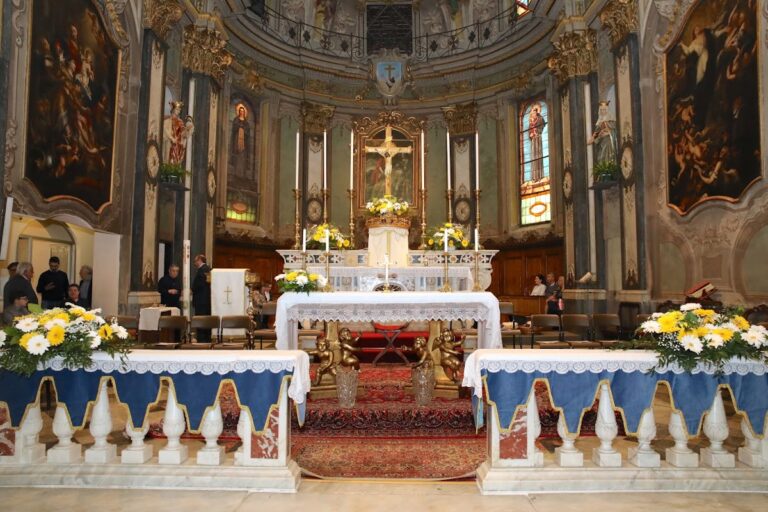
Angelo Ortelli built the high altar in white marble in 1940, following a design by Raffaele Salvatori. Its flanking columns are made of grooved onyx. At the center stands a marble aedicule, a small shrine-like structure framing a sacred image, which contains a wooden statue of Madonna della Guardia carved by Antonio Giuseppe Canepa in 1894. Archbishop Tomaso Reggio crowned the statue on 10 June 1894 on behalf of Pope Leo XIII. The Golden Rose presented by Pope Benedict XVI on 17 May 2008 is placed at the statue’s feet.
Behind the marble altar is a temple-like structure designed by Richini. A black processional crucifix stands near the left side of the high altar. The second chapel on the right contains an altar dedicated to Saint Gianna Beretta Molla, decorated with pink and blue ribbons offered by parents of newborn children.
Apparition chapels
First Chapel of the Apparition
The First Chapel of the Apparition is a small rectangular structure measuring approximately 3 by 4 metres. It is traditionally identified as the place of the apparition. Its simple wooden roof has two sloping sides, and traces of an earlier floor survive inside. The original chapel is incorporated within the later structure.
A carved niche in the lower wall contains a 40-centimetre-high marble Madonna identified as the first marble image of Madonna della Guardia. Laura Ghersi donated the statue. The chapel also contains a larger Madonna dated 1632 and made by an unknown sculptor, together with a marble statue of Benedetto Pareto added in 1850. A square extension built in 1800 contains the marble altar supporting the 1632 statue. A bronze statue of Saint Luigi Orione stands in front of the gate. Pietro Zegna made it, and it was installed in 2000.
Second Chapel of the Apparition
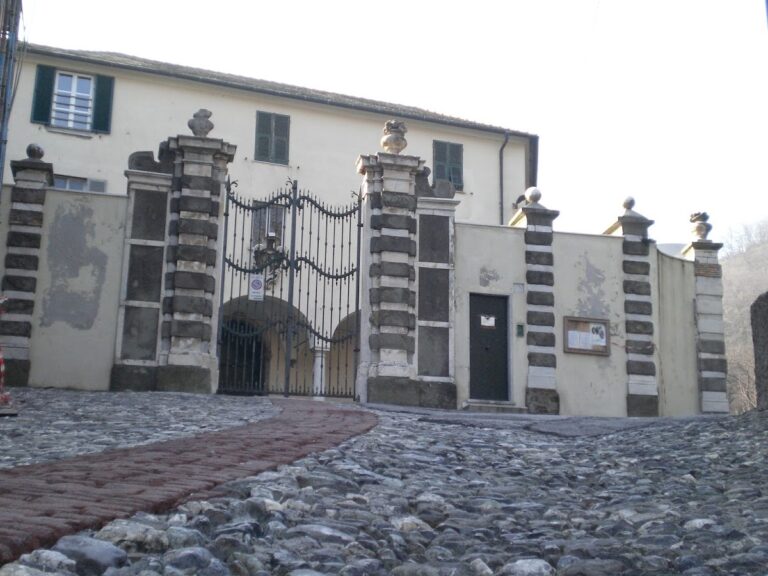
The Second Chapel of the Apparition stands on the slopes of Monte Figogna at Livellato rather than on the summit. Tradition identifies its location with the former house of Benedetto Pareto. The chapel was built in earlier centuries with stones taken from Pareto’s house and bears a plaque commemorating the events of 1490.
An adjoining octagonal chapel was built in 1902. Its interior was covered with frescoes in 1985 depicting scenes from Pareto’s life and episodes from the later history of the shrine.
Offerings, altars, and musical furnishings
The hall of offerings is reached from the left aisle. It contains paintings, photographs, objects, and written messages left by worshippers in gratitude for protection or healing connected with illness, accidents, wars, and shipwrecks. The first shrine’s former high altar is preserved in the sacristy, while the Baroque altar that replaced it during the eighteenth century is now in the church of Santa Maria di Quezzi.
The basilica received organs made by the Gaetano Cavalli firm in 1915 and monumental organs by the Inzoli firm during the post-1960 renovation. New stained-glass windows made by Casa Albano Maccario of Turin were installed in 1925. The floor was renewed in 1939 to a design by the Rapallino brothers of Genoa, with the coat of arms of Archbishop Pietro Boetto at its center. Further interior restoration followed in 1942.