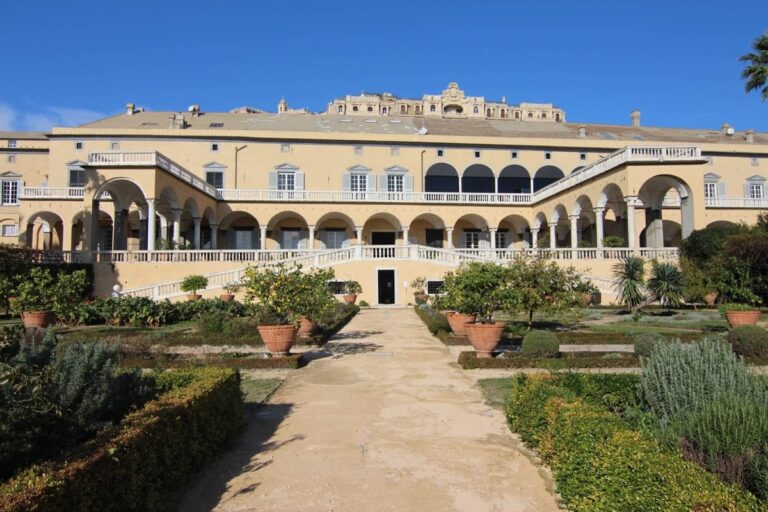
Abbazia di San Nicolò del Boschetto: A Historic Benedictine Abbey in Genoa


Site at a Glance
- Rating
- 4.3
- Popularity
- Very Low
- Country
- Italy
- Primary era
- Medieval
- External website
- Open
- Eras represented
- Medieval, Early Modern, Modern
- Civilizations
- Genoese
- Site type
- Religious
- Remains
- Monastery
On this page15 sections
History
Abbazia di San Nicolò del Boschetto is a historic monastery and church in Genoa, Italy, whose origins lie in a chapel founded in 1311 and whose surviving buildings combine Gothic, Renaissance, and Baroque phases. It stands in the lower Val Polcevera, on the right bank of the Polcevera stream at the foot of Coronata Hill, between Cornigliano and Rivarolo.
From Grimaldi Chapel to Monastery
The Genoese patrician Magnone, also called Magnano, Grimaldi founded the chapel in 1311. An inscription preserved in the church records the foundation, while the Grimaldi family and its heirs held the chapel’s patronage from 1312. By the middle of the fourteenth century, the building was being called a church. The name Boschetto refers to the dense vegetation that once surrounded the site, before the lower Val Polcevera underwent extensive industrial development during the first decades of the twentieth century.
In 1410, the heirs of Grimaldi gave the small church dedicated to Saint Nicholas and an adjoining house to Benedictine monks. The house became their first residence. Pope Martin V formally recognized the monastery in 1415. During the fifteenth century, the Grimaldi, Doria, Lercari, and Spinola families supported its construction, chose it as a burial place, and supplied furnishings and works of art. The first chapel was enlarged and absorbed into the larger complex, and the church was consecrated in 1502 by Domenico Valdettaro, general vicar of the Genoese curia.
The monastery also included a large hospice for travelers. Its position near a ford across the Polcevera placed it on a route through Rivarolo linking Genoa, Cornigliano, and Sestri Ponente. The abbey therefore served both the monastic community and people moving along this important local passage.
Expansion and Benedictine Influence
In 1507, the abbey accommodated King Louis XII of France as he advanced to reconquer Genoa. Around 1530, it was described as an exceptionally beautiful and distinguished establishment occupied by observant monks of the Monte Cassino congregation, a Benedictine community centered on the traditions of Monte Cassino. During this period, numerous churches and Benedictine monasteries in Liguria were placed under its authority.
The monastery was united with the Cistercian Abbey of Rivalta Scrivia in the Diocese of Tortona in 1538. The Cistercians were a Catholic monastic order that developed as a reform of Benedictine observance. A papal bull, the formal document issued by a pope, dated 10 September 1541, then raised the monastery to the rank of abbey.
Prominent members of the Benedictine congregation served as its heads. One was Blessed Nicholas of Prussia, a fifteenth-century monk who lived at Boschetto for 34 years and died there on 23 February 1456. The abbey’s period of prosperity also supported elaborate Holy Week celebrations and sacred performances, religious theatrical presentations based on Christian scripture or the lives of saints. Fourteen paintings showing episodes from the Passion of Jesus were used for these events. Made between the sixteenth and eighteenth centuries, they are now preserved in the Diocesan Museum of Genoa.
Baroque Transformation and Decline
Between the seventeenth and eighteenth centuries, the Grimaldi family financed a major rebuilding campaign. The work gave the complex a Baroque character and altered much of its earlier Gothic and Renaissance appearance.
The War of the Austrian Succession, an eighteenth-century conflict over the Habsburg succession, began the monastery’s decline. In the early months of 1747, Austrian troops occupied the buildings during their campaign against Genoa. The monks moved into the city with the archive and much of the furnishings and artwork. They returned after the war, but the occupation had caused extensive damage. In May 1797, popular disturbances led to an incursion into the church during which many heraldic emblems on the tombs were destroyed.
Suppression and Later Uses
Napoleonic laws suppressing religious orders forced the monks to leave again in 1810. Private owners purchased the monastery buildings, which later passed to the Delle Piane family. Much of the artwork and furnishings was dispersed or transferred to other churches. A workshop was installed in the church, while the monastery buildings were converted into housing. The owners reopened the church for worship in 1870.
The Benedictines returned in 1912, but the abbey was definitively suppressed in 1939. They continued to operate a college there until 1958. During the 1950s, the former monastery housed workers from several regions of southern Italy who were employed in constructing the Italsider steelworks at Cornigliano.
In 1960, the complex was entrusted to the Piccola Opera della Divina Provvidenza. Its Orionite priests, members of a Catholic congregation combining pastoral work with charitable and social service, provide ecclesiastical care. The associated voluntary organizations have promoted social and cultural activities. The former monastery now accommodates voluntary associations, a day center for older people, guest facilities chiefly serving workers temporarily away from home, and social and sporting activities. The church belongs to the parish of Santa Maria and San Michele Arcangelo of Coronata in the Cornigliano vicariate of the Archdiocese of Genoa.
Remains
Courtyard and Cloisters
The complex consists of the church, two arcaded cloisters, and the monastery. A short paved lane from Via del Boschetto leads to an internal courtyard dating from the fifteenth century and remodeled in the sixteenth. The abbey’s coat of arms appears above the entrance, beside a short colonnade. On the left is a marble portal attributed to Battista da Bissone, which leads to a side entrance of the church. A passage from the courtyard connects the two cloisters, whose Renaissance arcades draw on Tuscan models.
Great Cloister
Built between 1492 and 1519, the Great Cloister has a square plan measuring 22 meters on each side. Its arcades are bordered by the refectory, the monks’ cells, the abbot’s apartment, the chapter house, and the church. The chapter house was the room where the monastic community met for official business, discipline, and the reading of its rules. A well stands at the center of the cloister. It is probably older than the surrounding structure and may date back to the foundation of the chapel in 1311. A spring beneath the monastery feeds it.
Small Cloister
The Small Cloister, also called the guest cloister, is the oldest of the two. It has an irregular quadrangular plan and was built between 1468 and 1483. Rooms for receiving pilgrims and an infirmary formerly opened onto its arcades, reflecting the monastery’s role in offering hospitality and care.
Church and Bell Tower
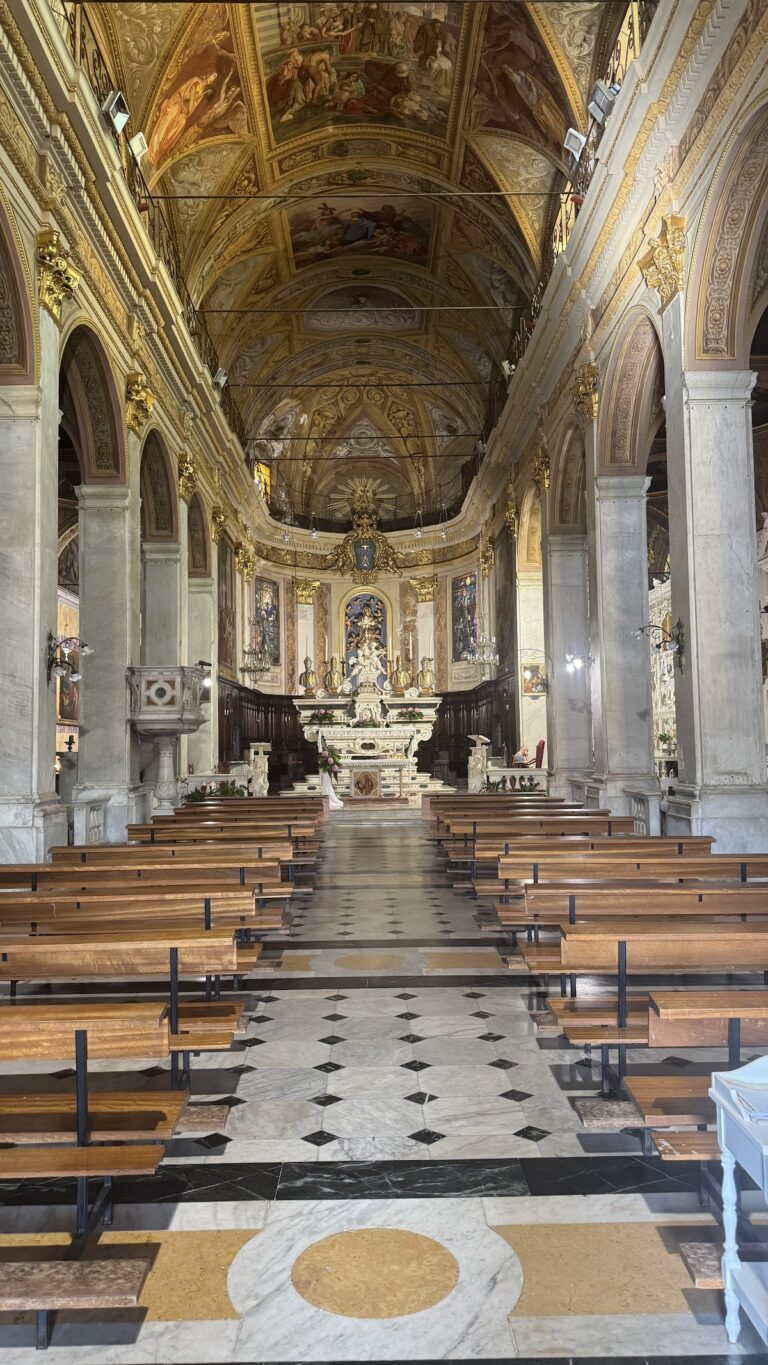
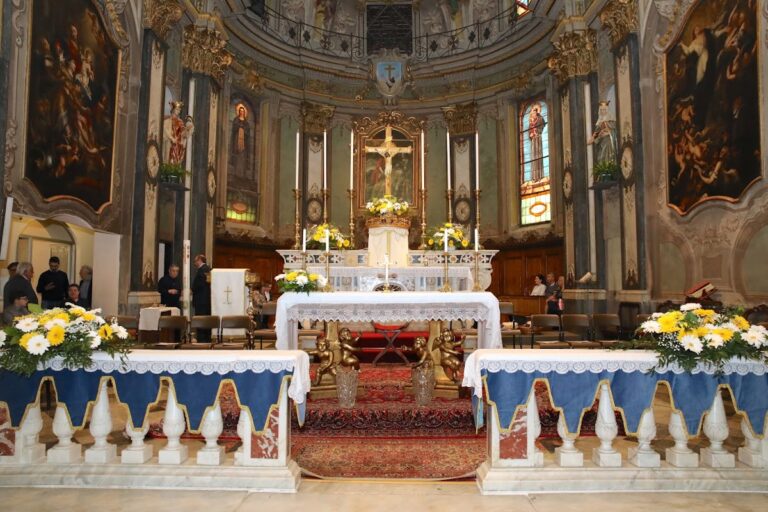
The church’s load-bearing walls preserve the structure of the original fourteenth-century building, while the interior was remodeled with three aisles in the Baroque period. The first chapel had been a single nave measuring eight meters wide and fifteen meters long. Successive alterations left only limited traces of it inside the present church.
Chapel of Saint Benedict
At the end of the left aisle, the fifteenth-century Chapel of Saint Benedict escaped the main Baroque transformation. In its present form, it represents a sixteenth-century alteration of Magnone Grimaldi’s original chapel. The chapel contains paintings of Saint Benedict and other saints dated 1779 and attributed to B. Cattaneo, together with a painting by Francesco Campora showing Saint Benedict, the Holy Trinity, and the Virgin.
Chapel of the Madonna
At the end of the right aisle stands the mausoleum chapel of Doge Giovanni Battista Lercari, also known as the Chapel of the Madonna. A doge was the elected head of the Republic of Genoa. The chapel contains the tombs of Lercari, his son Stefano, and other members of the family. Several artists painted its mid-sixteenth-century frescoes, including artists whose work has been attributed to Perino del Vaga and to the Calvi brothers.
Tombs and Funerary Sculpture
Numerous fifteenth- and sixteenth-century tombs belong to members of the Doria and Grimaldi families and to Genoese doges, including Battista Spinola, Giovanni Battista Lercari, Alessandro Grimaldi, and Luca Grimaldi. Among the funerary sculptures is Pellegrina Doria’s tomb, made in the second half of the sixteenth century as a marble sarcophagus with her figure shown lying down. In the presbytery of the Chapel of Saint Benedict is Paolo Doria’s tomb, dated 1474 and attributed to the workshop of Giovanni Gaggini.
The fourteenth-century Gothic bell tower was remodeled in the fifteenth century. Its central octagonal spire is surrounded by four smaller square corner spires, giving the tower a distinctive crown above the church.
Monastery and Later Adaptations
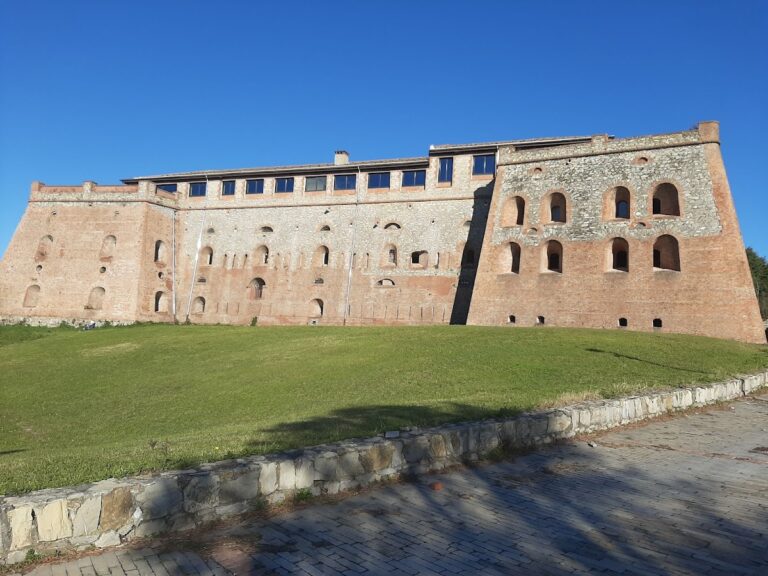
The monastery occupies the southern side of the complex and consists of buildings erected in different periods. The western section is the oldest and derives from the original fifteenth-century construction. The imposing eastern structure faces Corso Ferdinando Maria Perrone and incorporates later extensions. Its Latin-cross plan follows an eighteenth-century layout.
After the Orionites took responsibility for the complex in 1960, part of the eastern building was renovated for association offices and modern guest rooms. A seven-a-side football field with synthetic turf was created within the former monastic complex in 1967. It serves as a training ground for A.S.D. Fegino, whose social headquarters are in the former monastery.
Passion Paintings
The fourteen paintings once used during the abbey’s Holy Week performances depict episodes from the Passion of Jesus. They were painted between the sixteenth and eighteenth centuries on sturdy blue fustian cloth, the material traditionally associated with dockworkers and known as “Genoa blue.” The paintings are now held by the Diocesan Museum of Genoa.
Nearby sites