Ensdorf Abbey: A Benedictine Monastery and Salesian Educational Centre in Germany


Site at a Glance
- Rating
- 4.8
- Popularity
- Very Low
- Country
- Germany
- Primary era
- Early Modern
- External website
- Open
- Eras represented
- Medieval, Early Modern, Modern
- Civilizations
- Holy Roman Empire
- Site type
- Religious
- Remains
- Monastery
On this page16 sections
History
Ensdorf Abbey is a Benedictine monastery in Ensdorf, Germany, founded in 1121 by Count Palatine Otto V of Scheyern and Bishop Otto of Bamberg. Dedicated to Saint James the Elder, the monastery was established as a family burial place at the request of Otto’s father-in-law, Friedrich III of Pettendorf-Lengenfeld-Hopfenohe. Its history includes a double-monastery phase, medieval reform, dissolution during the Reformation, Catholic restoration, and later Salesian educational work.
Foundation and Benedictine Development
The first monks came from Sankt Blasien in the Black Forest, a reform monastery shaped by the influence of the Abbey of Cluny. Bishop Otto endowed Ensdorf with Bamberg properties at Eschenbach, Geiganz, Pommer, Gmünd, Letten, and Troschenreuth. Otto V added Weilenbach and Berngotzesreut, as well as vineyards at Kalbing and Uschelberg. Some of the Bamberg holdings may have originated in Friedrich III’s inheritance.
Heilika of Lengenfeld supported the new foundation by constructing a lead water conduit and donating church equipment. Members of the founding family were buried at Ensdorf, including Friedrich III, his wife Heilika, their daughter Heilika, her husband Count Palatine Otto, and their son Count Palatine Friedrich II of Wittelsbach. Heilika’s sister Heilwig of Lengenfeld and her husband Gebhard of Leuchtenberg were also buried there. Friedrich II later entered Indersdorf Abbey as a lay brother, a male religious who was not ordained as a priest, in 1179.
Ensdorf was a double monastery by 1166. This form of religious foundation joined separate male and female communities within one institution. After her husband’s death, Heilika founded the women’s convent, which stood on the north side of the church. The women’s community was dissolved in 1314, the same year that Ensdorf received lower jurisdiction from Louis IV of Bavaria, the future emperor.
Reform, Decline, and Dissolution
During the fourteenth century, economic decline, weakened monastic discipline, and disputes within the community placed pressure on the abbey. The Kastl Reform, a fifteenth-century movement intended to restore stricter Benedictine observance, was enforced at Ensdorf between 1413 and 1441 under Abbots Konrad II and Ludwig. The reform was followed by a renewed period of prosperity.
A major fire in 1507 led to rebuilding under Abbot Friedrich Prentel, although the monastery did not fully regain its former strength. By 1524, only six monks remained under Abbot Gregor Sintersperger. He resigned in 1525 because of negligence in office, and spiritual administrators then governed the abbey.
After the last conventual monk died in 1549, Ensdorf came under the secular administration of the Elector Palatine in 1554. This followed Elector Ottheinrich’s introduction of the Palatine Reformed church order, which aligned church administration with the Protestant Reformation. The abbey was completely dissolved in 1556.
In 1571, Count Palatine Louis VI ordered the bones of his ancestors to be gathered from the chapter house and Saint Peter’s Chapel and reburied together in the abbey church. Two lead coffins found beneath the choir altar during the demolition of the old church in 1695 were later placed in the abbey mausoleum in 1721.
Restoration and Baroque Prosperity
During the recatholicization of the Upper Palatinate, Elector Ferdinand Maria restored Ensdorf on 23 July 1669 as a priory dependent on Prüfening Abbey. A priory is a monastic house governed below the rank of an independent abbey. Ensdorf regained independent abbey status in 1695, when the former Tegernsee abbot Bonaventura Oberhuber became its first abbot after the resettlement. He governed until 1716.
The present church was rebuilt from 1694 and consecrated on 8 October 1717. Progress was slowed by the War of the Spanish Succession, fought from 1701 to 1714 as a major European conflict over the succession to the Spanish throne. Work was also affected by Oberhuber’s administration of Ensdorf from Reichenbach after 1699 and by the death in 1706 of Wolfgang Dientzenhofer, presumed to have been the first master builder. Construction advanced more quickly under Anselm Meiller, an administrator from Amberg who became abbot in 1716.
Meiller led the monastery until 1761, and the years from 1716 to 1772 are regarded as the scholarly high point of the community. He acquired a Madonna and Child around 1720, while the monastery library was substantially enlarged. His successor, Anselm Desing, governed until 1772. Diepold Ziegler, who had taught philosophy, biblical languages, and biblical interpretation, later established a school in 1778 to train capable schoolmasters.
Secularization and Later Institutional Uses
After Ziegler died on 21 November 1801, the government prevented the election of another abbot. Ensdorf was dissolved on 25 January 1802 during secularization, although the community still comprised seventeen priests and one lay brother. The monastery’s land and property, including the forest and the Leidersdorf hammer mill, passed into state ownership.
The abbey church became the parish church. Between 7,000 and 8,000 library volumes were transferred mainly to the newly established Provincial Library of Amberg, where Joseph Moritz continued to care for them. The Regensburg episcopal ordinariate acquired large parts of the complex and established the Xaverianum priests’ house. The collection of 1,497 mortuary scrolls, produced between 1716 and 1789 in seven folio volumes, has also been held at the Provincial Library of Amberg since secularization.
The Salesians of Don Bosco took over the complex in 1920 and established their novitiate there. The Salesians are a Catholic congregation founded by John Bosco for the education and pastoral care of young people. A further fire damaged the monastery in 1940, and the interior was fully repaired in 1962 and 1963.
From 1959 to 1996, the complex housed the lower section of a humanistic secondary school with a boarding house, organizationally affiliated with Marianum Buxheim. The school maintained a boys’ choir and, especially during the 1980s, a wind orchestra. Musical education for children and young people remains part of Ensdorf’s work.
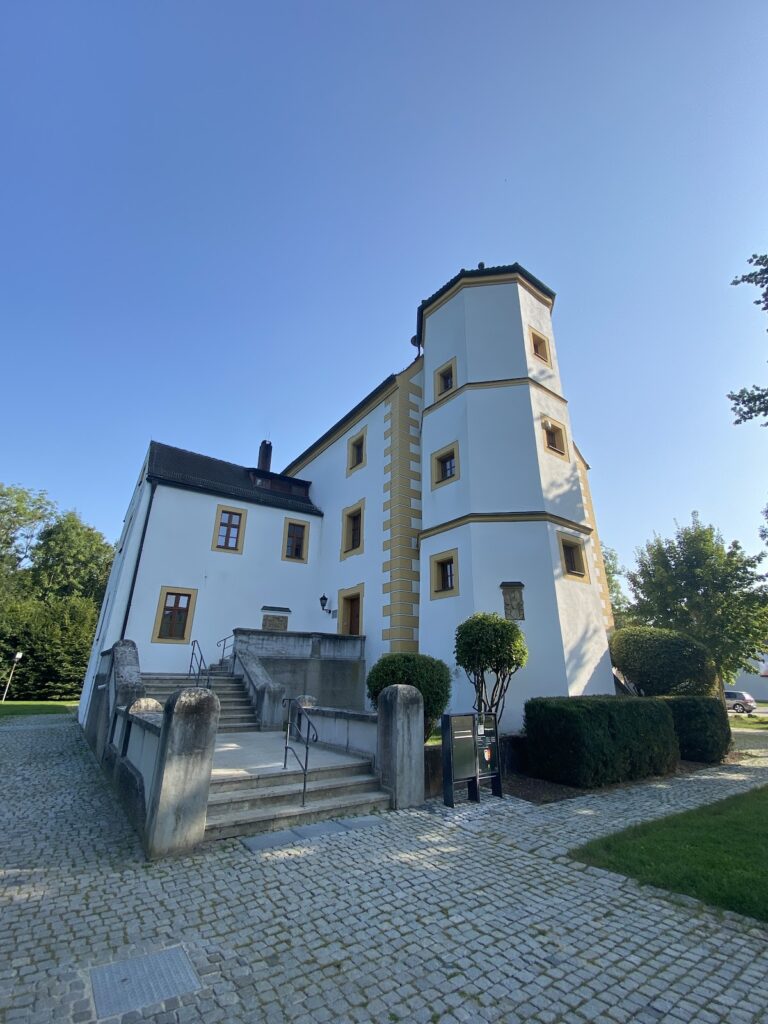
Ensdorf is now a Salesian establishment with a youth education centre, an environmental station, and an environmental music workshop. Its programmes include orientation days, residential school stays, and environmental education centred on creation. A printing works on the grounds belongs to Don Bosco Medien GmbH. Approximately twenty members of the order live at the monastery, and a Salesian serves as parish priest while the fathers also support surrounding parishes.
Since the Middle Ages, Ensdorf has been a pilgrimage station on the Upper Palatinate route of the Way of Saint James, the network of Christian pilgrimage routes traditionally associated with Saint James the Greater and leading to Santiago de Compostela. The route continues from the Tillyschanz border crossing through Schwandorf, Nuremberg, and Ansbach to Rothenburg ob der Tauber, where it joins the Franconian Way.
Remains
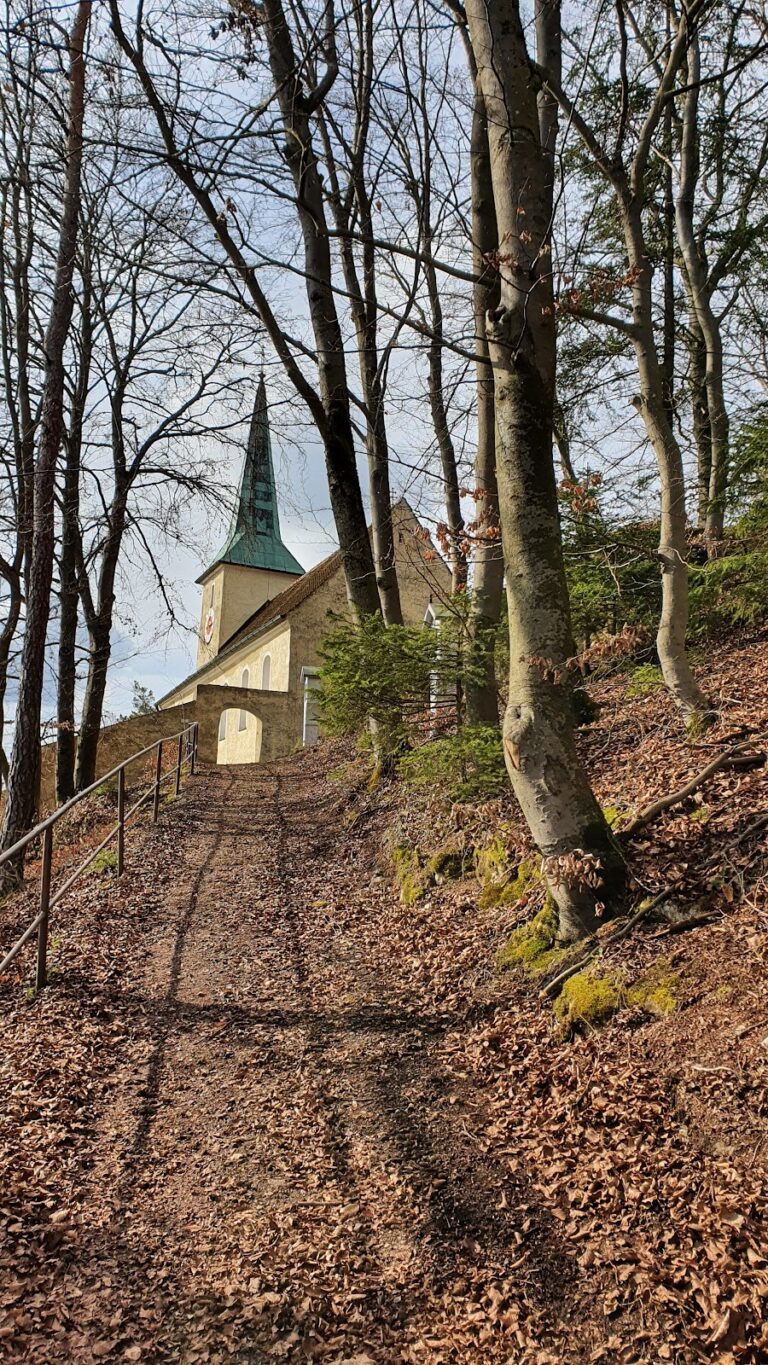
The surviving complex brings together remains and furnishings from several building phases. The first church was a wooden structure, while the later Romanesque church used a cross-shaped basilican plan. The present church belongs to the Baroque rebuilding begun in 1694 and completed with its consecration in 1717. The monastic water system, cloister, burial spaces, paintings, stucco, and organs preserve evidence of the abbey’s changing religious and artistic life.
Churches and Burial Spaces
Early and Romanesque Churches
Bishop Otto consecrated the first monastery church on 25 July 1123. It was built of wood. A stone church followed in 1179 and 1180 under Abbot Boto, who governed from 1170 to 1202, with the support of Count Palatine Friedrich II of Wittelsbach.
The stone church followed the Hirsau building type, a Romanesque tradition associated with the reform monastery of Hirsau. At Ensdorf, this design comprised a flat-roofed basilica with three naves, three apses, a crossing dome, twin towers, and a two-storey western vestibule known as the Paradise. The baptismal font and a column capital survive from this church. Under Abbot Ulrich, who died in 1369, the building received a Gothic vault, and fragments of its ribs remain.
Gothic Cloister
The cloister was converted to the Gothic style under Abbots Hermann Hollenfelder and Hauser, who died in 1468 and 1503 respectively. Their grave slabs also survive as part of the monastery’s architectural evidence.
Baroque Abbey Church
The present church was constructed from 1694 and consecrated in 1717. Johann Gebhard of Prüfening painted the high-altarpiece pictures. Cosmas Damian Asam created the ceiling paintings and completed his first major work at Ensdorf. The principal fresco bears the date 1714. Hans Georg Asam was also intended to contribute, but he died in nearby Sulzbach in 1711.
Thomas, Matthias, and Bernhard Ehamb worked on the stucco together with Philipp Jakob Schmuzer. A simple monument to the founders was completed in 1715. To the left of the high altar stands the mausoleum built under Abbot Bonaventura in 1715. In 1721, under Abbot Anselm Meiller, it received the two lead coffins recovered beneath the choir altar of the demolished older church.
Ceremonial Sacristy
A carved ceremonial sacristy incorporating an imperial eagle was made in 1743 for Abbot Meiller, probably by Emperor Charles VII, Elector of Bavaria. The monastery’s wartime burdens during the War of the Austrian Succession meant that the work could not be financed from Meiller’s own resources.
Organs and Musical Furnishings
Abbey Church Organ
Johann Sebastian and Georg Carl Wild of Kirchenrohrbach built the abbey church organ in 1739. Andreas Weiss of Nabburg replaced it in 1782 with an organ having 24 stops and two manuals, reusing decorative elements from the earlier instrument in a new case. The case retains the signature “Andreas Weiss 1782.”
A pneumatic organ by Binder & Siemann was installed in 1913. During a comprehensive restoration in 2009, Rainer Kilbert and Hönighausen added a 16-foot Posaune stop to the pedal division.
House Chapel Organ
The monastery house chapel contains an organ built by Albert Reiser in 1951. It has eighteen stops, two manuals, and electropneumatic action. Orgelbau Rainer Kilbert thoroughly overhauled the instrument in 2020 and rebuilt its wind system.
Eggenberg Church Organ
The associated Eggenberg Church contains a Positiv organ made by Manderscheidt in 1648. The instrument has five stops and one manual and is the second-oldest organ in the Upper Palatinate.
Water Infrastructure and Monastic Setting
The former monastic water infrastructure included a lead conduit constructed for Ensdorf by Heilika of Lengenfeld. The women’s convent of the former double monastery occupied the north side of the church, while the chapter house and Saint Peter’s Chapel were connected with the earlier burial arrangements of the founding family.
Nearby sites