Želiv Monastery: A Premonstratensian Abbey in Czechia


Site at a Glance
- Rating
- 4.7
- Popularity
- Medium
- Country
- Czechia
- Primary era
- Early Modern
- External website
- Open
- Eras represented
- Medieval, Early Modern, Modern
- Civilizations
- Habsburg, Holy Roman Empire, Kingdom of Bohemia
- Site type
- Religious
- Remains
- Monastery
On this page18 sections
History
Želiv monastery in Czechia is a medieval Christian complex founded at Želiv in 1139 and later shaped by Premonstratensian religious life and Bohemian Baroque Gothic architecture. Its foundation date is not certain. The year 1139 comes from a fourteenth-century chronicle, while another tradition links the establishment to a 1144 charter transferring Želiv and its associated properties to the bishops of Prague. The monastery was also known as Siloe, a Latin biblical name, and as Seelau or Selau in German.
Benedictine and Premonstratensian beginnings
Želiv began as a daughter house of Sázava Abbey and was initially Benedictine. In 1148 or 1149, Premonstratensian canons from Steinfeld Abbey in the Eifel settled there at the initiative of Jindřich Zdík, bishop of Olomouc, with the approval of Daniel I, bishop of Prague. Gottschalk became the first Premonstratensian abbot. The Premonstratensians are a Catholic order whose members combine communal religious life with pastoral and educational work.
Under the Premonstratensians, Želiv became an influential religious and economic centre. The abbey founded or colonized other Premonstratensian houses, including Geras, Milevsko, Louňovice, Dolní Kounice, and Pernegg. In 1233 it acquired the Humpolec estate and patronage rights in Humpolec and Jihlava from the Teutonic Order. Its possessions also included parishes, villages, and vineyards.
Destruction and the loss of the medieval estate
A fire damaged the monastery in 1374 or 1375, and the complex was subsequently rebuilt. The Hussite Wars, religious and political conflicts in fifteenth-century Bohemia connected with reform movements associated with Jan Hus, brought further destruction. Želiv was plundered or devastated probably in 1420 and again in 1424. The chronicler Vavřinec of Březová included it among the monasteries destroyed by the Hussites. One former Želiv monk, Jan Želivský, became a prominent radical Hussite preacher.
The religious community returned after the wars, but its position soon weakened. In 1468, King George of Poděbrady pledged the monastery and its estates to Burian Trčka of Lípa. Trčka expelled the canons, and a new abbot was elected in the sacristy of St. James’s Church in Jihlava on 17 August that year. The community retained only its Moravian possessions, while the Trčka family converted the western part of the complex into Trčkův Castle.
Restoration and Baroque rebuilding
Abbot Jan Lohel of Strahov restored the monastic community, probably at Jihlava, in 1590. Premonstratensians connected with Strahov reacquired the former Želiv estate from Maria Trčka of Lípa around 1622 or 1623. Želiv became an independent monastery again in 1643. Swedish forces damaged the complex in 1645 and 1646, after which a major rebuilding campaign began in 1680.
The convent buildings were reconstructed between 1680 and 1688 according to plans by Giacomo Antonio de Maggi. A fire in 1712 led to further work on the principal interiors. From 1713 to 1720, the abbey church and much of the complex were rebuilt under Jan Blažej Santini-Aichel in the Bohemian Baroque Gothic style, which combines Gothic structural forms with Baroque ornament and movement. The church furnishings were completed by 1736. During this period, the composer Josef Leopold Václav Dukát lived at Želiv as a canon.
A monastery school founded in 1703 continued until it was transferred to Deutschbrod in 1807. Another fire in 1907 caused further repairs, including the rebuilding of the abbot’s building in the Neo-Baroque style.
Suppression, internment, and return
The Communist government dissolved the Premonstratensian abbey in 1950 during Action K, a state operation that forcibly dissolved male religious communities in Czechoslovakia. Abbot Vít Bohumil Tajovský was arrested and later received an eleven-year sentence in a show trial, serving ten years. From 1950 to 1956, the complex operated as an internment camp for 464 politically undesirable priests and religious members. Among those detained were the future Cardinal František Tomášek, Bishop Karel Otčenášek, Antonín Šuránek, Leopold Škarek, and Antonín Zgarbík.
After 1954, part of the former monastery housed a branch of the psychiatric hospital in Havlíčkův Brod, and the buildings deteriorated severely. Following the 1989 Velvet Revolution, the monastery was returned to the Premonstratensians. Restitution was recorded in 1991, restoration and thorough repairs began around the same period, and the religious community was re-established. Želiv was designated a national cultural monument on 8 February 2010. A memorial to victims of the Communist regime was unveiled in 2011, and a 2019 Reconciliation Pilgrimage commemorated the traditional foundation date of 1139 and the arrival of the Premonstratensians in 1149. The same event saw the unveiling of a bronze Crucifixion memorial by the Slovak architect Svetozár Ilavský.
Remains
The monastery occupies a spur above the Želivka near the confluence of two rivers. Its surviving complex includes the Church of the Nativity of the Virgin Mary, the convent, the abbot’s building, Trčkův Castle, gardens, agricultural buildings, and the wider monastic farm. The buildings and open spaces preserve the layered history of a religious foundation repeatedly rebuilt after fire, war, political seizure, and twentieth-century neglect.
Abbey church
Church of the Nativity of the Virgin Mary
The Church of the Nativity of the Virgin Mary began as a Romanesque building constructed before 1250. In the early fourteenth century it was rebuilt as a Gothic three-aisled church with three choirs. It was partly restored before 1462, repaired probably by an Italian architect, and reconsecrated in 1630. Santini’s rebuilding between 1713 and 1720 gave the church its present Baroque Gothic character.
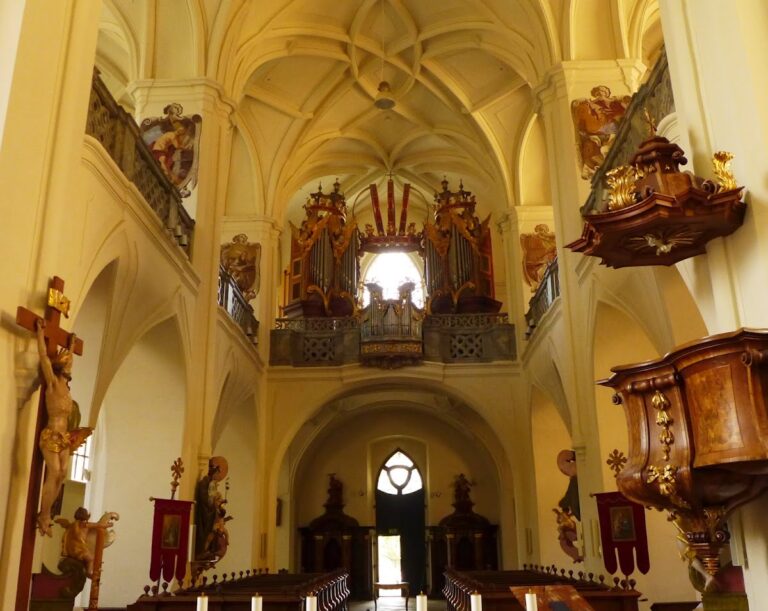
The church is a hall church with a wider central nave, a very long presbytery, and two towers in the facade. Four bays of cross vaulting cover the presbytery. Three pairs of Gothic piers divide the nave, which carries a barrel vault with stucco ribs imitating an elaborate late Gothic design. Tribunes above the side aisles connect with the choir loft and contain a rich network of stucco ribs. The arches between the piers are divided by hanging consoles.
Interior furnishings
The presbytery contains an Early Gothic sanctuary from the early fourteenth century, while the marble slab of the high altar bears the date 1462. Baroque furnishings include choir stalls, side altars, and sculptures by the Jihlava woodcarver F. Hoebbel and F. Neth of Humpolec. Other features include a baptismal font dated 1629, paintings by F. A. Maulbertsch and V. J. Nosecký, and a Baroque organ made by J. Dvorský in 1719.
Convent and abbot’s building
Convent
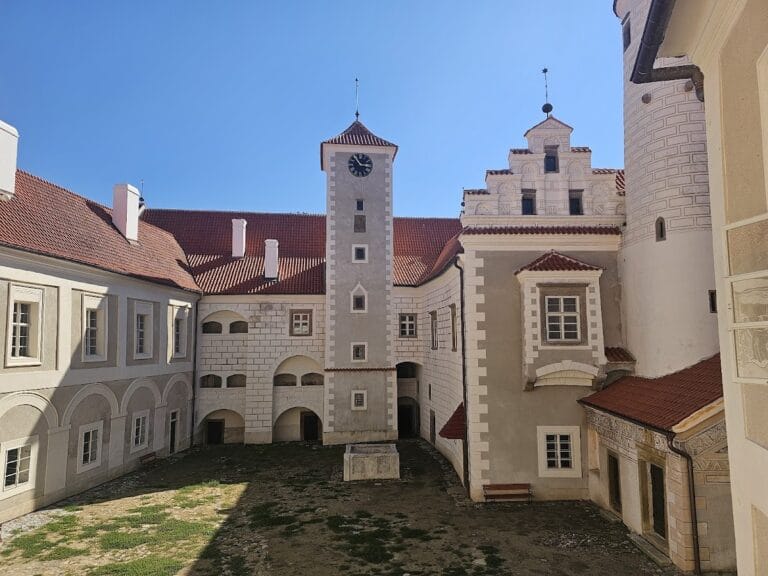
The two-storey convent has a square plan and was built at the end of the seventeenth century to designs by Giacomo Antonio de Maggi. Glazed arcades surround its courtyard. The refectory occupies the ground floor of the northern wing, where Jan Kalina painted frescoes between 1726 and 1729. Kalina was a pupil of V. J. Nosecký. The upper floor contains a large library with frescoes by the same artist.
Abbot’s building
A corridor on the upper floor connects the convent with the abbot’s building. The latter was rebuilt after the 1907 fire in the Neo-Baroque style. A memorial plaque to Bohumil Vít Tajovský is associated with the monastery’s twentieth-century history.
Western complex and grounds
Trčkův Castle
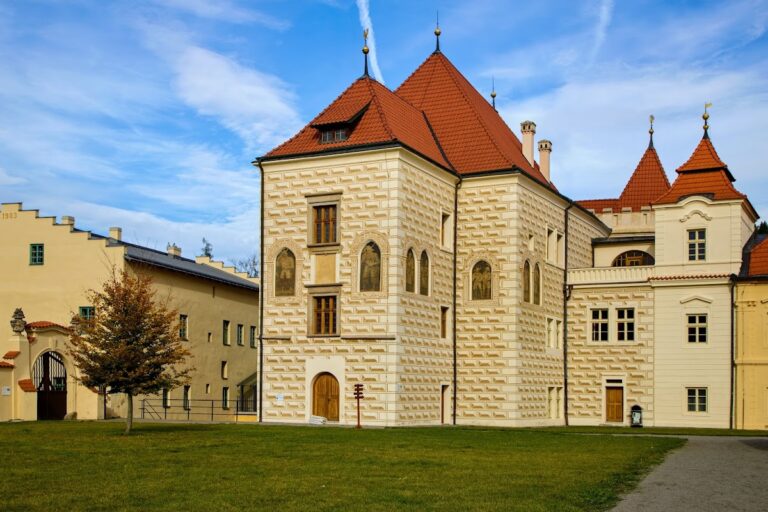
Trčkův Castle forms the western continuation of the monastery. It is a plain Late Gothic and Renaissance palace created from the western part of the complex after the Trčka family took control in 1468. The building was altered after 1907 and contains rooms with frescoes by B. Dvořák and V. Häusler.
Garden and agricultural buildings
Farther west, toward the river confluence, a garden contains a statue of the Madonna by A. Bílek and gravestones commemorating Abbot Jindřich, dated 1370, and Siard Falk, dated 1676. Baroque agricultural buildings and the monastic farm continue beyond the garden.
Eastern church and memorials
Church of Saints Peter and Paul
East of the monastery stands the cemetery Church of Saints Peter and Paul, probably a surviving part of the earliest foundation associated with 1139. It has a rectangular nave with a flat ceiling and a five-sided vaulted presbytery. Its Early Baroque furnishings are valuable survivals within the wider monastery landscape.
Memorials and liturgical objects
A memorial wall in the cloisters records the names of all priests and religious members interned at Želiv. Other memorials commemorate persecuted priests and religious members in the Church of the Nativity of the Virgin Mary and preserve the memory of Bohumil Vít Tajovský. The monastery also holds the so-called Pickle Jar Monstrance, a monstrance used to display the consecrated Eucharistic host. Imprisoned priests secretly made it from the glass bottom of a bottle and pickle tins.
The bronze statue of Jesus Christ on the cross unveiled during the 2019 Reconciliation Pilgrimage was based on a statue used at the 2003 beatification of the religious sister Zdenka Schelingová in Bratislava. Ilavský’s associated altar table was installed in the monastery church in 2018.
Nearby sites