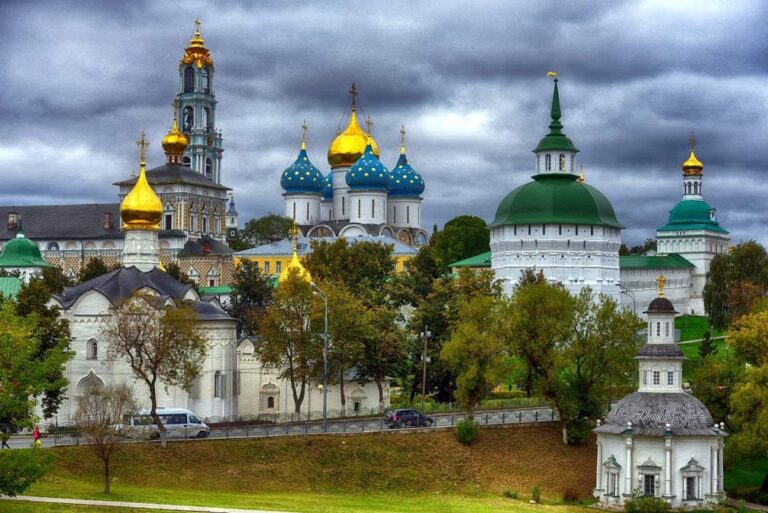
Fedorovsky Monastery: An Orthodox Monastic Complex in Pereslavl-Zalessky

Site at a Glance
- Rating
- 4.9
- Popularity
- Low
- Country
- Russia
- Primary era
- Early Modern
- External website
- Open
- Eras represented
- Early Modern, Modern
- Civilizations
- Russian
- Site type
- Religious
- Remains
- Fortified Monastery
On this page14 sections
History
Fedorovsky Monastery is an Orthodox women’s monastery in Pereslavl-Zalessky, Russia, founded in the early fourteenth century and associated with the Russian Orthodox tradition. It was established in memory of a battle fought near the town on 8 June 1304, when Moscow forces led by Prince Yuri Danilovich defeated forces associated with Tver and the boyar Akinf was killed. The victory fell on the feast day of Theodore Stratelates, a Christian military saint associated in Orthodox tradition with warriors, who became the monastery’s patron.
Medieval foundations and princely support
During the fifteenth century, Pereslavl was an important center of trade and crafts. Its monasteries also served as pilgrimage centers for Moscow rulers and their families. Ivan III and Vasily III supported Fedorovsky Monastery, and Vasily III granted it the villages of Fedorovskoye, Polovetskoye, and Potanino. A document issued during Vasily III’s rule names Gerontius as the earliest superior of the monastery whose name is known.
Expansion under the tsars
The monastery flourished during the reign of Ivan IV, commonly known as Ivan the Terrible and the first Russian ruler to use the title tsar. After the birth of his son Fyodor in 1557, Ivan IV ordered the construction of the Cathedral of Theodore Stratelates, the monastery’s first stone building. He also financed residential buildings for the monks and an enclosing wall, granted extensive lands, and supported the growth of the community. Tsar Fyodor Ivanovich and Boris Godunov continued this royal support.
Fyodor Ivanovich visited the monastery repeatedly, sometimes remaining for extended periods to pray there. The Russian Orthodox Church later canonized him. The monastery was also affected by the Polish intervention in Russia, when Polish-Lithuanian forces advancing toward Moscow destroyed and plundered the monasteries of Pereslavl. Repairs at Fedorovsky Monastery began in 1622 on the orders of Tsar Michael I. By 1654, the cathedral had been reroofed, the monks’ residential buildings had been rebuilt, and a second church joined to a refectory had been erected.
Transformation into a women’s monastery
In 1667, Fedorovsky Monastery became a women’s monastery, while its remaining monks were transferred to other Pereslavl communities. Abbess Irynarcha became its first superior, directing a community of 150 women who followed monastic life. The early period was difficult because some nuns and novices rejected the liturgical reforms of Patriarch Nikon, the seventeenth-century head of the Russian Orthodox Church whose changes caused a major division among Russian believers.
The monastery continued to receive substantial gifts from the tsars, including Peter the Great and members of his close family. Its greatest prosperity came during the first half of the eighteenth century. Peter the Great’s sister Natalia funded the Church of the Entry of the Mother of God into the Temple in 1710, while the Church of the Kazan Icon of the Mother of God was built beside the monastery hospital in 1714. The Entry of the Mother of God into the Temple is an Orthodox feast commemorating the Virgin Mary’s presentation at the Temple.
At the end of the nineteenth century, the affiliated Alexeevskaya Hermitage was established as a small religious settlement associated with the monastery. The abbess’s house was repaired in 1825, and in 1865 the merchant Avraamy Ushakov built a two-storey residential building for the nuns. By 1916, about 500 nuns and novices lived at Fedorovsky Monastery. The community controlled three hermitages and four parish schools.
Closure, restoration, and renewed religious life
Soviet authorities closed the monastery in 1923. A monastic community that had operated as an agricultural cooperative since 1918 was dissolved in June of that year after it failed to secure permission to continue as a labor commune. The former monastery complex subsequently housed a children’s colony, an old people’s home, and workers and employees. It later passed for an extended period to military authorities, while the former pilgrims’ hospice became the office of a construction trust.
Restoration of the former monastery buildings began in 1967. In 1998, the churches and other buildings were returned to the Russian Orthodox Church and placed under the Nikolsky Monastery in Pereslavl-Zalessky. The first Divine Liturgy after the return was celebrated in the Church of the Entry of the Mother of God into the Temple on Easter Day that year.
Alexander Alexeev became the monastery’s serving priest in 1999, and Abbess Eustolia (Afonina) became its superior. The community was formally treated as an affiliated institution of Nikolsky Monastery in December 1999 and became fully independent three years later. In 2000, an autonomous power station was installed and the electrical system was replaced. Abbess Varvara (Chekotkova) led the monastery from 2006 until her death in 2017 and was raised to the rank of abbess in 2011. Daniila (Severinenko) became superior in 2017. The monastery now has approximately 20 nuns and novices, functions as a religious institution, and holds federal-level cultural-heritage status in Russia.
Remains
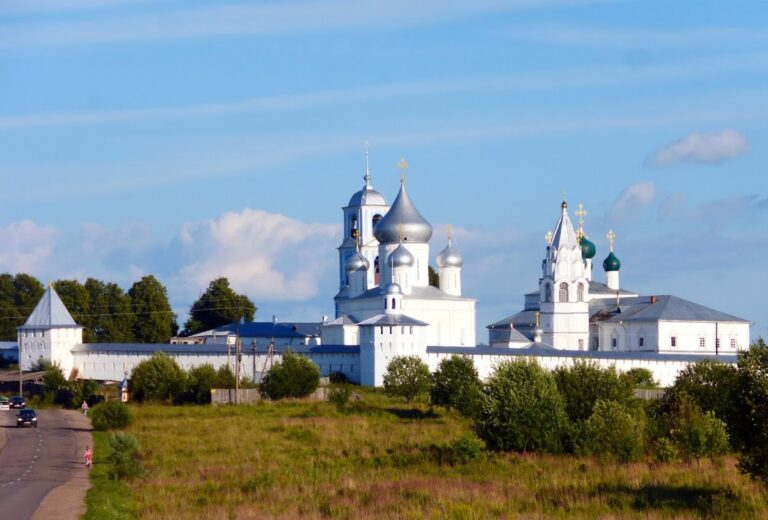
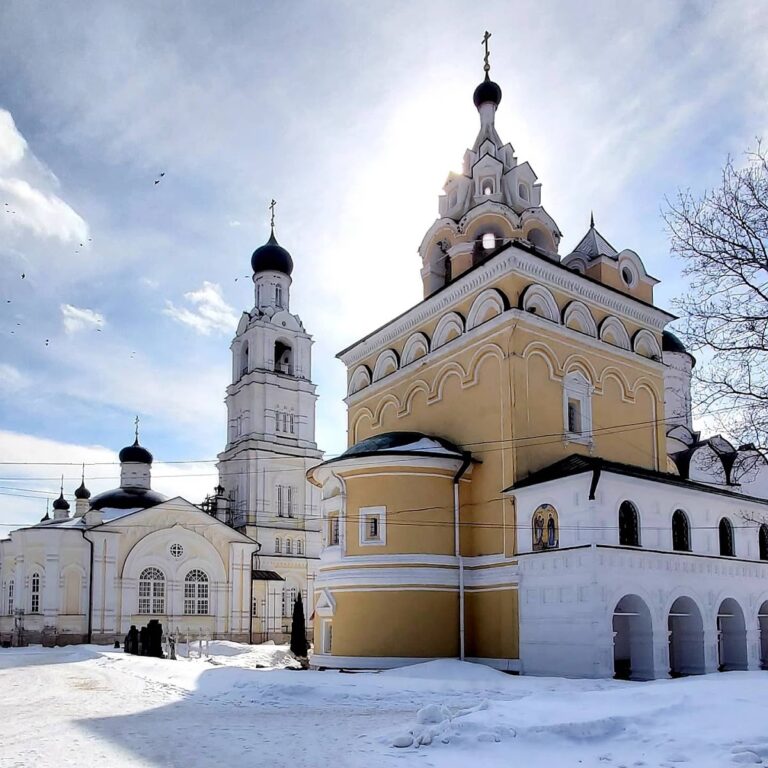
The monastery complex is organized around churches, residential buildings, service structures, entrances, and an enclosing wall. Its buildings represent several phases of construction from the sixteenth through the nineteenth centuries, followed by restoration that began in 1967 and continued after the return to religious use in 1998.
Monastery churches
Cathedral of Theodore Stratelates
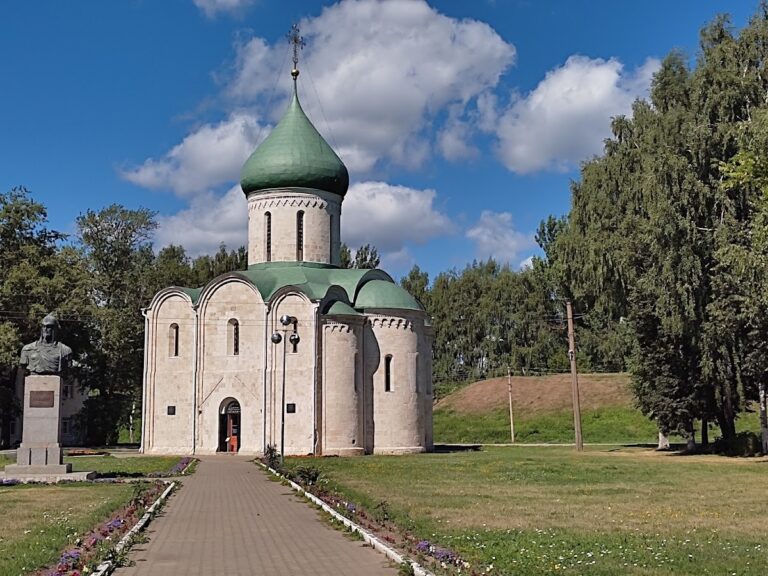
Built in 1557, the Cathedral of Theodore Stratelates has a square plan, three semicircular apses at the altar end, and five domes. One apse originally held a side altar dedicated to Saint Hermias. That altar had been abolished by 1668, after which the space was converted into a sacristy, a room for storing vestments and liturgical objects. The cathedral also contains side chapels dedicated to the Feodorovskaya Icon of the Mother of God and Seraphim of Sarov, a major Russian Orthodox saint of the eighteenth and nineteenth centuries.
Church of the Entry of the Mother of God into the Temple
The Church of the Entry of the Mother of God into the Temple is a heated church built in 1710. Its side altars are dedicated to the Sign Icon of the Mother of God and to Saints Adrian and Natalia. The main altar was consecrated in December 1999, after the complex had returned to religious use.
Church of the Kazan Icon of the Mother of God
The Church of the Kazan Icon of the Mother of God was built in the 1710s beside the monastery hospital. It forms part of the group of eighteenth-century religious buildings that expanded the monastery during its period of greatest prosperity.
Residential and service buildings
Cells and residential buildings
The complex includes old and new cells, as well as a two-storey cell building near the northern wall. The building housed the sisters, and a heating plant was installed there in 1999. A separate two-storey residential building for the nuns was built by the merchant Avraamy Ushakov in 1865.
Gates, refectory, and utility structures
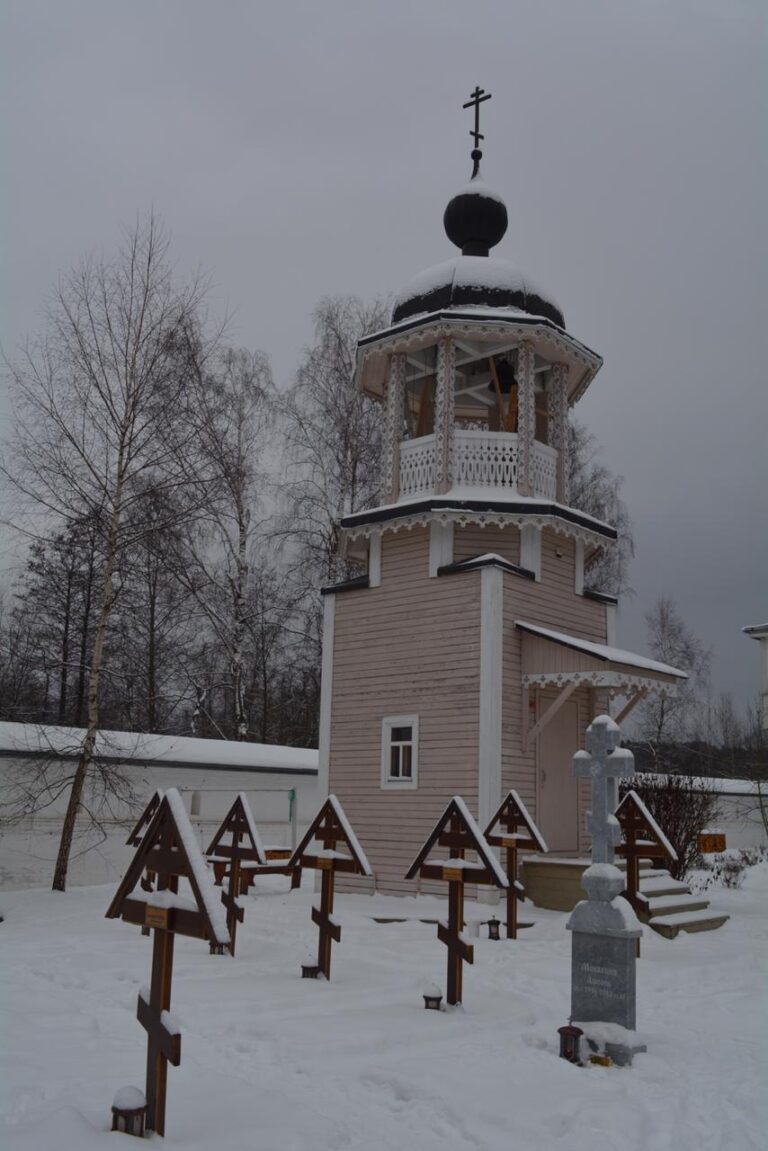
Other structures include a forge, Holy Gates with a gate church above them, a pilgrims’ hospice, a new refectory, a chapel over a well, and a tower. The complex also contains a wooden pilgrims’ house, where stoves were installed after the monastery’s return to religious use.
Images and burials
Icons associated with the monastery are held in the Pereslavl museum collection. They include images of Saint John Chrysostom with scenes from his life, Saint Nicholas, the Trinity, the Hodegetria Icon of the Mother of God, and the icon titled “All Creation Rejoices in You.” Ivan IV donated the Hodegetria Icon and “All Creation Rejoices in You” to the monastery.
The monastery’s burials include the schema-monk Sergius, identified as a builder of the monastery, in the Church of the Entry of the Mother of God into the Temple. Natalia Ivanovna Vzimkova, a childhood companion of Peter the Great, was buried in the cathedral, as was General Gavriil Petrovich Samsonov. Agafiya Fedorovna Yaguzhinskaya, the wife of Yaguzhinsky, lies in the side chapel of Saints Adrian and Natalia. General Pavel Semyonovich Soloviev, a hero of Sevastopol, was buried in the Church of the Entry of the Mother of God into the Temple, while Maria Nikolaevna Tonchi, daughter of the artist Nikolai Tonchi, was buried in the cathedral.