Kloster Wöltingerode: A Medieval Monastery in Germany


Site at a Glance
- Rating
- 4.6
- Popularity
- Low
- Country
- Germany
- Primary era
- Medieval
- External website
- Open
- Eras represented
- Medieval, Early Modern
- Civilizations
- Holy Roman Empire
- Site type
- Religious
- Remains
- Monastery
On this page15 sections
History
Kloster Wöltingerode is a former monastery in Germany, founded in 1174 by the Counts of Wohldenberg on the site of their earlier castle. Its Romanesque church and monastic buildings developed through medieval expansions, while later confessional changes, fire, dissolution, and reuse shaped the complex that survives today.
Foundation and Cistercian development
The Counts of Wöltingerode moved their principal residence toward the Ambergau during the twelfth century. They built Wohldenberg Castle between 1153 and 1160, and Count Ludolf I transferred his seat there after 1174. Counts Ludolf II, Hogerus, and Borchardus of Wohldenberg then established Wöltingerode as a Benedictine monastery. Benedictines followed the Rule of Saint Benedict, which emphasized communal prayer, disciplined living, and work. The founders endowed the monastery with 1,500 Morgen of land, woodland, a pond, tithes, and mills, and designated it as the family burial place.
On 19 October 1174, Bishop Adelog of Hildesheim confirmed the foundation under the Benedictine rule. He granted the monastery immunity and the free election of its abbot, while confirming the counts’ rights of advocacy and protection. The male community was soon changed into a Cistercian nunnery. Cistercians were a reform movement within Western monasticism that developed from Benedictine traditions and founded monasteries for both monks and nuns. An imperial confirmation from 1188 records the presence of Cistercian nuns at Wöltingerode.
Pope Honorius III placed the monastery of St. Mary at Wöltingerode under papal protection on 3 October 1216 and confirmed its possessions and rights. The church was first mentioned in 1208. During the early thirteenth century, the church and convent buildings were enlarged and altered, and Bishop Konrad of Hildesheim consecrated the monastery in 1244 while confirming arrangements made under Bishop Adelog.
Medieval prosperity and decline
Wöltingerode became a respected Cistercian institution and the mother house of several monasteries, including Althaldensleben, Wienhausen, and Derneburg. During its first prosperous period in the thirteenth century, the nuns practiced manuscript illumination. Several manuscripts associated with Wöltingerode are preserved in the Herzog August Bibliothek in Wolfenbüttel.
Construction continued during the thirteenth century. A hospital was recorded in 1279, a new dormitory in 1293, and an altar in the northern part of the monastery in 1305. The decline of the Wohldenberg family during the late thirteenth and fourteenth centuries weakened an important source of support. The family became extinct in the male line in 1383. Wöltingerode had already been compelled to sell property in 1290, and in 1337 Bishop Heinrich of Hildesheim appealed for general assistance on its behalf.
The monastery entered a second period of prosperity in the fifteenth century. Its political position changed after the Hildesheim Diocesan Feud, a territorial conflict settled in 1523 that transferred Wöltingerode to the sovereignty of Duke Henry the Younger of Brunswick-Wolfenbüttel.
Reformation and Thirty Years’ War
When forces of the Schmalkaldic League drove Duke Henry from his territory between 1542 and 1547, the nuns were ordered either to accept Lutheran teaching or to leave. Catholic worship returned after the duke was restored, but it ended again in 1568 when his son and successor, Duke Julius, reintroduced Lutheran teaching. After Anna von Haus was installed as abbess, Wöltingerode became a Lutheran women’s foundation.
The Edict of Restitution, issued by Emperor Ferdinand II in 1629 to restore Catholic ecclesiastical property secularized since the Reformation, led to the reintroduction of Cistercian nuns from Bavaria in 1630 under Provost Heinrich Götze. During the Thirty Years’ War, Jesuits based at Goslar’s imperial palace attempted to take possession of Wöltingerode under an imperial rescript, with the consent of Prince-Bishop Ferdinand. The nuns were forcibly removed, taken to Goslar, and sent to their home regions with travel money.
Swedish troops entering Goslar in 1632 forced the Jesuits to leave Wöltingerode. The monastery remained Lutheran until 1643, when it returned with the wider Hildesheim foundation to the Bishopric of Hildesheim. This ecclesiastical principality and diocese in northern Germany shaped the monastery’s administration and religious status. Cistercian nuns from Teistungen then settled at Wöltingerode and, in 1650, placed themselves under the authority of the abbot of Altenberg near Cologne.
Fire, dissolution, and later administration
A major fire on 25 May 1676 was followed by the rebuilding of the monastery buildings. Construction inscriptions commemorating this work include a long Latin text in gold capital letters around much of the timber-framed upper storey of the cloister. It combines consoling and admonitory biblical passages with prayers for blessing.
Wöltingerode passed with the Bishopric of Hildesheim to Prussia in 1802 and to the Kingdom of Westphalia in 1807. A decree of 13 May 1809 dissolved the nunnery. Israel Jacobson, a Jewish banker and Enlightenment-era reformer who had been appointed Privy Councillor of Finance by Jerome Bonaparte, bought the monastery for 200,000 francs. The fate of its treasures is unknown. After Jerome’s fall in 1813, the Bishopric of Hildesheim returned to Hanover, and Jacobson surrendered Wöltingerode to the Hanoverian government because Hanoverian law prohibited Jews from owning real estate.
The monastic estate became part of the General Hanoverian Monastery Fund in 1818. On 24 May 1831, the Royal Hanoverian government established the Wöltingerode administrative office, which was based at the monastery. The former monastery later contributed, together with three other administrative areas, to the formation of the present Goslar district. A rural women’s school operated there from 1918 to 1993. Wöltingerode was incorporated into Vienenburg in 1929, and Vienenburg became a district of Goslar on 1 January 2014.
Modern uses and conservation
The complex was renovated in 1976, and the nuns’ gallery was converted into a concert hall in 1979. It is administered by the Hanover Monastery Chamber and contains a hotel with catering and conference facilities, a distillery, a liqueur manufactory, and an agricultural enterprise. A bakery and farm shop operate in the entrance hall of the Baroque manor house.
Wöltingerode has participated in the Harz Monastery Summer since 2008 and is a station on the Harz Monastery Trail, a regional long-distance route linking historic monasteries and convents. Since 1994, salmon juveniles have been released into the Oker near Wöltingerode. The Oker Salmon 2000 project, founded in 2002 by angling clubs, water-management associations, and other organizations with support from Lower Saxony and Saxony-Anhalt, seeks to restore Atlantic salmon and sea trout to the Aller, Oker, and their tributaries. A salmon information center opened in the former mill building in September 2011. Its exhibition presents salmon and other native fish species.
Remains
Kloster Wöltingerode lies on the southern edge of the Harly hill, on the left bank of the Oker. The river separates the monastery from the built-up area of Vienenburg. A mill leat branches from the Oker south of the monastery in the Okertal nature reserve, passes through the grounds, and rejoins the river east of the complex along the Harly slope. The surviving buildings are organized around the church and a cloister enclosing a large rectangular courtyard.
Church and western section
Romanesque church
The eastern part of the monastery church remains in use as a church. It is a Romanesque cruciform basilica, a church arranged around a longitudinal nave, with a transept, the cross arm of the building, and a single-bay choir. The eastern section was probably built soon after the foundation in 1174, while two nave bays in the bound system, a layout in which each nave bay corresponds structurally to two aisle bays, date from the beginning of the thirteenth century. The eastern choir bay was added during an enlargement around 1700.
Crypt and nuns’ gallery
The western section contains a Romanesque crypt-like lower church, probably the original burial place of the Counts of Wohldenberg. Above it is a Gothic upper church that served as the nuns’ gallery. The western section was later used by the estate for storage and now functions as a concert and event hall for about 250 people. The adjoining Baroque tower bears the date 1718.
Baroque furnishings
A Baroque interior was created around 1700 after Catholic worship was restored. The two-storey high altar carries figures of saints at its sides and painted altarpieces depicting the Coronation of Mary and, above it, Mary between Anne and Joachim. The pulpit shows Christ and the four Evangelists. It dates from the first half of the eighteenth century and was finished in white and gold in 1792.
Other eighteenth-century furnishings include a confessional, vault stucco depicting angels with the instruments of Christ’s Passion above the Romanesque choir bay, a shell-shaped holy-water basin, and a two-storey western gallery. Some furnishings were transferred after the monastery’s dissolution. A side altar, twelve paintings of the Apostles, and a confessional went to the Catholic Church of the Holy Family in Vienenburg, built between 1826 and 1829. Since the 1830s, the altar from the nuns’ gallery has served as the high altar of St. Andrew’s Catholic Church in Sottrum, in Holle.
Cloister and monastic buildings
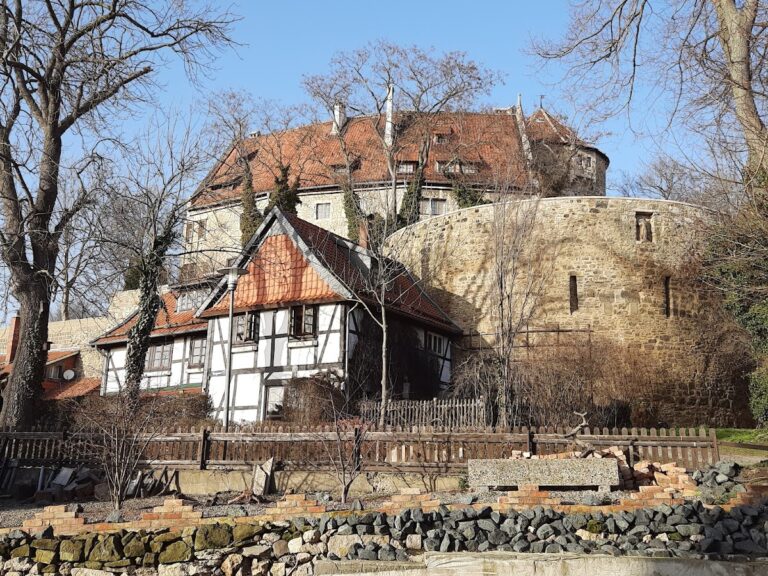
The cloister adjoins the south side of the church and, with its adjoining rooms, encloses a large rectangular courtyard. The buildings have solid ground floors with round-arched windows and timber-framed upper storeys. The rebuilding after the fire of 1676 is commemorated by construction inscriptions, including the extensive gold-lettered Latin inscription around the upper storey of the cloister.
Mill and agricultural industry
Historic distillery
The distillery has produced grain spirit and liqueurs since 1682. Grain from the monastery’s own cultivation is combined with clear well water, kiln-dried barley malt, and wheat before fermentation and two distillations. The resulting fine spirit has an alcohol content of 96 percent, and is diluted with water from the monastery well to 38 percent and aged for at least one year in oak barrels in the old crypt. Plant, fruit, and herb extracts, sometimes prepared according to older recipes, are used for the liqueurs. A steam engine more than a century old assists production during winter.
Brewing and mill leat
Brewing continued on the monastic estate until 1803. The tradition returned in 2004 with naturally cloudy Wölti-Bräu produced at the Altenau Brewery. The Klostergutsbrauerei Wöltingerode company took over the Altenau operation on 1 August 2012 and sold it in 2021.
The former mill building now houses the salmon information center and its exhibition on salmon and other native fish. The mill leat remains part of the site’s water system, linking the monastery grounds with the Oker.