Chancelade Abbey of Our Lady of the Assumption: An Augustinian Monastery in France


Site at a Glance
- Rating
- 4.5
- Popularity
- Low
- Country
- France
- Primary era
- Early Modern
- External website
- Open
- Eras represented
- Medieval, Early Modern, Modern
- Civilizations
- French
- Site type
- Religious
- Remains
- Monastery
On this page13 sections
History
Chancelade Abbey of Our Lady of the Assumption is a Roman Catholic Augustinian abbey in Chancelade, France, whose development extended from the tenth or eleventh century into the twelfth. The monastic foundation traditionally dates to around 1096, while the principal monastery began after 1128. Its history includes medieval expansion, destruction during the French Wars of Religion, a seventeenth-century revival, and the return of an Augustinian community in the modern era.
From hermitage to Augustinian abbey
Around 1096, Abbot Foucault opposed Pope Urban II’s proposed transfer of the monks of Saint-Pierre de Cellefrouin to Charroux. The move would have changed their observance from the Rule of Saint Augustine to the Benedictine rule. Foucault withdrew as a hermit to a spring called Fons Cancellatus, meaning “enclosed spring.” Other monks joined him there, forming the community that came to be associated with Chancelade Abbey.
Gérard de Montlau became the community’s first abbot in 1128 after receiving his blessing from Guillaume d’Auberoche, bishop of Périgueux. The canons then resolved to construct the monastery, its enclosed conventual buildings, the abbey church, and a nearby parish church. In 1133, the community formally adopted the Rule of Saint Augustine and became part of the congregation of Augustinian canons, clergy living in community under that rule.
The abbey church was dedicated to the Virgin Mary, while the parish church was dedicated to Saint Mary Magdalene. Raymond de Mareuil consecrated both churches on 12 October 1147. Around 1140, Geoffroi de Cauzé donated the lands of Merlande to the canons. They built a chapel beside a spring there, and the chapel was soon enlarged into a priory.
War and reconstitution
In 1360, Chancelade had 22 religious members and placed itself under the protection of Cardinal Hélie de Talleyrand-Périgord. His gift of 3,800 gold florins supported the recruitment of 38 additional canons. The abbey was soon drawn into the conflict between England and France during the Hundred Years’ War, a prolonged struggle for control of territories in France.
English forces occupying Périgueux expelled the monks between 1360 and 1367 and installed a garrison in the monastery. Bertrand du Guesclin, a French military commander associated with the reconquest of English-held territories, recovered the abbey after returning from Spain. After his departure, the English retook it and held it until the fifteenth century. Around 1440, the community was reconstituted under the protection of Arnaud de Bourdeille through the efforts of Abbot Geoffroy de Pompadour.
Destruction and seventeenth-century revival
During the French Wars of Religion, a series of conflicts between Catholics and Protestants in sixteenth-century France, Huguenot forces captured Périgueux in 1575. Langoiran seized Chancelade Abbey, which was pillaged and burned. The crossing, its dome, and the bell tower were the only parts of the abbey church to survive the attack. The nave vault and the Romanesque choir were destroyed.
When Alain de Solminihac took possession of the abbey in 1614, only four monks remained. After receiving his abbatial blessing from François de La Béraudière at Saint-Front Cathedral in Périgueux in 1622, he rebuilt the damaged church, reconstructed the cloister, residences, and service buildings, and reorganized the community. He also recruited new members. In 1635, he resisted incorporation into the Congregation of France, also known as the Génovéfains, an Augustinian reform founded by Cardinal de La Rochefoucauld. Chancelade was permitted to continue as an independent congregation.
Louis XIII appointed Solminihac bishop of Cahors on 17 June 1636. He returned to Chancelade in 1638 to consecrate the rebuilt church. His later recognition included beatification by Pope John Paul II on 4 October 1981. The rebuilding associated with his abbacy accounts for much of the church and conventual complex visible today.
Scholarship, Revolution, and renewed community
Under Abbot Jean IV Antoine Le Gros de Beler, who led the abbey from 1730 to 1763, the monks were encouraged to pursue scholarly study. The library acquired cartularies, manuscript collections of charters and institutional records, together with about 4,000 books. In the scriptorium, the room used for copying manuscripts and organizing documentary materials, texts and charters were copied and classified.
The Reverend Father Joseph Prunis discovered Michel de Montaigne’s travel journal in an old trunk in the library tower. Montaigne was a sixteenth-century French writer and philosopher. The journal was published in Rome in 1774. During the French Revolution, the abbey was sold as national property in 1790. Many documents went to the Bibliothèque nationale de France, where they form a collection of 183 volumes, while several hundred works, including a copy of the cartulary, entered the municipal library of Périgueux. The former abbey church became a parish church at the beginning of the nineteenth century.
Restoration of the conventual buildings began in 1955 under Mr. and Mrs. Caignard. The abbey reopened to pilgrims and the public in the 1970s. Augustinian canons of the congregation of Saint-Victor, an Augustinian reform tradition, re-established a community at Chancelade in 1998. In 2004, the diocese acquired the abbot’s residence and park from the Caignard family for development as a spiritual center. A new community house was completed in 2016, and the abbot’s residence was renovated between 2019 and 2025.
The present community maintains prayer and worship in the abbey church, including Lauds and Vespers, and serves the parishes of Saint Peter-Saint Paul des Rives de l’Isle and Saint Vincent sur Beauronne. Its members also undertake ministries in schools, colleges, and medical centers. The community comprised seven brothers in March 2006 and eight canons were living permanently at the abbey in December 2025.
The abbey church was classified as a historic monument in 1909. Later protections, issued between 1942 and 2008, extended to the Logis de Bourdeilles, the abbot’s residence, other buildings, the enclosure, gardens, terraces, entrance, bridge, mill, Abbey Square, and Route des Carrières. The Logis de Bourdeilles and the abbot’s residence were classified in their entirety in 2008, while other parts received classification or registration in 1959 and 2006.
Remains
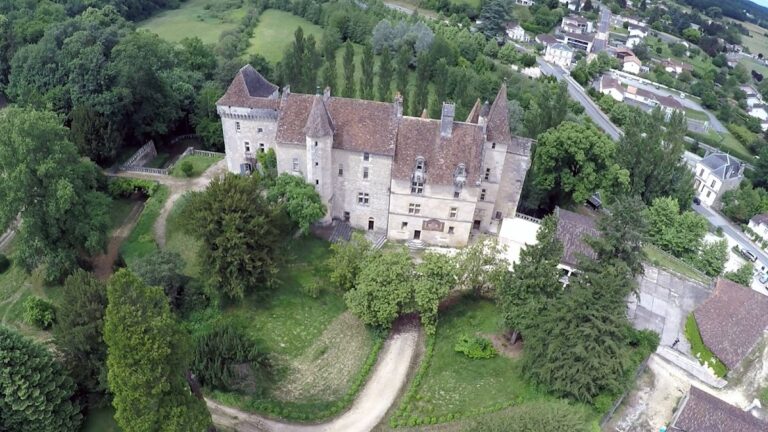
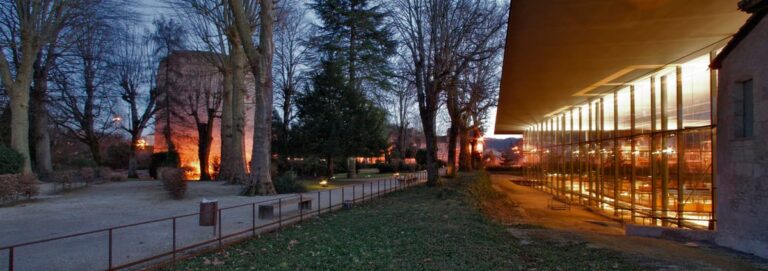
The surviving complex brings together a remodeled Romanesque abbey church and parts of the conventual buildings, including the presbytery. Its fabric reflects construction and alteration from the twelfth through the seventeenth centuries. The church underwent major changes in the fourteenth, sixteenth, and seventeenth centuries, while the wider grounds retain terraces, gardens, an enclosure, an entrance gate, a bridge over an arm of the Beauronne, and a spring associated with the abbey’s foundation tradition.
Abbey church
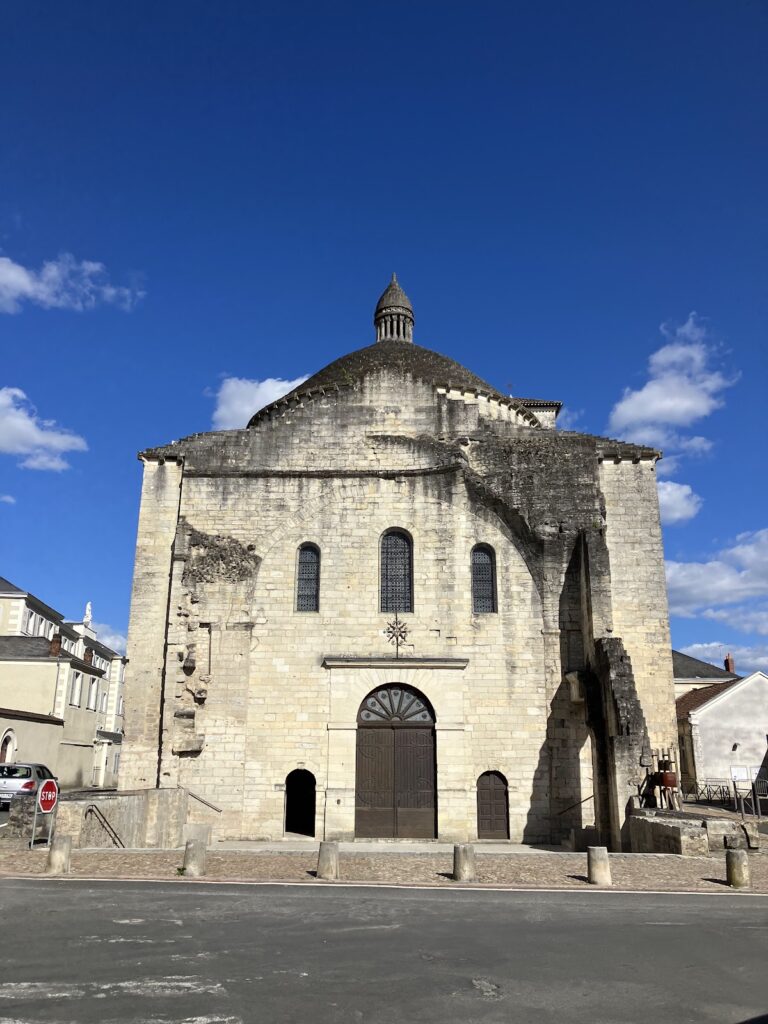
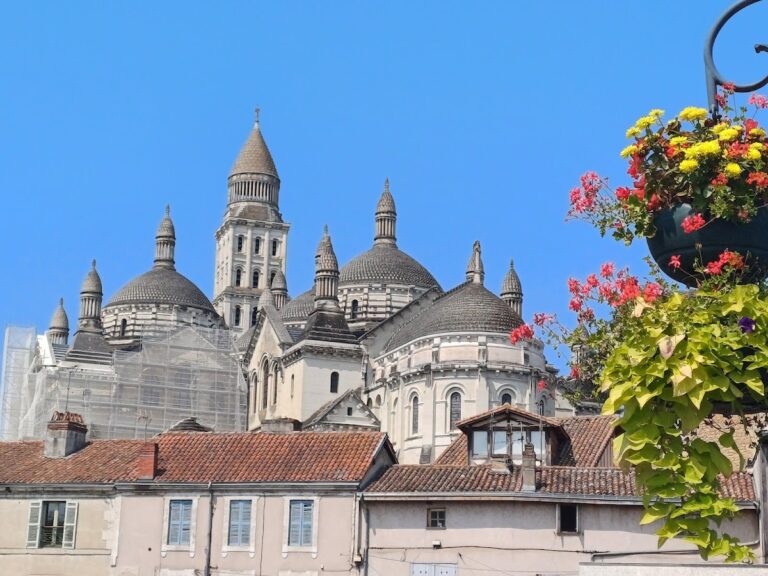
The abbey church is a Romanesque cruciform building oriented east-southeast. Romanesque architecture is a medieval European style characterized by massive masonry, simple geometric forms, and relatively small openings. The lower wall sections and windows belong to the twelfth-century church. The nave received a ribbed vault divided into five bays in 1630. At the crossing, a dome rests on pendentives, curved triangular supports that carry a dome over a square space, and the crossing also supports a square bell tower.
The choir was entirely rebuilt in the seventeenth century, when a sacristy was added. Its walnut choir stalls contain 64 seats, and frescoes occupy the area above them. The church also houses Christ Mocked, a seventeenth-century painting successively attributed to Georges de La Tour, Gerrit van Honthorst, or a member of Honthorst’s workshop. The painting was reportedly given to Alain de Solminihac by Louis XIII.
Chapel across the square
The Chapel of Saint John stands about 50 metres southwest of the abbey church entrance, across the square. Consecrated in 1147, it is a small twelfth-century Romanesque building measuring 19 by 5 metres. It was originally roofed with stone slabs. Inside, a pointed barrel vault covers the chapel, while the semicircular apse has a hemispherical vault. A cross-bearing sheep motif appears on the facade. The chapel was separately protected as a historic monument in 1912.
Conventual and service buildings
Logis de Bourdeilles
The Logis de Bourdeilles is attached to the northwest corner of the abbey church and now serves as the presbytery. It was built in the fifteenth century and substantially remodeled in the seventeenth century.
Abbot’s residence
The Logis de l’Abbé incorporates a section begun in the thirteenth century and renovated in the eighteenth century. This three-level building has a ground-floor gallery formed by eight basket-handle arches.
Western service buildings
The western service buildings include a vat house, cellar, residential building, and mill. The large fifteenth-century vat house received a lowered barrel vault in the seventeenth century. The cellar dates from the fourteenth century and was given a groin vault, a vault formed by intersecting curved surfaces, in the seventeenth century.
A seventeenth-century residential building extends at right angles from the cellar and adjoins the fortified mill. Parts of the mill date from the fourteenth century, while other sections were altered in later centuries. The rectangular structure spans the full width of a diversion of the Beauronne and is fed by that watercourse. Some of its Romanesque openings were later blocked.
Grounds and foundation spring
The abbey grounds contain terraces, gardens, an enclosure, an entrance gate, and a bridge over an arm of the Beauronne. Beside the road, a memorial stele to Alain de Solminihac marks the spring associated with Fons Cancellatus, the place linked to Abbot Foucault’s withdrawal and the foundation tradition of Chancelade Abbey.
Nearby sites