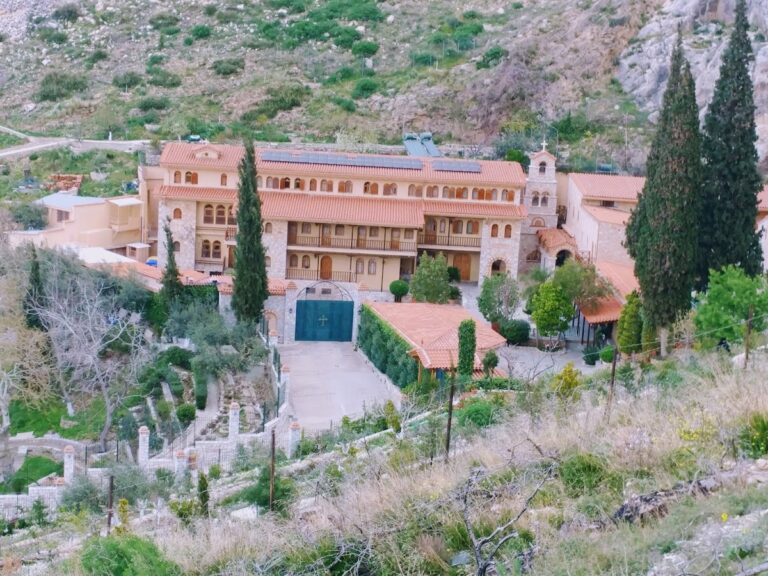
Zoodochos Pigi Monastery, Poros: An Orthodox Monastic Foundation


Site at a Glance
- Rating
- 4.6
- Popularity
- Very Low
- Country
- Greece
- Primary era
- Early Modern
- Eras represented
- Early Modern
- Civilizations
- Ottoman
- Site type
- Religious
- Remains
- Monastery
On this page9 sections
History
Zoodochos Pigi monastery, Poros, is an Orthodox monastery in Greece founded in 1720 by Jacob II, Metropolitan of Athens, beside a spring believed to have healing powers. Its name, meaning “Life-Giving Spring,” is an epithet of the Virgin Mary in Eastern Orthodox Christianity. The foundation followed Jacob II’s recovery after drinking from the spring, and the monastery became an important religious institution on Poros.
Earlier Foundations and Ecclesiastical Authority
Jacob II visited an older monastery at the site, dedicated to the Taxiarchs, the archangels Michael and Gabriel. This earlier foundation probably dated from the fourteenth century. In 1733, Zoodochos Pigi was placed under the jurisdiction of the Ecumenical Patriarchate, the Eastern Orthodox patriarchate historically based in Constantinople, now Istanbul. It is identified as an Orthodox monastery belonging to the Metropolis of Hydra, Spetses and Aegina, an ecclesiastical jurisdiction overseen by a metropolitan of the Church of Greece.
The Greek War of Independence and Its Aftermath
During the Greek War of Independence, the nineteenth-century struggle that established Greece as an independent state from Ottoman rule, the monastery offered spiritual and financial support to the fighters. It also sheltered monks from Dionysiou Monastery on Mount Athos, a monastic peninsula in northern Greece. The monks brought church treasures to safety, including part of the relics of Saint John the Baptist, the Christian prophet and ascetic traditionally associated with baptizing Jesus.
In 1828, Ioannis Kapodistrias, the first governor and ruler of independent Greece, established an orphanage within the monastery walls. The institution housed 180 children whose parents had died while fighting for Greek independence. The first theological school to operate at the monastery opened in 1830. After the Revolution, the monastic settlement was formally attached to the municipality of Kalavreia in 1834. It now falls within the Municipality of Poros. The 2021 census recorded five monks, compared with 28 in 2011.
Twentieth-Century Monastic Life
Saint Nektarios of Aegina, a Greek Orthodox bishop and ascetic who became widely venerated as a saint, stayed at the monastery for several months in the early twentieth century. Ephraim Stenakis served as abbot from 1985 until 14 January 2001.
Remains
The monastery occupies a lush hillside setting in southern Poros, at an elevation of 67 metres. It stands about four kilometres from Poros town and approximately four kilometres east-northeast of the port. The complex is associated with the healing spring that shaped its foundation, while its principal church provides the main architectural focus.
Monastery Church
Katholikon
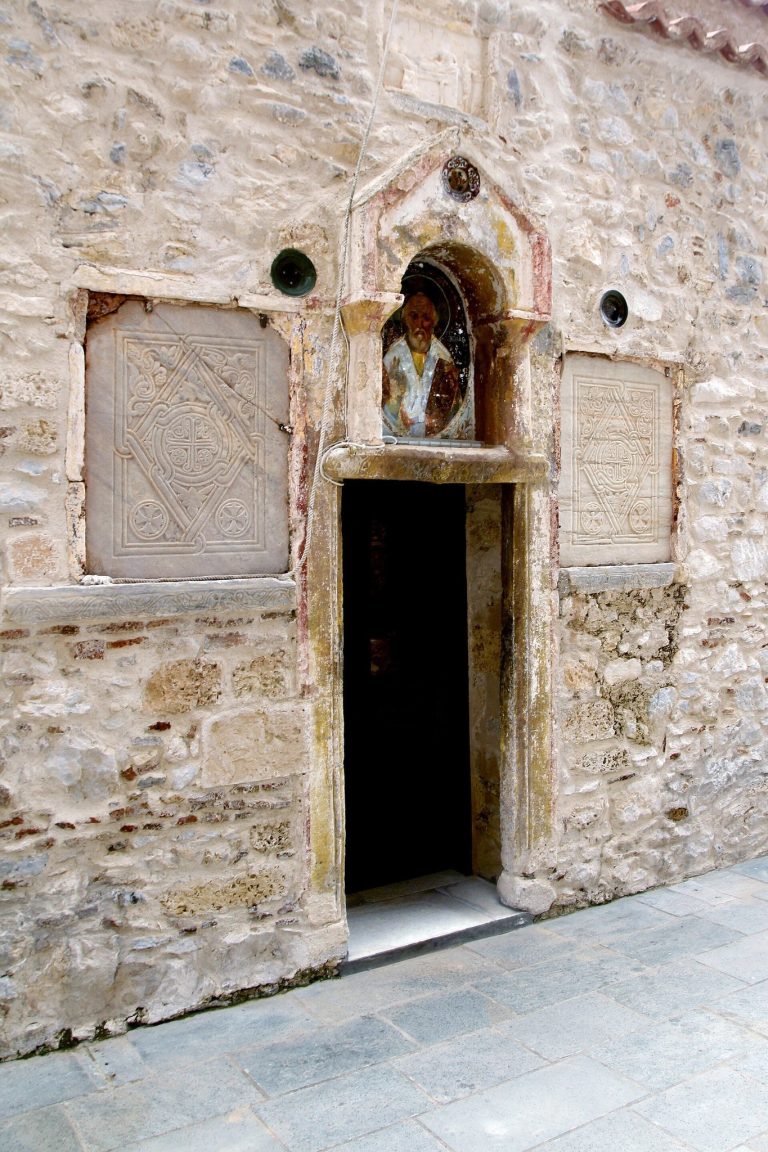
The katholikon, or principal church of an Orthodox monastery, is Byzantine in style and has the form of a domed basilica. A tower-like bell tower rises with the church, and the southern wall carries a sundial made by the monastery’s abbot Galaktion Galatis. At the entrance are the tombs of Nikolis Apostolis and Manolis Tombazis, admirals who took part in the Greek War of Independence.
Iconostasis
Inside the church, a carved wooden iconostasis, the screen of icons separating the sanctuary from the main body of an Orthodox church, reaches approximately five metres in height.
Icons and Collections
The monastery’s religious objects include the miracle-working icon of Panagia Zoodochos Pigi, dated 1650. Panagia means “All-Holy” and is another title for the Virgin Mary. Other important icons include Panagia Amolintos from 1590, an image of the Virgin Mary and Jesus made in 1849 by the Italian artist Raphael Tsekoli, and an icon of Christ Pantokrator dated 1780. Pantokrator means “Ruler of All” and is a traditional title and depiction of Christ.
A library forms another part of the monastery’s collections, alongside the church and its religious furnishings.