Le Vieux-Moulin: A Historic Watermill on Vernon’s Medieval Bridge


Site at a Glance
- Rating
- 4.5
- Popularity
- Medium
- Country
- France
- Primary era
- Medieval
- External website
- Open
- Eras represented
- Medieval, Early Modern
- Civilizations
- French
- Site type
- Economic
- Remains
- Watermill
On this page9 sections
History
Le Vieux-Moulin is a former watermill in Vernon, France, built around the sixteenth century in a half-timbered architectural form on the remains of the town’s medieval bridge over the Seine. The bridge and its associated structures helped secure the river’s right bank and connected Vernon with Vernonnet, a settlement incorporated into Vernon in 1804.
The medieval bridge
The bridge supporting the mill was constructed in the twelfth century and was traditionally attributed to Philip Augustus, the common English name of Philip II, king of France from 1180 to 1223. It replaced an older crossing possibly dating to the reign of Henry I, Duke of Normandy. Parts of the medieval bridge ran parallel to the Seine rather than directly across its course, reflecting the complex arrangement of the crossing near the Île du Talus, an island in the river.
The bridge was not a single isolated structure. Several buildings were integrated into it, including the mill that later became Le Vieux-Moulin. The crossing remained an important connection between Vernonnet and Vernon until the nineteenth century.
From working mill to historic landmark
The present building functioned as a hanging-wheel watermill, using a suspended wheel whose height could be adjusted to changing river levels and currents. During the nineteenth century, changes in milling technology ended its original use, and the machinery was removed. Le Vieux-Moulin is the last surviving witness of the mills that once stood at this location.
Between 1925 and 1930, the mill belonged to Jean Nouguès, a French composer and writer of theatrical revues. He had a barge converted into a dance hall and moored nearby, but the vessel sank after an accident on 6 February 1927. Nouguès sold the mill in 1930 to the American William Griffin.
After Griffin died in 1947, the city of Vernon restored the building, which had suffered substantial damage during military operations in the Second World War. The mill and surviving bridge remains have formed part of a classified natural site since 1943. They are also recorded in the French General Inventory of Cultural Heritage under reference IA27000182, while the mill and bridge were listed as historic monuments by an order dated 22 September 2025.
Remains
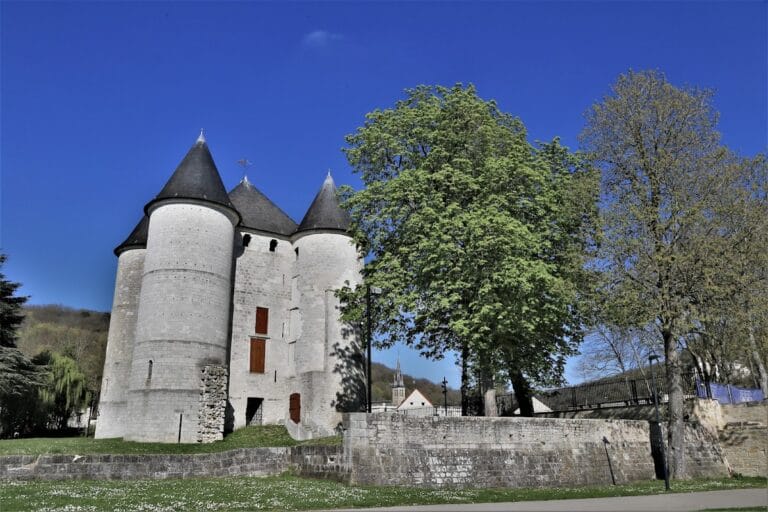
Le Vieux-Moulin is a two-story half-timbered house set directly above the surviving remains of the medieval bridge. It stands on two massive bridge piers on the right bank of the Seine, near the Île du Talus and within sight of the Château des Tourelles, a historic castle in Vernon. The building’s steep roof and position over the bridge give it the form of a house-bridge, an uncommon surviving architectural arrangement in France.
Surviving bridge structures
The orphan arch
In front of the mill stands the orphan arch, the last surviving arched section of the former bridge system. Its position preserves a visible part of the crossing that once extended across the Seine toward the island.
The bridge piers
Four further surviving piers extend behind the mill toward the Île du Talus. Together with the two piers beneath the building, they show how the mill was incorporated into the wider bridge complex.
The mill house
The mill was originally fitted with a hanging water wheel, known in French as a roue pendante. The wheel is no longer preserved, and the internal machinery has been completely removed, leaving the building and its bridge-mounted structure as the principal surviving physical evidence of its former milling function.
Monet’s view of the mill
Around 1883, Claude Monet, a leading French Impressionist painter known especially for landscapes, depicted the mill and its surroundings in several paintings. One of them, Maisons sur le vieux pont à Vernon, is held by the New Orleans Museum of Art.