Zočište Monastery: A Serbian Orthodox Healing Shrine in Kosovo


Site at a Glance
- Rating
- 4.9
- Popularity
- Low
- Country
- Kosovo
- Primary era
- Medieval
- Eras represented
- Classical, Medieval
- Civilizations
- Byzantine, Roman, Serbian
- Site type
- Religious
- Remains
- Monastery
On this page9 sections
History
Zočište Monastery is a Serbian Orthodox male monastery in Kosovo, located in the village of Zočište about 5 kilometres southeast of Orahovac. Dedicated to Saints Cosmas and Damian, Christian healer saints traditionally associated with treating illness, it belongs to the Eparchy of Raška and Prizren, the Serbian Orthodox diocese covering the historical Raška and Kosovo–Metohija regions. The monastery’s foundation is generally dated to the fourteenth century, during the rule of the Nemanjić dynasty, and it became known as a shrine connected with healing.
Early Christian and Medieval Foundations
The monastery stands on a site with a much older religious history. Archaeological work at the location of the present church uncovered early Christian funerary monuments from the fourth century, together with pottery dating from the third and fourth centuries. The monastery was built over the remains of an older Byzantine sanctuary. An earlier church dedicated to Saint Nicholas is dated to the thirteenth century.
The foundation of the present monastery is generally placed in the fourteenth century, although its patron is unknown. A later tradition claimed that the church was three centuries older than Dečani and originated in the eleventh century, but the building itself is dated to the fourteenth century. The earliest written reference to Zočište comes from 1327, in a charter issued by Stefan Dečanski, the medieval Serbian king of the Nemanjić dynasty.
A second fourteenth-century church within the monastery was dedicated to the Presentation of the Virgin, the Christian feast commemorating the presentation of the Virgin Mary in the Temple. The monastery also possessed a fifteenth-century liturgical book. It was held in the National Library until the library was destroyed by bombing on 6 April 1941, when the book was lost.
Damage, Rebuilding, and Later Reconstruction
Zočište was damaged during the Battle of Kosovo in 1389. The monastery was rebuilt in the second half or late sixteenth century, after the restoration of the Serbian Patriarchate of Peć. It was mentioned in the late seventeenth century by the Ragusan merchant Nikola Bošković, and another reconstruction took place in 1860.
The monastery suffered severe upheaval during the Kosovo conflict in 1998. In July, the Kosovo Liberation Army, an Albanian armed organization active in the conflict, attacked while about thirty elderly Serbs, seven monks, and a nun were sheltering inside. The attack lasted approximately 45 minutes and damaged the communal building with two grenades. The monks resisted with four rifles for about two hours before surrendering, and those inside were taken to a school in nearby Semetište.
Thirty-five abducted Serbs were released on 22 July 1998, followed by another ten during the night of 29–30 July. The fate of an estimated forty others remained unknown in 2001. In 2005, the remains of 47 victims were excavated from two mass graves.
After the Kosovo War, the monastery was looted and destroyed in 1999. The brotherhood building was burned in June, while the two churches were destroyed with explosives in September, principally on 13–14 September. The monks were evacuated, and the brotherhood temporarily moved to Duboki Potok Monastery. The relics of Saints Cosmas and Damian were transferred to Sopoćani Monastery. The main bell was thrown into a well, while icons and liturgical vessels were recovered and placed in Velika Hoča. The violence also damaged the Serbian cemetery and houses in the surrounding village.
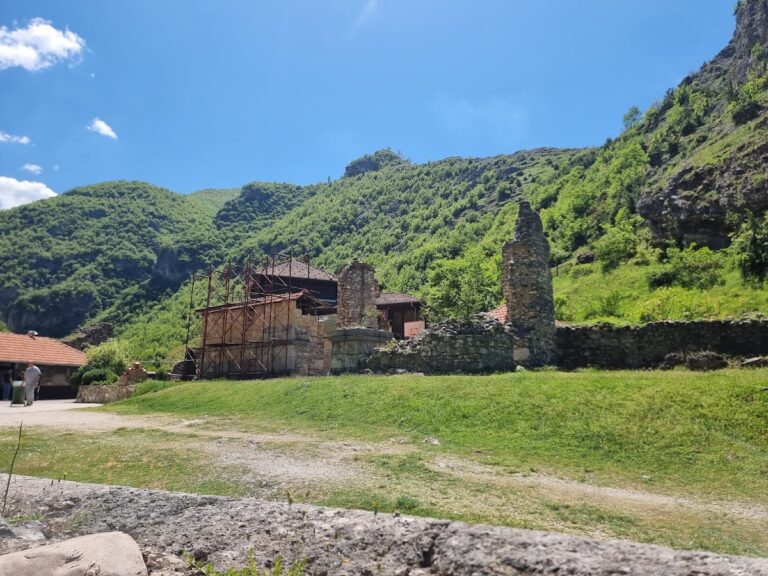
The monks returned under the protection of KFOR, the NATO-led international peacekeeping force deployed in Kosovo in 1999, on 17 October 2004. Archimandrite Stefan Milenković and the brotherhood have administered the monastery since 20 May 2004. Reconstruction began in October 2004, using stones and fragments from the ruined church and consolidating its existing foundations. KFOR halted the work in 2005 because of opposition from the local population, but construction resumed after the ban was lifted.
By 2006, the brotherhood building and the Church of Saints Cosmas and Damian had been rebuilt. Bishop Artemije of Raška and Prizren consecrated the restored monastery on 14 July 2007, and further restoration followed in 2008. A religious service held among the ruins of the church on 14 June 2002 was followed by another fire at the site. After restoration, the church and grounds were enclosed with barbed wire installed by KFOR.
Healing Tradition and Heritage Status
Zočište’s religious reputation is closely connected with the relics of Saints Cosmas and Damian. The shrine was believed to help cure eye diseases and mental or psychosomatic disorders. The name Zočište is associated with a spring believed to have healing water for the eyes. After the displacement of the Serbian population from the village, the monastery was chiefly visited by people from Velika Hoča and Orahovac, foreign visitors, and local Albanians who also venerated the relics because of their healing reputation.
The monastery was designated Cultural Heritage of Serbia in 1954 and is registered as an immovable cultural property. It was added to Kosovo’s list of Special Protective Zones on 20 February 2008. On 13 November 2007, a bus carrying about thirty students was stoned outside the monastery.
Remains
Church of Saints Cosmas and Damian
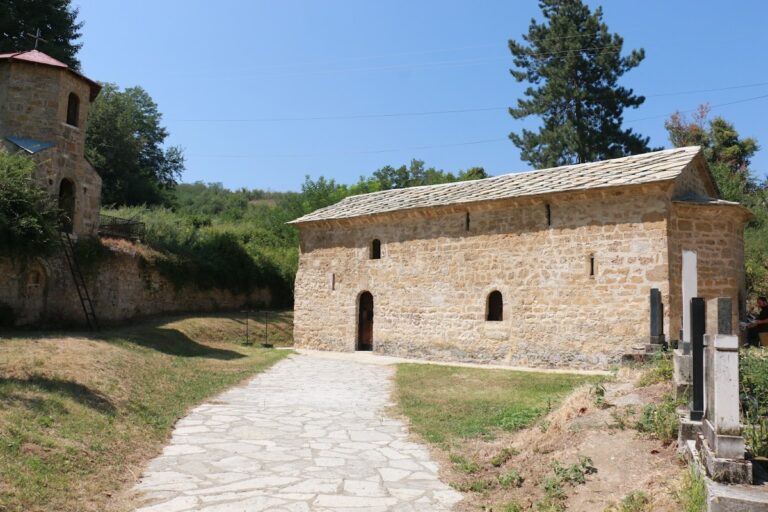
The reconstructed Church of Saints Cosmas and Damian stands within an old Serbian graveyard. It follows the form of the destroyed building and incorporates original stones and fragments from the ruins. The structure has a rectangular plan and a single nave covered by a linear barrel vault, a continuous semicircular or segmental vaulted roof. At the east end is an apse, while the narthex, the entrance or vestibular space of the church, was somewhat wider and higher than the main body.
The walls were built from dressed or irregularly cut stone bonded with lime mortar and covered by stone-slate roofing. Two niches beside the altar table served the prothesis, where the Eucharistic offerings were prepared, and the diaconicon, used for liturgical storage and service. After the church was remodeled as a funerary chapel, it contained a table for a coffin and seats for mourners.
Frescoes
Partially preserved frescoes of high artistic quality belong to the fourteenth century, the period of the church’s foundation. A frieze of prophets extended through the decoration, while images of Saints Cosmas and Damian appeared in the vault and in a niche above the western entrance to the narthex. These paintings are the oldest surviving frescoes associated with the church’s foundation period.
The southern wall carried images of Saint Nicholas, Saint Paraskeva, two Holy Warriors, and part of an officiating archbishop. Holy Warriors are warrior saints represented as armed soldiers. The western wall showed Saint Sava and Saint Simeon Nemanja, while the northern wall contained the Vision of Saint Peter of Alexandria. On the eastern wall was the Archangel Gabriel from the Annunciation, and a niche in the prothesis contained an image of an archdeacon.
Cemetery and Archaeological Remains
The church is surrounded by an old Serbian cemetery whose tombstones date from the fifteenth and sixteenth centuries. The cemetery was damaged or destroyed during the violence of 1999. Beneath and around the church site, archaeological remains include early Christian funerary monuments from the fourth century and pottery from the third and fourth centuries, placing the location within a much earlier religious and settled landscape.
Relics and Ecclesiastical Objects
The monastery held a collection of valuable icons and other ecclesiastical objects. Many were destroyed in 1999, while surviving icons and liturgical vessels were removed to Velika Hoča for safekeeping. The relics of Saints Cosmas and Damian, central to the monastery’s healing tradition, were transferred to Sopoćani after the destruction and are associated with the monastery’s religious identity.
Nearby sites