Church of Saint Nicholas in Velika Hoča: A Medieval Serbian Orthodox Church


Site at a Glance
- Rating
- 5
- Popularity
- Very Low
- Country
- Serbia
- Primary era
- Medieval
- Eras represented
- Medieval, Early Modern
- Civilizations
- Ottoman, Serbian
- Site type
- Religious
- Remains
- Church
On this page12 sections
History
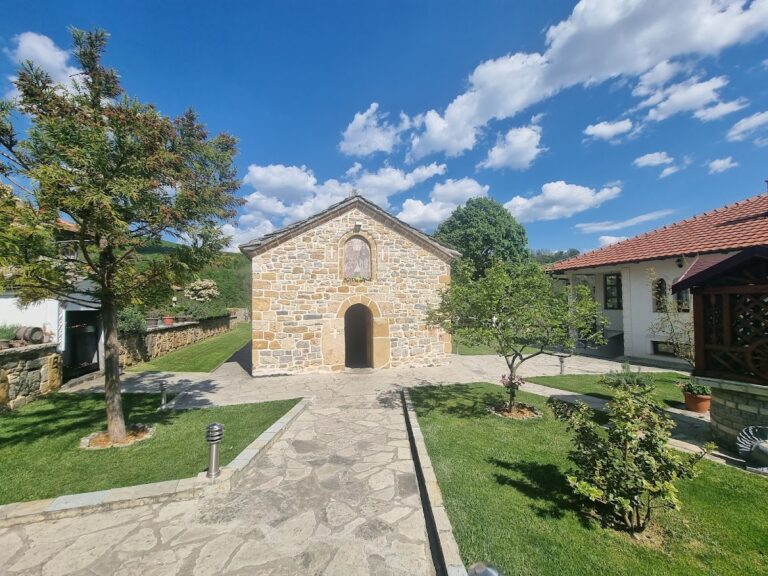
The Church of Saint Nicholas in Velika Hoča is a Serbian Orthodox church in Serbia, built and painted by 1345 during the period of the medieval Serbian state under King Dušan. It stands in the cemetery above the village and belongs to the Eparchy of Ras-Prizren, an ecclesiastical district governed by a bishop. Its early frescoes and later renovations preserve several phases of Serbian Orthodox religious and artistic history.
Foundation and fourteenth-century painting
The church was probably founded by the parents of Gradislav Sušenica during the second quarter of the fourteenth century. Gradislav was a čelnik, a high-ranking official in the medieval Serbian court, and is considered the probable patron of the frescoes. The date of the building and its decoration is established by the burial of Marta, Gradislav’s mother, who was a nun. She was buried in the church by 1345, and her tombstone preserves the record of her burial.
The original paintings are stylistically associated with the reign of King Dušan, also known as Stefan Dušan, whose rule saw major political and cultural development in the medieval Serbian state. The fresco program included scenes from the life of Saint Nicholas, as well as a composition of Saint Sava and Saint Simeon Nemanja bowing before an icon of the Virgin and Child. Saint Sava was the first archbishop of the autocephalous Serbian Church, while Saint Simeon Nemanja, his father, founded the medieval Nemanjić dynasty. An icon of the Virgin and Child is attributed to the same general period.
Sixteenth-century renovation
The church was renovated in the second half of the sixteenth century. The work added the upper zones of the walls and the vault, and the interior was then repainted by two painters whose abilities were unequal. Their models came from the painters who decorated the renovated narthex, or entrance antechamber, of the Peć Patriarchate in 1561. This artistic connection places the later decoration within the regional tradition associated with the Peć Patriarchate and the Dečani monastery.
The church probably received three throne icons by Longin in 1577. Longin was a sixteenth-century Serbian Orthodox icon painter. Around the same period, an artist from the Peć-Dečani circle painted an icon of the Deesis, a composition showing Christ with the Virgin and Saint John the Baptist in intercession. The dating and circumstances of the installation of this iconostasis, the screen separating the sanctuary from the main body of an Orthodox church, remain uncertain.
Nineteenth-century furnishings and conservation
The present iconostasis was carved and painted in 1825 by Petar of Debar, who signed the beam separating its upper zones. It was made to accommodate an existing icon of Saint Nicholas. That icon was later transferred to the Church of Saint Stephen in Velika Hoča. The church therefore contains evidence of both the medieval and later traditions of Orthodox image-making.
Building-conservation work took place from 1970 to 1973 under the Provincial Institute for the Protection of Cultural Monuments of Kosovo. Between 1970 and 1975, damaged frescoes were repaired, fourteenth-century paintings were uncovered and conserved, and part of the sixteenth-century fresco layer was transferred to a new support and moved to the museum at Dečani Winery in Velika Hoča. The church is protected as a cultural monument of exceptional importance in Serbia and is also listed in Kosovo as a protected archaeological cultural-heritage site under designation number 02-237/58.
Remains
The church is a single-nave building with a barrel vault. Its apse has a polygonal exterior and a semicircular interior. The former wall separating the narthex from the nave has been removed, leaving the two areas connected. The surviving paintings and the later iconostasis reveal how the building’s interior was altered and redecorated over several centuries.
Medieval structure and frescoes
Building form
The simple single-nave plan is enclosed by walls supporting the barrel vault, while the polygonal outer form of the apse contrasts with its semicircular interior. The narthex occupies the western part of the church. Fourteenth-century fresco fragments remain on its west and south walls, on the base of the altar table, and on the north wall of the nave. A further portion of the original decoration is preserved on the west wall.
Fourteenth-century images
The early frescoes include episodes from the life of Saint Nicholas and the scene in which Saint Sava and Saint Simeon Nemanja bow before the Virgin and Child. The related icon of the Virgin and Child belongs to the same general period. These paintings and the icon preserve the church’s medieval devotional program, even though the frescoes now survive in fragmentary form.
Later decoration and furnishings
Sixteenth-century fresco layer
The later paintings include full-length saints and busts of saints set within medallions. They also contain cycles devoted to the Great Feasts, the principal festivals of the Orthodox liturgical year, the Passion of Christ, and the life of Saint Nicholas. In the narthex, the decoration includes the Akathist of the Virgin, a cycle of hymns and devotional images honoring the Virgin Mary, together with scenes of Christ’s miracles and parables and a representation of the Last Judgment.
1825 iconostasis
Petar of Debar’s 1825 iconostasis is carved and painted. Its throne icons, the principal icons in the lower section of an Orthodox iconostasis, were painted in oil on canvas stretched over wooden panels. The other painted parts were executed in oil on wood. A cross with a painted Crucifixion occupies the third zone of the screen.
Burial beside the altar
A grave beside the church, behind the altar, bears an inscription dated 1766. It forms part of the physical evidence surrounding the building and complements the earlier burial of the nun Marta, whose tombstone records her interment by 1345.
Nearby sites