Zhao Mausoleum: Tang Imperial Tomb of Emperor Taizong
Site at a Glance
- Rating
- 3.9
- Popularity
- Very Low
- Country
- China
- Primary era
- Medieval
- Eras represented
- Medieval, Early Modern
- Civilizations
- Ming, Qing, Tang
- Site type
- Burial
- Remains
- Tomb
On this page17 sections
History
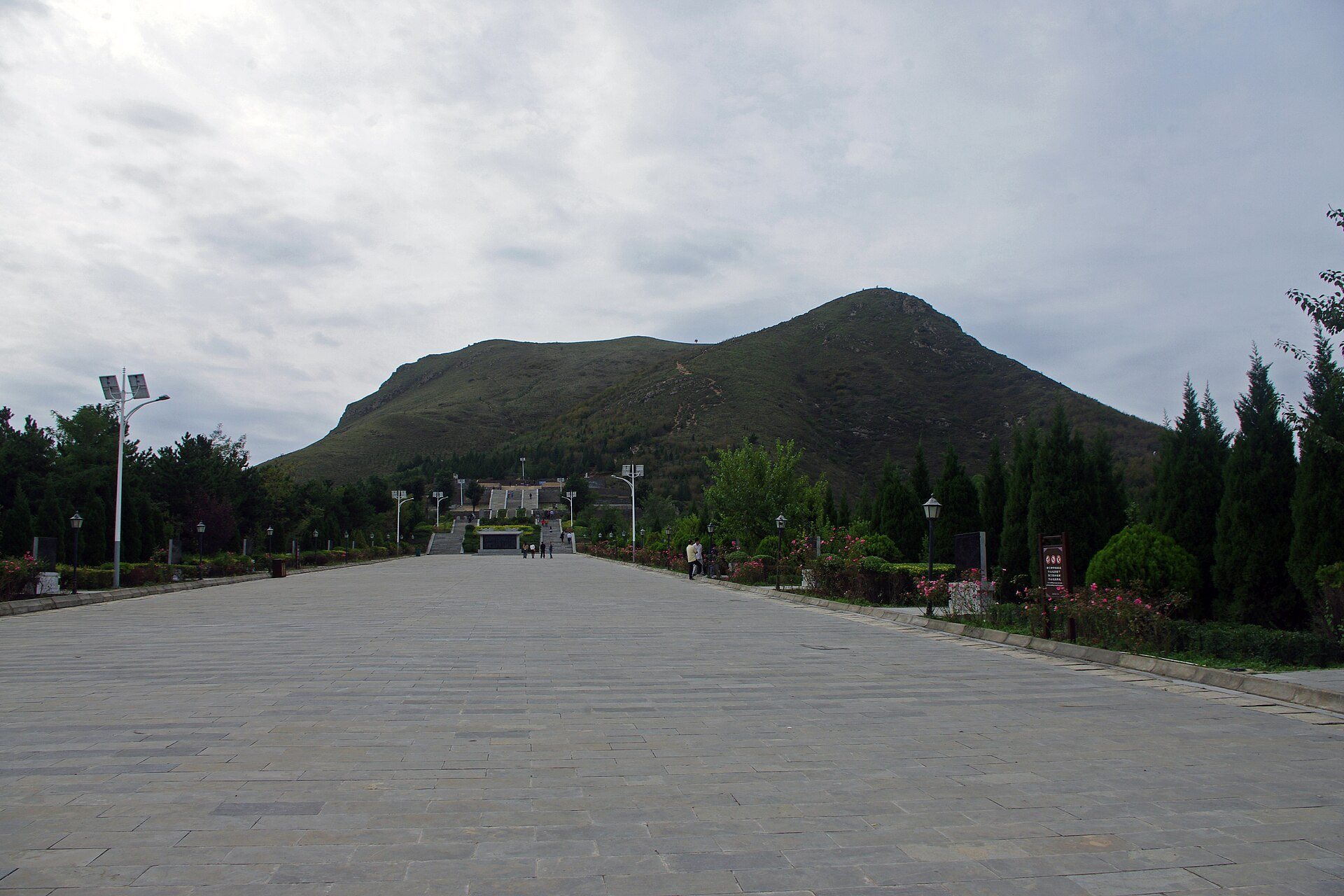
Zhao Mausoleum, also known as Zhaoling, is a Tang-dynasty imperial mausoleum in Jiuzong Mountain near Liquan County in Shaanxi, China. Built during the Tang dynasty, which ruled China from 618 to 907, it became the burial place of Emperor Taizong and Empress Zhangsun, also known as Wende. It is the largest of the eighteen Tang imperial mausoleums in Shaanxi and is probably among the largest royal mausoleums in the world.
Foundation under Empress Wende and Emperor Taizong
The mausoleum began in 636 after Empress Wende died. She had requested burial according to the mountain, without a large artificial mound, and her burial established the site. Construction of Emperor Taizong’s own tomb probably began in 637. Taizong, the temple name of Li Shimin and the second Tang emperor, died on 29 September 649 and was buried at Zhao Mausoleum more than two months later. His tomb was completed in connection with his burial.
Taizong had helped establish the Tang dynasty with his father, Li Yuan, who became Emperor Gaozu, and took power in 627. His military victories and political achievements were commemorated at the mausoleum through equestrian reliefs and official statues. The layout was based on Chang’an, the Tang capital, and Yan Lide and Yan Liben are identified with its design. Yan Liben is also regarded as the probable designer of the Six Steeds reliefs, although both this attribution and his precise role in planning the mausoleum remain uncertain.
Expansion as an imperial cemetery
The complex continued to grow for more than a century after Taizong’s burial. Its associated cemetery eventually contained more than 200 additional burials, including members of the imperial family, consorts, princes, princesses, civil and military officials, foreign officials, and relatives of people buried there. The carefully planned landscape was known as the “City of Cypresses.” Among the eminent officials buried in the cemetery were Wei Zheng, Li Jing, Li Shiji, Fang Xuanling, and Yuchi Gong. Wei Gui, a consort of Taizong, had the closest auxiliary tomb to the main mausoleum, while Wei Zheng had the closest auxiliary tomb belonging to a meritorious official. These were the only two auxiliary tombs described as being built into the mountain.
Plunder, protection, and archaeological investigation
After the fall of the Tang dynasty, Wen Tao, a military commissioner during the Later Liang period, plundered Zhao Mausoleum and other Tang imperial tombs. He described a spacious and richly furnished burial chamber from which books, calligraphy, and other burial goods were removed. His account also indicates painted walls, although the chamber’s complete contents and decoration can no longer be established.
The Tang imperial mausoleums received provincial cultural-property protection in 1956. Zhao Mausoleum was designated a National Key Cultural Relic Protection Unit in 1961 together with Qian Mausoleum. A cultural-management office was established at Li Shiji’s tomb in 1972, and the Zhao Mausoleum Museum was founded there in 1978. Archaeological work took place in 1965, 1982, and 2002, with excavations around the northern platforms continuing in 2002 and 2003. These investigations recovered or identified fragments of the fourteen official statues and clarified the surviving arrangement of the northern entrance area.
Remains
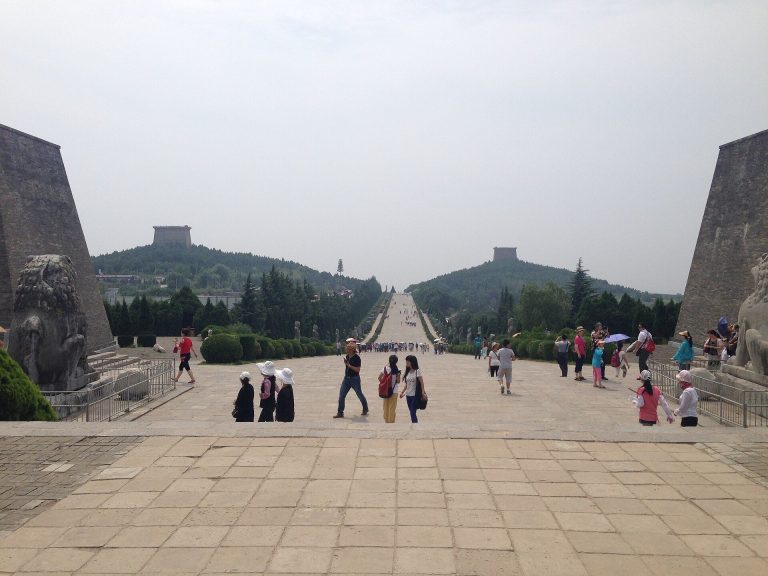
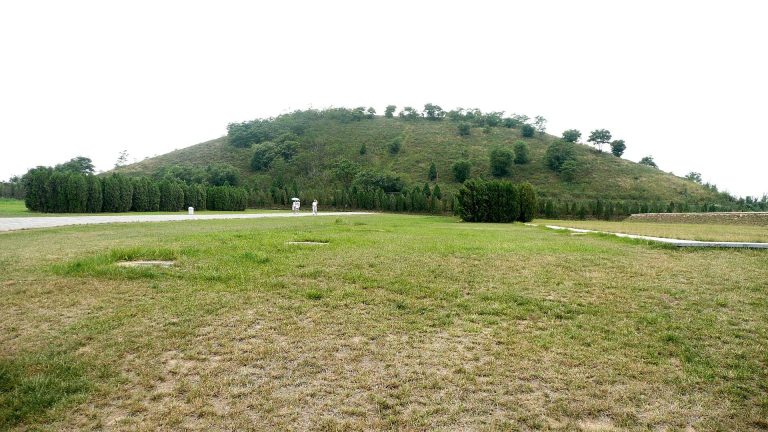
Zhao Mausoleum is organized along a south to north axis with east to west symmetry. Rather than surrounding the burial with a large pyramid-shaped mound, the complex uses Jiuzong Mountain itself. The mountain rises to about 1,200 metres above sea level, with nine ridges descending toward ravines, uneven ground to the east and west, a southern cliff, and a northern slope. The associated cemetery spreads across the plain below the mountain’s southern face.
The mountain tomb and southern ceremonial area
The Xuangong burial chamber
The main burial chamber, known as the Xuangong, was cut into the southern side of Jiuzong Mountain. A passage about 232.5 metres long led to it, while five stone doors sealed the inner burial area. The chamber reportedly consisted of a central room with a side chamber on either side. Stone couches in the side chambers supported stone coffins, which contained metal cases for books, ink, paper, and calligraphy.
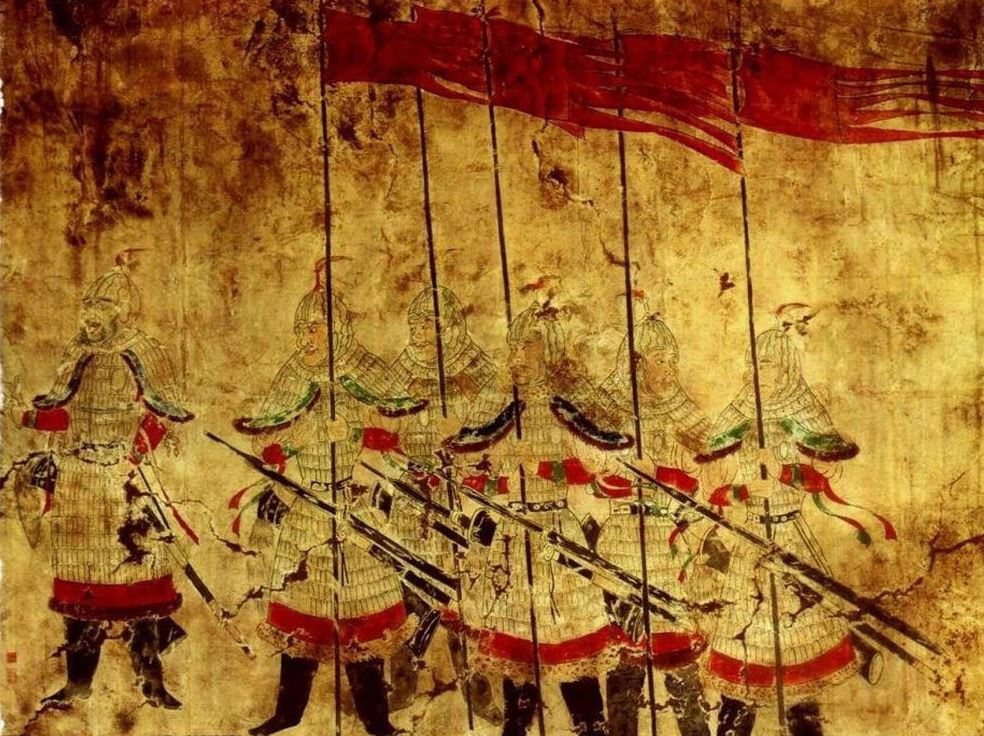
Access to the burial entrance was so difficult that a temporary wooden route had to be constructed along the mountainside and removed after the tomb was sealed. The tomb is now closed, and its exact entrance is unknown. Reports of painted walls, together with comparisons to excavated Tang tombs, suggest that the interior may have contained elaborate murals, but this remains an inference rather than a fully established surviving feature.
The southern gate and Offering Hall
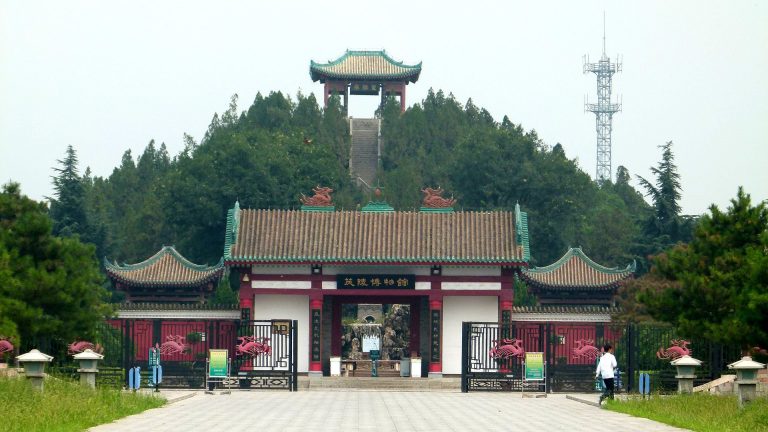
The principal ceremonial structures stood beside the southern cliff. They included the southern gate, two tower gates, and the Xiandian, or Offering Hall, where ceremonies of homage and sacrifice were performed. The hall had foundations measuring about 40 by 40 metres and was probably approximately 10 metres high. Three doors opened on its southern side, and traces of wall paintings were found among its remains.
The watchtowers
Two watchtowers stood outside the southern gate, which was also called the Vermilion Bird Gate. Each tower measured about 23 metres in diameter, and the towers were approximately 90 metres apart.
The northern platforms
The northern slope contained a terrace about 86 metres from south to north and 61 metres between the eastern and western ravines. Five platforms formed the terrace, with a total height difference of about 31 metres. Most of the mausoleum’s above-ground structures were located in this area, whose western side preserves the clearest remains. Architectural remains from the Tang, Ming, and Qing periods have been identified.
The fourth platform
The fourth platform contained the entrance to the inner burial area. A brick-lined drain inside the gate carried water away from the entrance. The stele of Empress Wende also stands on this platform. It was the first stele installed at the mausoleum, and Taizong composed its text and ordered its production. The monument measures about 1.22 metres high, 0.67 metres wide, and 0.40 metres thick, and it bears an inscription from the Ming dynasty.
The stele was last recorded during the Ming period and was rediscovered in 2001 after roughly five centuries. It appears to have been cut down and reconstructed as a Ming stele. Earlier, its top had six hornless dragons, and the monument had been reused as the base of another stele. Its base, broken into two pieces, was also recovered.
The fifth platform corridors
The fifth platform contained two parallel open corridors, each about 23 metres long and more than 5 metres wide. Eight rows of columns divided each corridor into seven sections. The floor rose by approximately 30 to 40 centimetres between sections to follow the slope of the ground.
The Inner Palace
The Qingong, or Inner Palace, stood southwest of the main mausoleum. It covered about 300 by 240 metres and was enclosed by a wall with three gates, one to the south and two to the north. The complex housed personnel responsible for the mausoleum and was also associated with the imagined residence of the deceased spirit. It burned during the Tang dynasty, after which Emperor Dezong ordered its reconstruction nearly 10 kilometres from Zhao Mausoleum.
Auxiliary tombs and stone monuments
The auxiliary cemetery contains 194 tombs holding more than 200 people. Thirty tombs have been excavated and 74 occupants identified. The tombs belong to five types, ranging from mountain-cut or flat-topped mound tombs decorated with stones and statues, through ordinary circular burial mounds, to simple graves marked by a stone.
The Six Steeds
The Six Steeds are high-relief stone panels showing six warhorses personally selected by Taizong: Quanmaogua, Shifachi, Baitiwu, Telebiao, Qingzhui, and Saluzi. Three horses gallop, two walk, and one stands while a man removes an arrow from its chest. Four of the horses are shown with wounds from arrows received in battle. Their manes use a crenellated pattern, and their saddles have five bands. A square area on each panel bears the horse’s name and a laudatory poem.
The reliefs originally stood in two rows beside the northern entrance and before Taizong’s tomb. They were removed in the 1910s. Four are now displayed at the Stele Forest Museum in Xi’an, while two are held by the Penn Museum in Pennsylvania. Each panel measures approximately 2 metres wide and 1.7 metres high.
The official statues
Fourteen life-size stone statues portrayed officials with individualized facial features, hairstyles, ethnic clothing, and weapons. Excavations recovered about 40 fragments, making it possible to identify thirteen of the fourteen figures. Thirteen heads and eleven torsos have also been restored or recognized. The statues are believed to have been made on the orders of Emperor Gaozong, Taizong’s son and successor, although their exact date remains unknown.
Stelae and stone lions
Other important stone monuments include numerous stelae associated with auxiliary tombs and two stone lions found in a nearby village. A stele is an upright inscribed stone monument. Together with the Six Steeds, the official statues, and Empress Wende’s stele, these monuments preserve the commemorative and funerary program created around the imperial tomb.