Qianling Mausoleum: A Tang Imperial Funerary Complex in China
Site at a Glance
- Rating
- 4.4
- Popularity
- Very Low
- Country
- China
- Primary era
- Medieval
- Eras represented
- Medieval, Early Modern
- Civilizations
- Qing, Tang
- Site type
- Burial
- Remains
- Necropolis
On this page16 sections
History
Qianling Mausoleum is a Tang-dynasty imperial funerary complex in Qian County, Shaanxi, China. Built during the late seventh and early eighth centuries in the Tang imperial tradition, it became the shared burial place of Emperor Gaozong and Wu Zetian, the only woman in Chinese history to rule in her own name as emperor.
Foundation and Imperial Burials
Construction began in 684, after Gaozong’s death in 683, and continued with additions until 706. Wu Zetian appointed Wei Daijia to supervise the works in 683. The principal tomb was designed for Gaozong and Wu Zetian, who was interred there on July 2, 706, after ruling as emperor from 690 to 705. Gaozong had ruled from 649 to 683, while Wu Zetian had first been his empress.
The complex belonged to a wider group of mausoleums associated with the Li imperial family. When Gaozong and Wu Zetian’s son Zhongzong regained the throne in 705, he rehabilitated members of the imperial family who had died during Wu Zetian’s political purges. In 706, he arranged honorable reburials for Li Xian, Li Chongrun, and Li Xianhui, whose attendant tombs were incorporated into Qianling.
Li Xianhui was probably killed at the age of 16 with her husband during Wu Zetian’s reign. After Zhongzong’s restoration, she received a grand tomb at Qianling. The funerary epitaphs of Li Xian, Li Chongrun, and Li Xianhui give their names, ranks, and burial dates, and their references to burial in 706 have helped date the tomb structures and their paintings.
Attendant Tombs and Later Damage
Qianling contains 17 attendant tombs for imperial relatives and senior officials. Five have been excavated: those of Li Xian, Li Chongrun, Li Xianhui, Chancellor Xue Yuanchao, and General of the Left Guard Li Jinxing. Other tombs belong to princes, princesses, imperial relatives, and officials, although the identities of several occupants remain uncertain.
The excavated attendant tombs were opened during the 1960s and early 1970s. Li Xianhui’s tomb was discovered in 1960 and excavated from 1964. Together, the excavated tombs produced more than 4,300 burial objects, including more than 1,000 from Li Chongrun’s tomb. Robbers’ passages were found in the tombs of Li Xian, Li Chongrun, and Li Xianhui, but murals and other surviving objects were later studied and conserved.
The lower palace was looted and burned in 904. It had served as a temporary residence for emperors visiting the mausoleum and as accommodation for palace women and other members of the imperial household. Most of its remains are now agricultural land. The mausoleum precinct was also almost completely damaged by the 1556 Jiajing earthquake, which damaged 60 of its 61 foreign-official stone statues.
Protection and Unexcavated Principal Tomb
The principal tomb repeatedly escaped full looting attempts. Huang Chao reportedly mobilized an army of about 400,000 men during the late Tang period and cut a deep trench without finding the entrance. During the Five Dynasties period, Wen Tao organized the excavation of Tang imperial mausoleums, but Qianling was said to have survived because of the strength of its construction.
Local workers accidentally exposed the entrance passage to the principal tomb in 1958 while using blasting. An excavation committee was established in 1960, but Premier Zhou Enlai directed that the tomb should be left for future generations. A later national policy suspended the excavation of imperial tombs. A proposal to excavate the principal tombs of Gaozong and Wu Zetian was made in 1995 and opposed by most cultural-heritage specialists. In 2012, Shaanxi cultural-heritage authorities announced that no further excavation would take place for at least 50 years, primarily to protect the tomb and its artifacts.
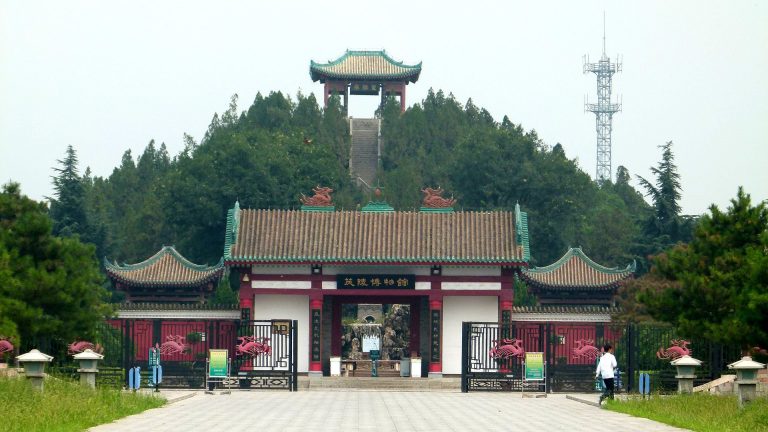
The Tang Eighteen Mausoleums, including Qianling, received Shaanxi provincial protection in 1956, and Qianling entered the first group of National Key Cultural Relics Protection Units in 1961. A local management office established after the excavation of Li Xianhui’s tomb became the Qianling Museum in 1978. Regulations restricting land use and construction within the protected area took effect in 2008.
Tradition associates Qianling with a large quantity of buried treasure. One account says that Gaozong’s collection of calligraphic works, possibly including Wang Xizhi’s Preface to the Orchid Pavilion, was buried with him. Another tradition places that work in Emperor Taizong’s Zhaoling Mausoleum.
Remains
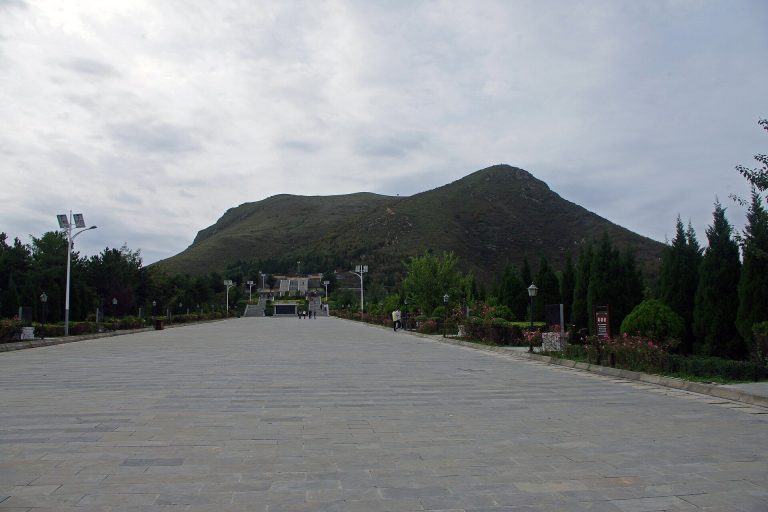
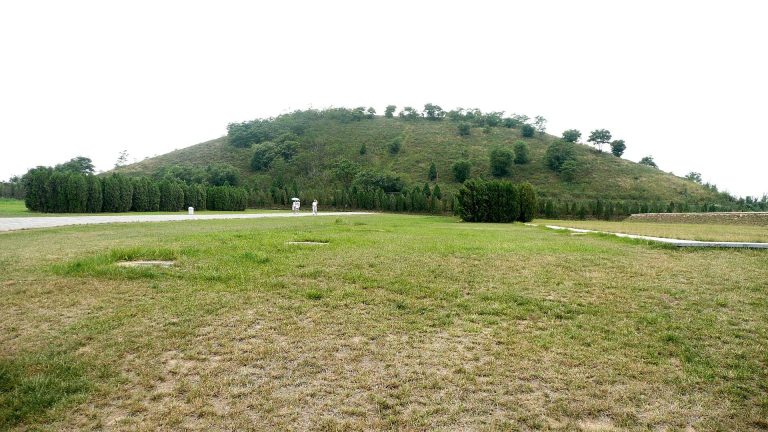
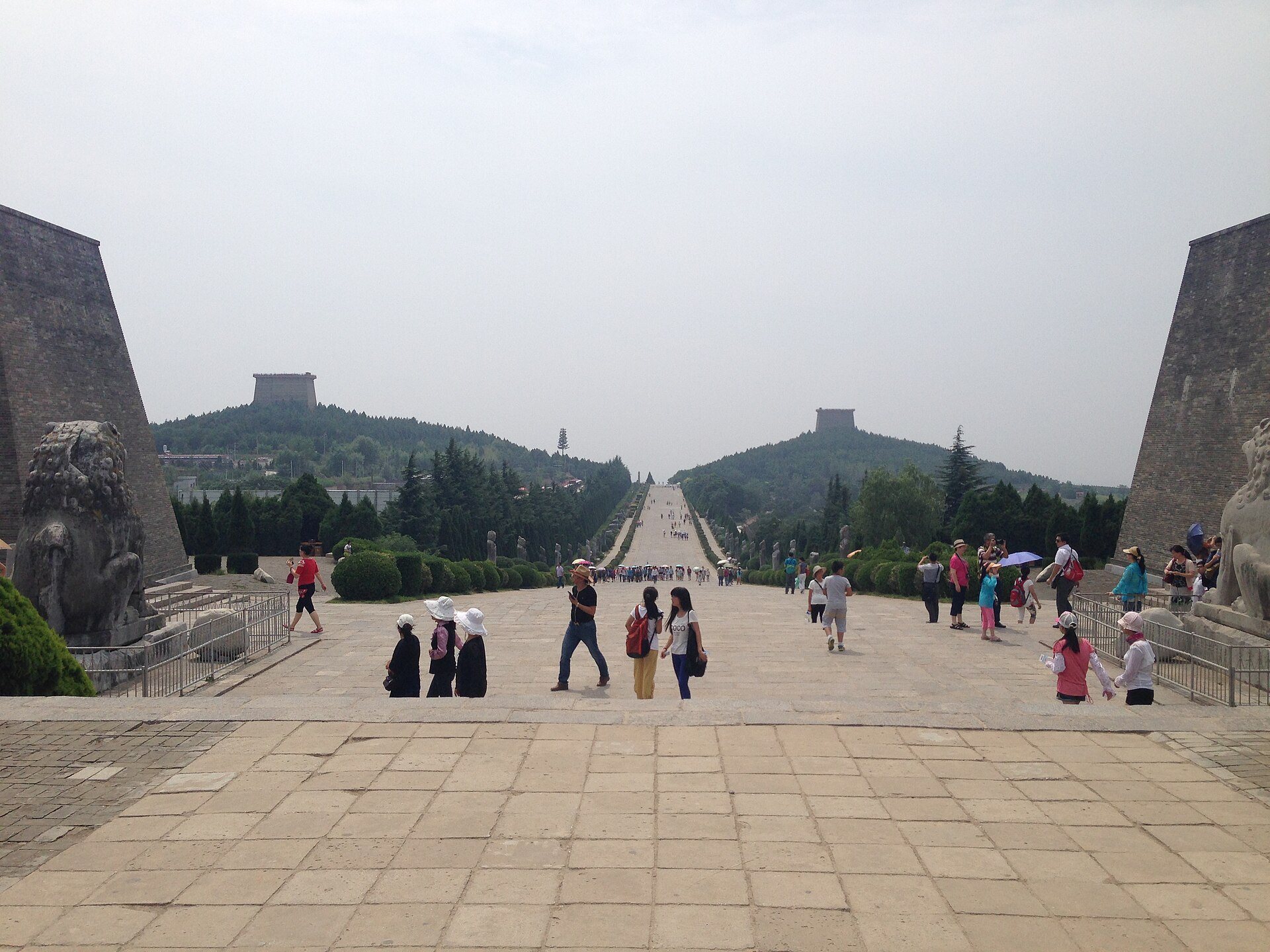
Qianling occupies Mount Liang north of the Wei River, at an elevation of about 1,049 metres. A valley lies to the east and a canyon to the west. The mountain itself forms the principal tomb mound. Its three main peaks organize the complex: the highest northern peak contains the principal underground tomb, while the two lower southern peaks face one another at the entrance area. Their tumuli are known as the Nipple Hills, and towers once stood on their summits.
Mountain Tomb and Enclosures
Principal Tomb
The largest tumulus occupies Mount Liang’s northern peak and marks the burial place of Gaozong and Wu Zetian. A tunnel approximately 61 metres long and 4 metres wide was cut through the mountain rock to reach the underground chambers. The entrance on the southeastern slope was sealed with stone blocks, iron poured into the joints, and rammed earth. The deep mountain burial follows a practice associated with Taizong’s burial in Mount Jiuzong. Fourteen of the 18 Tang emperors used natural mountains as their burial mounds.
Inner and Outer Enclosures
The original complex had inner and outer walls. The inner wall was about 2.4 metres thick and enclosed a roughly trapezoidal area of approximately 240,000 square metres within a perimeter of about 5,920 metres. Four inner-wall gatehouses have been identified. The surviving enclosure extends about 1,450 metres from north to south, while its eastern and western sides measure approximately 1,582 and 1,438 metres. Its southern and southwestern sections are irregular, producing an approximately square plan with modifications.
The inner enclosure followed the plan of Tang Chang’an. Its four gates were associated with the Azure Dragon Gate in the east, the Vermilion Bird Gate in the south, the White Tiger Gate in the west, and the Black Tortoise Gate in the north. Earthen, brick-faced que towers, monumental gate towers associated with authority, stood at the gates. The outer wall ran approximately parallel to the inner wall at a distance of about 220 metres. Its discovery provided the first identification of a double-wall arrangement among the Tang imperial mausoleums.
Spirit Way and Ceremonial Structures
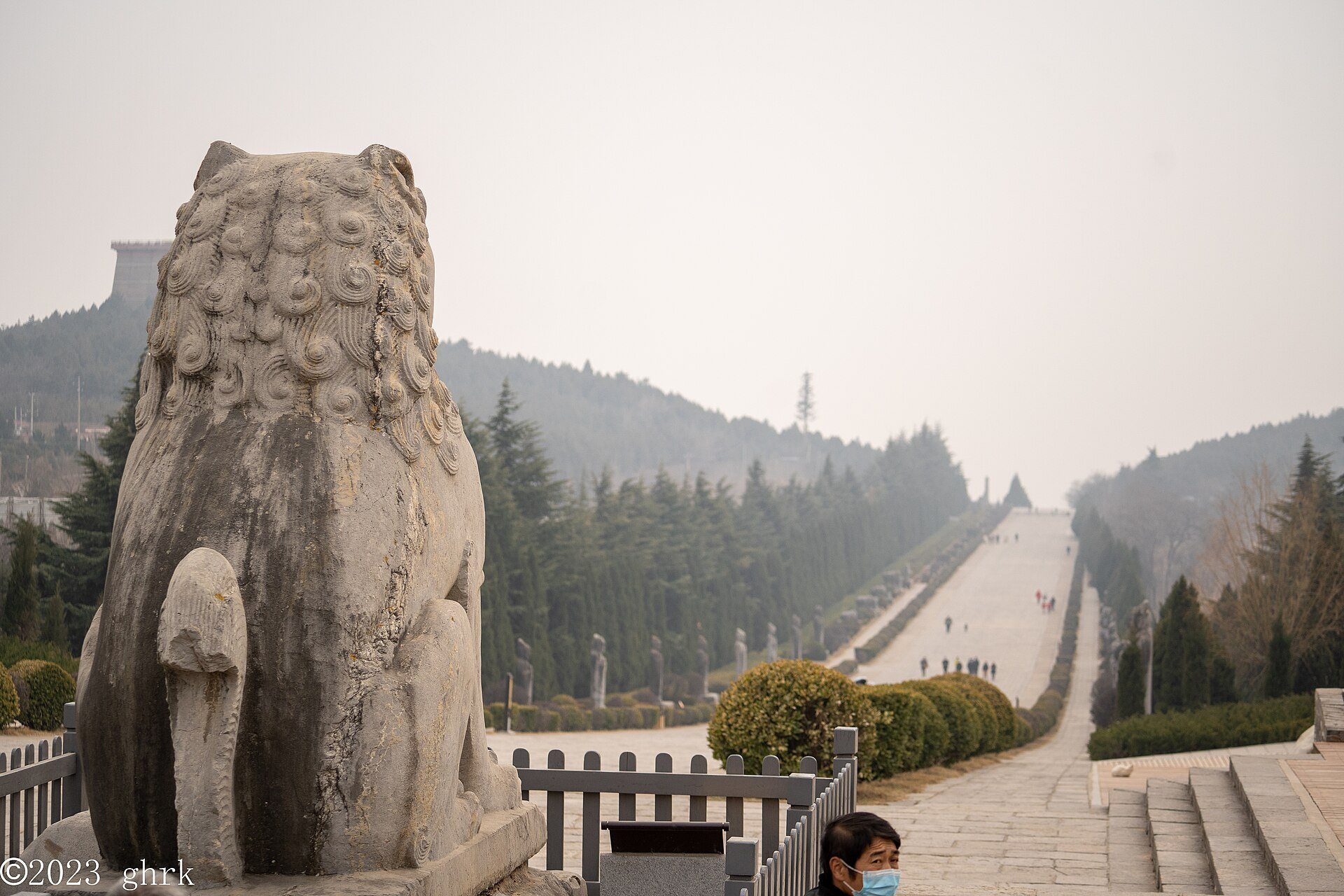
The spirit way, a ceremonial processional route leading to an imperial or elite tomb, extends for approximately 4 kilometres. Three successive gate areas at its southern end symbolically corresponded to the outer city, imperial city, and palace city of Chang’an. The first gate tower survives to about 8 metres in height. The second gate area was built on the southern peaks, originally about 40 metres above the surrounding ground, and surviving structures there reach about 15 metres. The third gate stood near the inner enclosure.
Stone Statues
Pairs of stone columns and statues line the spirit way. They include civil officials, foreign envoys, lions, horses, winged horses, horses with grooms, and ostriches. The arrangement also includes one pair each of ornamental pillars, winged horses, and vermilion birds, five pairs of mounted or led horses, ten pairs of official figures, and a pair of stelae.
Sixty-one foreign-official statues stand north of the third gate. Names of countries and individuals appear on their backs. The figures represent foreign rulers, tribal leaders, and envoys connected with regions administered by Tang frontier protectorates and with states west of the Pamirs. By 2003, the identities of 36 figures had been established. Most statues are now headless, and 60 were damaged in the 1556 earthquake. They are associated with envoys who attended Gaozong’s funeral. The spirit ways of the attendant tombs have fewer, smaller, and less finely made statues.
The ostrich carvings refer to animals presented to the Tang court by the Western Turks in 620 and by the Tushara Kingdom in 650. Reliefs dated around 683 show traditional Chinese phoenixes with bodies modeled on ostriches. Octagonal stone pillars along the route were believed to protect the tombs from evil spirits.
Stelae and Offering Hall
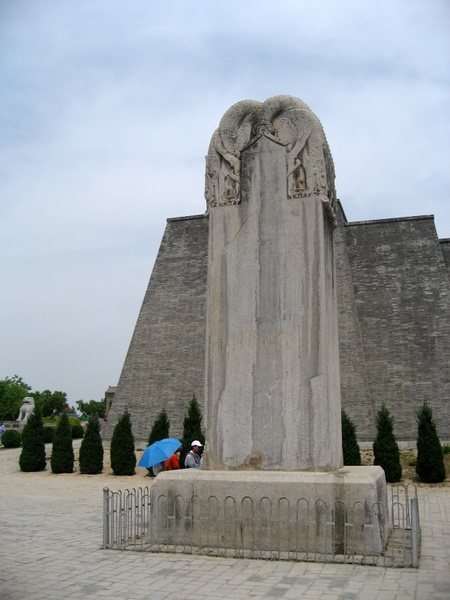
A 6.3-metre-high tiered stele, an upright commemorative stone monument, records Gaozong’s achievements. Wu Zetian’s adjacent stele is uninscribed. The Qianlong Emperor of the Qing dynasty later erected another stele near the principal tumulus. Near the southern gate of the inner wall, remains of a timber offering hall have been found.
A shrine or ancestral hall for 60 court officials stood beside the spirit way near the foot of the eastern southern peak. Its wall paintings have been tentatively associated with memorial portraits of leading officials displayed at the Lingyan Pavilion during Taizong’s reign. During the Tang period, hundreds of residences surrounded the mausoleum. Families living in them maintained the grounds and buildings, and remains of some houses have been discovered.
Attendant Tombs
The attendant tombs generally have truncated-pyramid tumuli above underground chambers reached by descending diagonal ramps. Six vertical shafts in each ramp allowed burial goods to be lowered into side niches. The underground arrangement consists of a main hall leading to two rectangular, brick-lined burial chambers joined by short corridors. The chambers have domed ceilings. Li Xian’s tomb has fully stone-built doors, a type with precedents in Han and Western Jin tombs that became more common during the Northern Qi period.
Li Xianhui’s Tomb
Li Xianhui’s tomb has a flattened pyramid-shaped mound rising about 12 metres above ground. A long, sloping entrance passage lined with murals leads to an antechamber and the main burial chamber, which lies about 12 metres below ground beneath a high domed roof. The tomb yielded 777 pottery figures, including tomb guardians, guardian beasts, mounted men and women, mounted foreigners, musicians, horses, oxen, pigs, camels, and three-coloured glazed figures. Wooden figures, gold objects, horse fittings, and copper floral ornaments were also recovered. One of the four tomb guardians and one of the four guardian beasts could be restored to their original forms.
Li Chongrun’s Tomb
Li Chongrun’s tomb contains more than 50 mural groups covering nearly 400 square metres. The paintings show palace guards, seated attendants, eunuchs, timber architecture, and multi-storeyed que gate towers, as well as a polo scene. Some scenes have been interpreted as possible representations of the Eastern Palace, the residence of the Tang crown prince, and as evidence for the appearance of Tang Chang’an.
More than 600 burial objects came from the tomb. They include glazed and three-coloured glazed pottery figures of women and men, warriors, civil officials, tomb guardians, horses, and horse attendants, together with a glazed flowerpot, a painted tower-shaped jar, ritual vessels, and other pottery. Gilded ceramic horses carry armed and armoured soldiers, while mounted musicians play flutes and trumpets and other riders use whips.
Li Xian’s Tomb
Murals in Li Xian’s tomb depict foreign envoys being received at court and palace women in gardens, with a hoopoe flying overhead. Ceramic civil officials, warriors, and tomb-guardian beasts, all more than 1 metre high, were also found. The paintings and figures preserve evidence of court ceremony, costume, and funerary art.
Murals and Burial Objects
The excavated tombs contain multiple passageways, shaft entrances, vaulted chambers, and extensive wall paintings. Their murals show courtyards, main halls, rooms, corridors, ventilation shafts, partitions, and air wells. The que towers represented in the paintings resemble towers whose foundations were identified at Chang’an.
The tomb of Li Yide yielded more than 1,000 objects, including funerary-text fragments, three-coloured glazed horses, mounted warriors and musicians, gilded-armour horsemen, glazed bowls, ear cups, bottles, inkstones, braziers, plates, wells, house models, jars, gold objects, gilt-copper horse fittings, and iron stirrups. The objects from the attendant tombs, together with their architecture and paintings, preserve material evidence for Tang court life, military display, foreign contacts, and burial customs.
The murals were made by anonymous tomb decorators rather than identified court handscroll painters. Their scenes include age differences, courtly behavior, foreign envoys, palace attendants, urban walls, gates, towers, and court personnel. Alongside the inscriptions and surviving objects, they provide the principal tomb complex and its attendant burials with enduring archaeological importance.