Valongo Wharf: An Archaeological Site of the Atlantic Slave Trade in Brazil
Site at a Glance
- Rating
- 4.6
- Popularity
- Medium
- Country
- Brazil
- Primary era
- Modern
- Eras represented
- Modern
- Civilizations
- Portuguese
- Site type
- Infrastructure
- Remains
- Harbour
On this page12 sections
History
Valongo Wharf is an archaeological site in Rio de Janeiro’s Saúde district, in Brazil, built in 1811 by the General Police Intendancy of the Court of Rio de Janeiro during the period of the Atlantic slave trade. It became the principal landing place for enslaved Africans arriving in Rio and is identified as the only surviving material remains associated with the arrival of enslaved Africans in the Americas. UNESCO added the site to the World Heritage List in 2017 under criterion (vi), which recognizes direct associations with events, traditions, ideas, beliefs, or works of outstanding significance.
Relocation to Valongo
Until the mid-1770s, enslaved Africans disembarked at Praia do Peixe, near present-day Praça XV, and were sold in public on Rua Direita in central Rio de Janeiro. In 1774, Dom Luís de Almeida Portugal, the second Marquis of Lavradio and viceroy of Brazil, ordered the market’s relocation to Valongo. He objected to newly arrived Africans entering the city through its principal streets. The market was established in the Valongo area in 1779.
Before the wharf was constructed, enslaved people were taken from the customs house by boat to Valongo and forced to come ashore directly on the beach. The stone landing place built in 1811 allowed ships to land captives at Valongo itself. It operated as both a landing place and a slave-trading site until 1831.
Peak of the slave trade
The movement of captives through Valongo expanded sharply after the Portuguese royal court moved to Brazil in 1808. Rio de Janeiro’s population then grew from about 15,000 to 30,000. Between 1811 and 1831, approximately 500,000 to one million enslaved Africans were landed at Valongo. Disease, inadequate food, and the inhumane conditions of the Atlantic crossing caused many others to die during the voyage.
Valongo received captives from Angola, East Africa, and Central-West Africa, while Maranhão and Bahia received ships from Guinea and West Africa. The trade reached its peak in the late 1820s. Brazil received approximately 4.9 million enslaved people through the Atlantic slave trade, making Valongo its largest receiving port and a major entry point of the African diaspora.
Closure and transformation
Under British pressure, Brazil prohibited the transatlantic slave trade in 1831, and Valongo was closed for the landing of enslaved people. The trade continued clandestinely, however, and Brazilian authorities largely tolerated it until the prohibition of 1850. The last illegal slave ship was recorded in 1856. Slavery in Brazil was abolished in 1888.
In 1843, the landing place was renovated for the arrival of Princess Teresa Cristina of Bourbon-Two Sicilies, who was to marry Emperor D. Pedro II. Teresa Cristina and her brother Leopold arrived in Rio de Janeiro on 3 September 1843 and were received there by the emperor and his retinue. The renovated landing place was renamed Cais da Imperatriz, or Empress Wharf.
From approximately 1850 to 1920, the area around the former wharf was occupied by enslaved and formerly enslaved Black people from different national backgrounds. The composer and artist Heitor dos Prazeres later called the area Pequena África, or Little Africa. In 1911, large-scale urban reforms led by Mayor Pereira Passos buried Empress Wharf, covering the archaeological remains of the earlier landing place beneath the later structure.
Rediscovery and memorialization
Archaeological research began in connection with the revitalization of Rio de Janeiro’s port area. In 2010, Brazil’s National Institute of Historic and Artistic Heritage, known as IPHAN, requested an archaeological research project. Excavation began on 25 January 2011 across much of the present Praça Jornal do Comércio and confirmed the area’s archaeological importance. The site was registered with an area of 2,545.98 square metres.
The excavations rediscovered Valongo Wharf and Empress Wharf in a superimposed sequence. IPHAN and the Municipality of Rio de Janeiro prepared the nomination dossier for UNESCO, and the site was inscribed on the World Heritage List at UNESCO’s 41st session in 2017. It is treated as an open-air memorial to the trafficking of enslaved Africans across the Atlantic and to the African cultural inheritances that emerged from this history. Its rediscovery also brought renewed recognition to traditions and communities associated with African religious practice, capoeira, samba, and Afro-Brazilian music and dance.
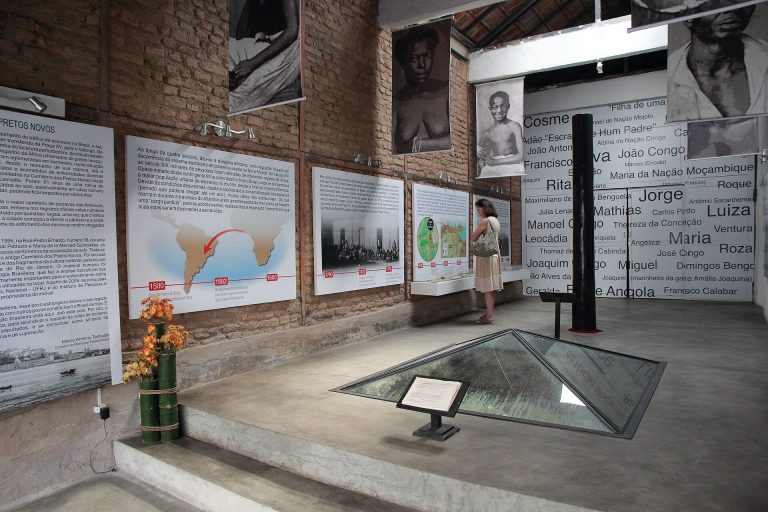
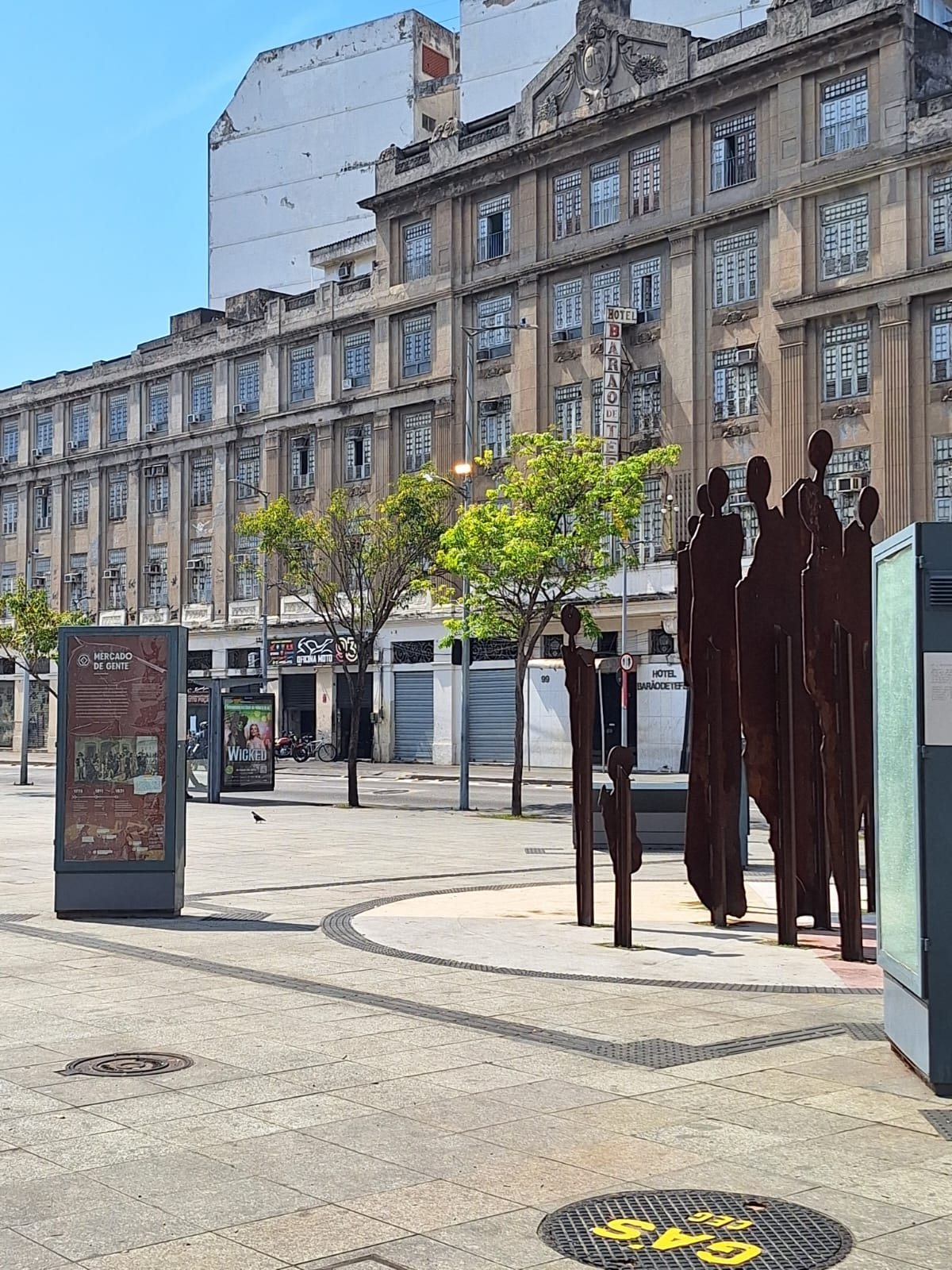
After the rediscovery, the site faced criticism over inadequate conservation and the lack of a comprehensive museum project. In 2018, it was at risk of losing its World Heritage status because agreed conservation measures and a planned museum in the Pedro II warehouses had not been completed. Works completed in November 2023 addressed flooding and improved the presentation of the site with new railings, lighting, and UNESCO-standard information signs. They also introduced the exhibition Valongo, Cais de Ancestralidades, which explains the wharf’s history and its relationship to Little Africa, together with a memorial sculpture of human figures forming the outline of Africa.
Remains
Layered landing structures
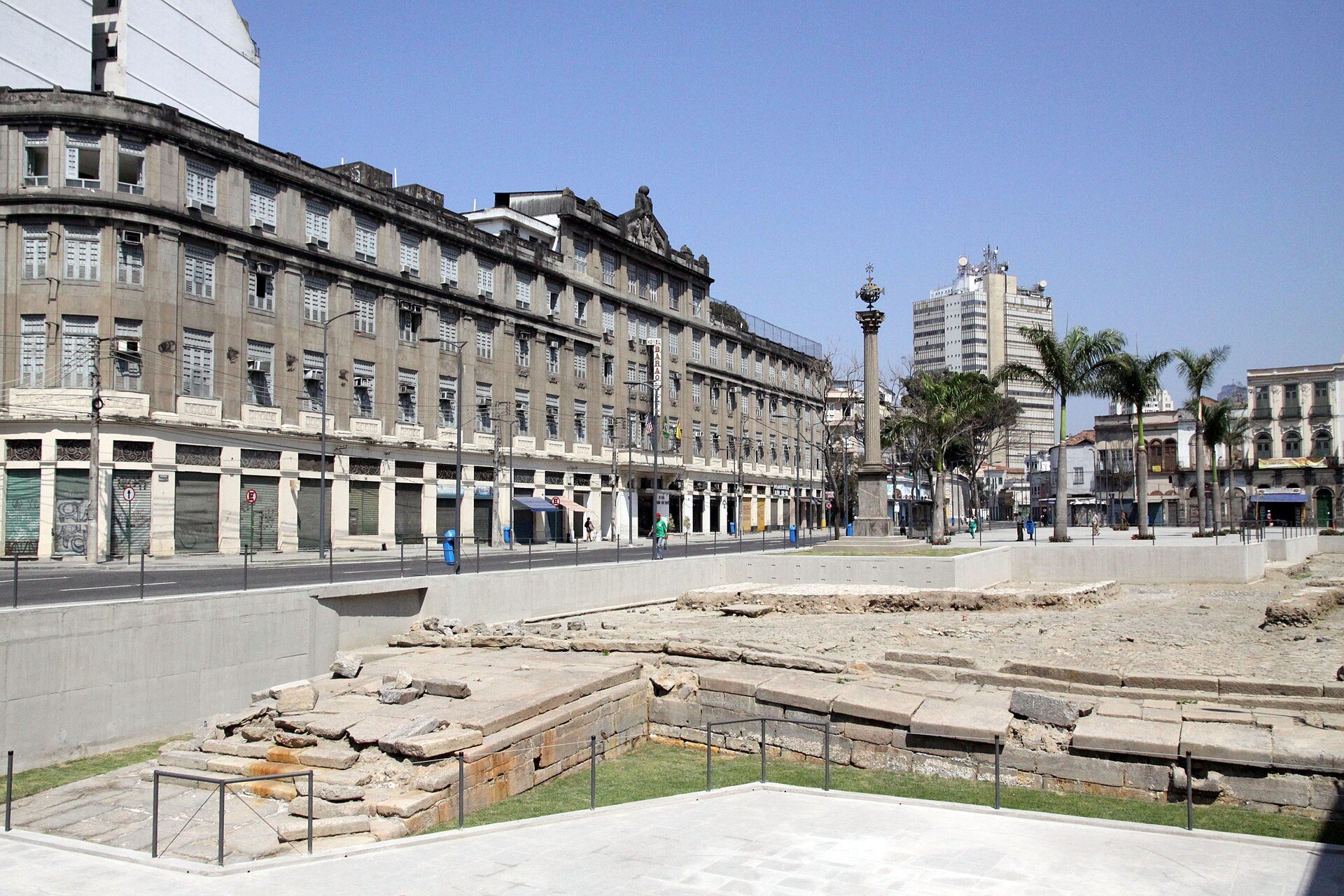
The archaeological site lies in Rio de Janeiro’s port district between present-day Coelho e Castro Street and Sacadura Cabral Street. The UNESCO property covers approximately 0.3895 hectares, with a buffer zone of approximately 41.6981 hectares. Excavation revealed two landing structures arranged one above the other, preserving the physical relationship between the 1811 wharf and the later structure created for the imperial arrival.
Valongo Wharf
Valongo was a stone landing wharf constructed in 1811 so that enslaved Africans could be brought ashore directly at the site rather than transferred by boat from the customs house to the beach. Its surviving archaeological remains form the lower part of the layered complex and provide material evidence of the forced arrival of Africans in the Americas.
Empress Wharf
In 1843, an embankment approximately 60 centimetres thick was laid over Valongo to create a new anchorage for Princess Teresa Cristina’s arrival. This later landing structure became known as Empress Wharf. It was subsequently buried during the early twentieth-century urban reforms, leaving it physically superimposed above the earlier wharf.
Archaeological excavation
The 2010–2011 project monitored the full extent of Praça Jornal do Comércio and excavated 110 sectors and six trenches. Both mechanical and manual methods were used. Concrete and upper rubble were removed mechanically, while sediments from archaeologically rich layers and from areas above the Valongo pavement were screened. Other layers were inspected visually.
Recovered objects and cultural evidence
Excavation produced approximately 1.2 million artefacts associated with everyday life, religious symbolism, cultural interaction, and resistance among enslaved Africans. The finds include protective objects and ornaments such as figas, crucifixes, beads, claws, cowrie shells, crystals, earrings, and bracelets. An apotropaic object, such as a protective amulet, was believed to guard its wearer or user against danger or harmful forces.
Many of the amulets and cult objects originated from the Congo, Angola, and Mozambique. Together, they reveal encounters among African cultural traditions whose communities had not necessarily been in direct contact before forced displacement, as well as interactions with Brazilian society. The collection was cleaned, identified, classified, numbered, inventoried, packaged, and stored in labelled containers. It is held provisionally at Galpão B, a municipal facility in Rio de Janeiro’s port area near the archaeological site, under the safeguarding responsibility of the Institute of Rio Heritage and the Municipality of Rio de Janeiro.
Contemporary installations
The surviving remains are presented with protective railings, lighting, and information signage. A memorial sculpture added in 2023 represents human figures forming the outline of Africa. These installations accompany the archaeological evidence and the interpretation of Valongo as a memorial to the forced movement of Africans and the cultural histories that developed in its aftermath.