Tomb of Huo Qubing: A Western Han Memorial Tomb in Shaanxi
Site at a Glance
- Rating
- 4.5
- Popularity
- Very Low
- Country
- China
- Primary era
- Classical
- Eras represented
- Classical
- Civilizations
- Han
- Site type
- Burial
- Remains
- Tomb
On this page13 sections
History
The Tomb of Huo Qubing is a Western Han burial monument in Xingping, Shaanxi, China, established in 117 BC within the funerary complex of Emperor Wu’s Maoling Mausoleum. The Western Han was the earlier major phase of the Han dynasty, which ruled much of China from 206 BC to AD 9. The tomb commemorates Huo Qubing, a Han general who died at the age of twenty-four and became famous for victories over the Xiongnu, a powerful confederation of steppe peoples, during the wars of 121 to 123 BC.
Huo Qubing and the imperial memorial
Huo Qubing was the nephew of Lady Wei, a favored consort of Emperor Wu and the mother of the emperor’s eldest son. Emperor Wu’s reign was associated with the expansion of Han power against the Xiongnu and with the construction of the Maoling imperial mausoleum. After Huo’s premature death, the emperor is said to have mourned him deeply and ordered an exceptional memorial above his burial place.
The memorial was designed to evoke the Qilian Mountains, a range in present-day Gansu near which Huo had achieved one of his greatest victories. Another tradition holds that he died there from wounds or illness connected with military operations. The tomb therefore joined a personal commemoration to the military achievements that had made Huo an important figure in the Western Han state.
Discovery, damage, and protection
The monument became known to European scholarship through expeditions in the early twentieth century. French scholars Victor Segalen and Daniel Lartigue visited it in 1914 and described its sculptures in detail. Seven sculptures were excavated from the ground during the 1950s, although the original arrangement of the group remains uncertain. It is not known whether the figures stood on the mound’s slopes or in front of it, or whether the entire ensemble followed a single symbolic system.
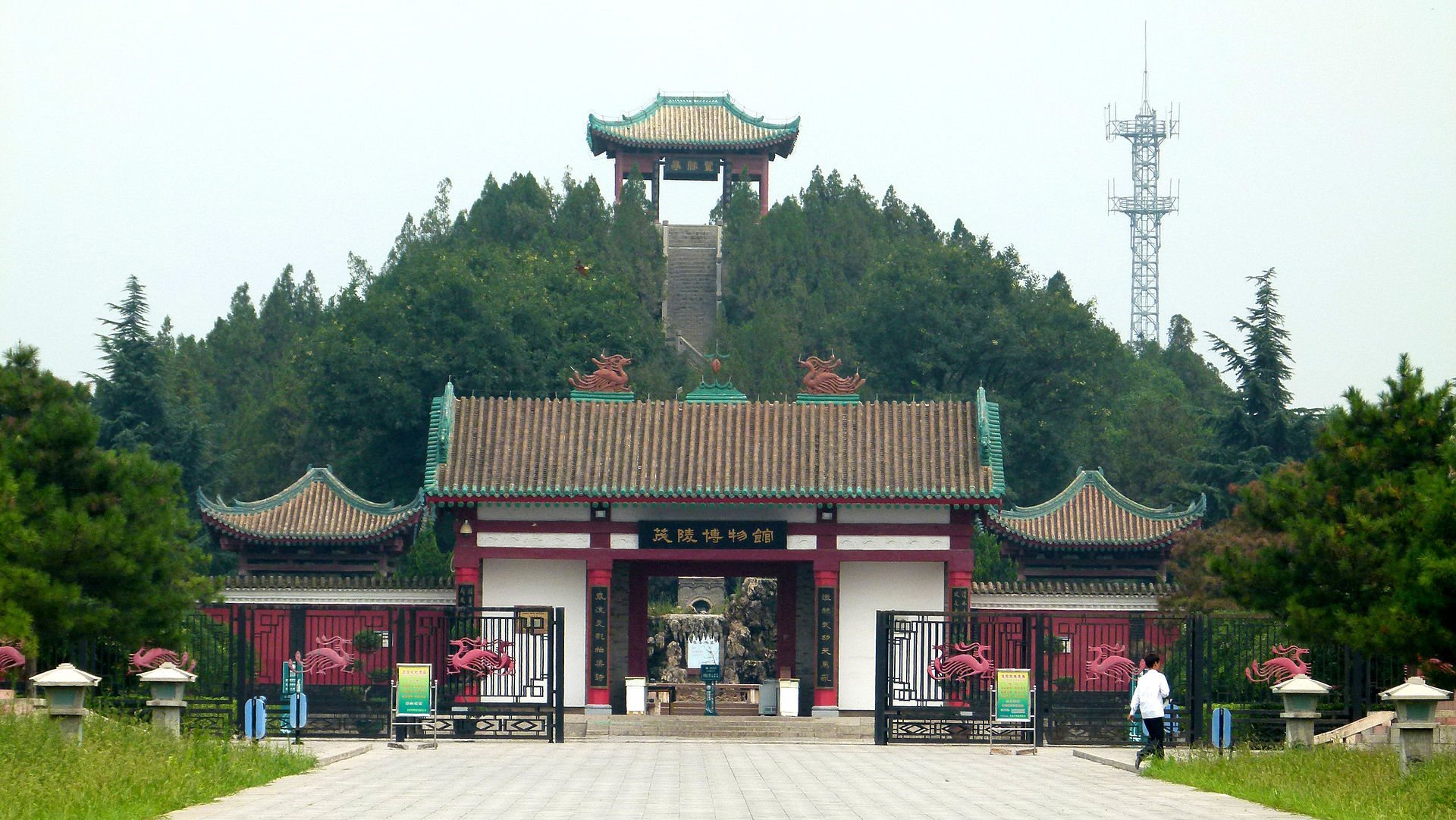
The site was damaged during the Cultural Revolution’s “Four Olds” campaign, an effort to eradicate old customs, culture, habits, and ideas. Red Guards destroyed a statue of Huo Qubing during the campaign. The tomb later became a museum site and was designated in 1961 as one of China’s first National Key Cultural Relics Protection Units.
Remains
Mound and ceremonial approach
Earthen burial mound
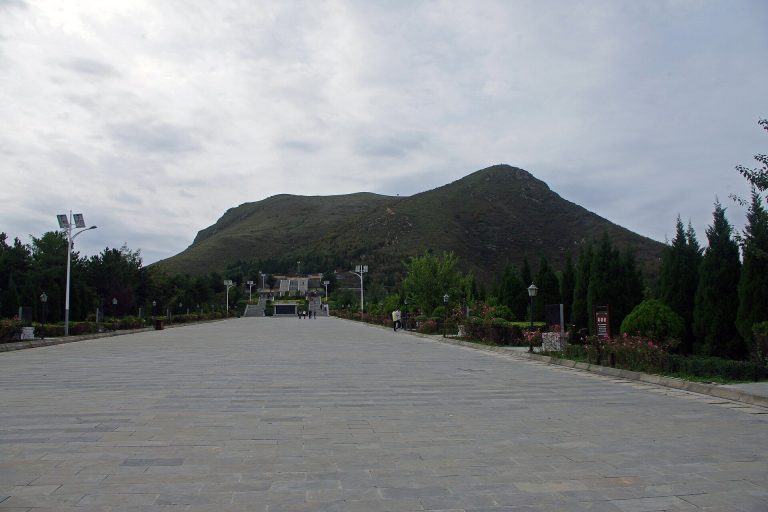
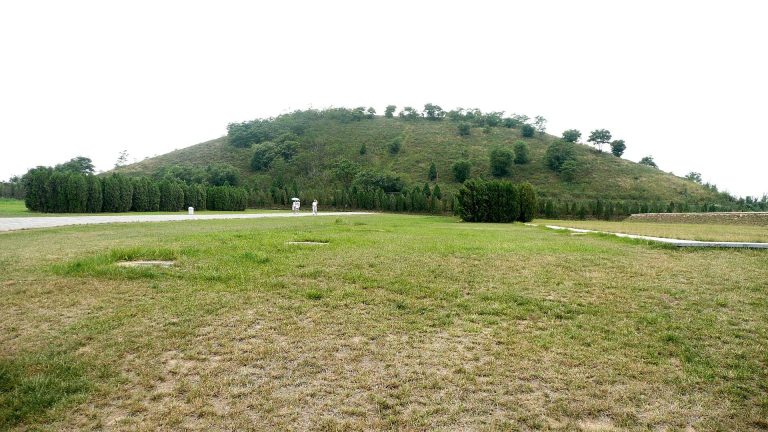
The tomb is marked by a large pyramidal earthen mound about 15 meters high. Its base measures approximately 92 meters from north to south and 61 meters from east to west, while the summit measures about 15 by 8 meters. The mound stands roughly 1 kilometer east of Emperor Wu’s Maoling Mausoleum, within the same overall funerary complex. Its scale and form provide the physical setting for the sculptures associated with Huo Qubing’s memorial.
Spirit way
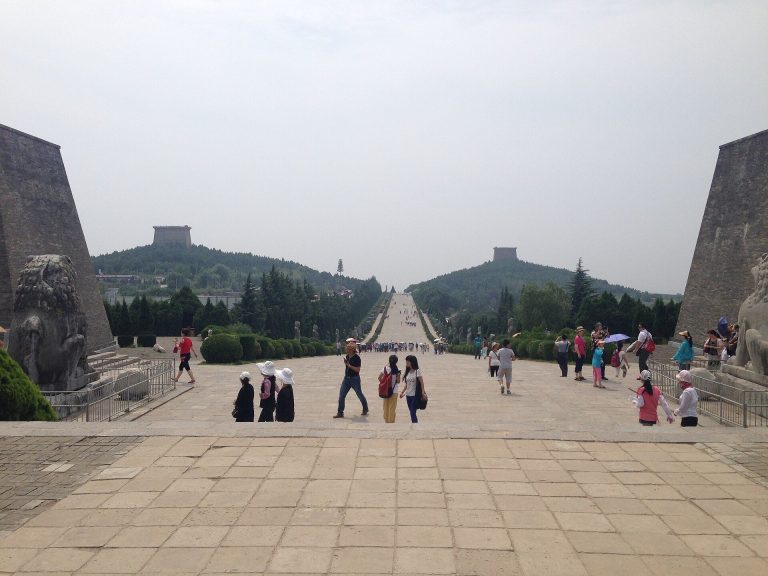
A spirit way, or ceremonial approach to a Chinese tomb, leads toward the burial mound. It is associated with at least sixteen Western Han stone sculptures, including animals, human figures, and mythical creatures. These works belong to one of the earliest known and best-preserved groups of Chinese tomb-path stone figures. The term shixiangsheng describes such stone figures placed along Chinese tomb approaches.
Stone sculpture groups
Abstracted animal forms
The sculptures were carved from granite blocks using iron and steel tools. Some are minimally worked boulders whose natural surfaces suggest the outlines of living creatures, including toads, frogs, and fish. The toads were carved from dark green, veined stone whose color and texture correspond to the animals’ appearance. These works rely on the shape and surface of the stone as well as on deliberate cutting.
Reclining animals
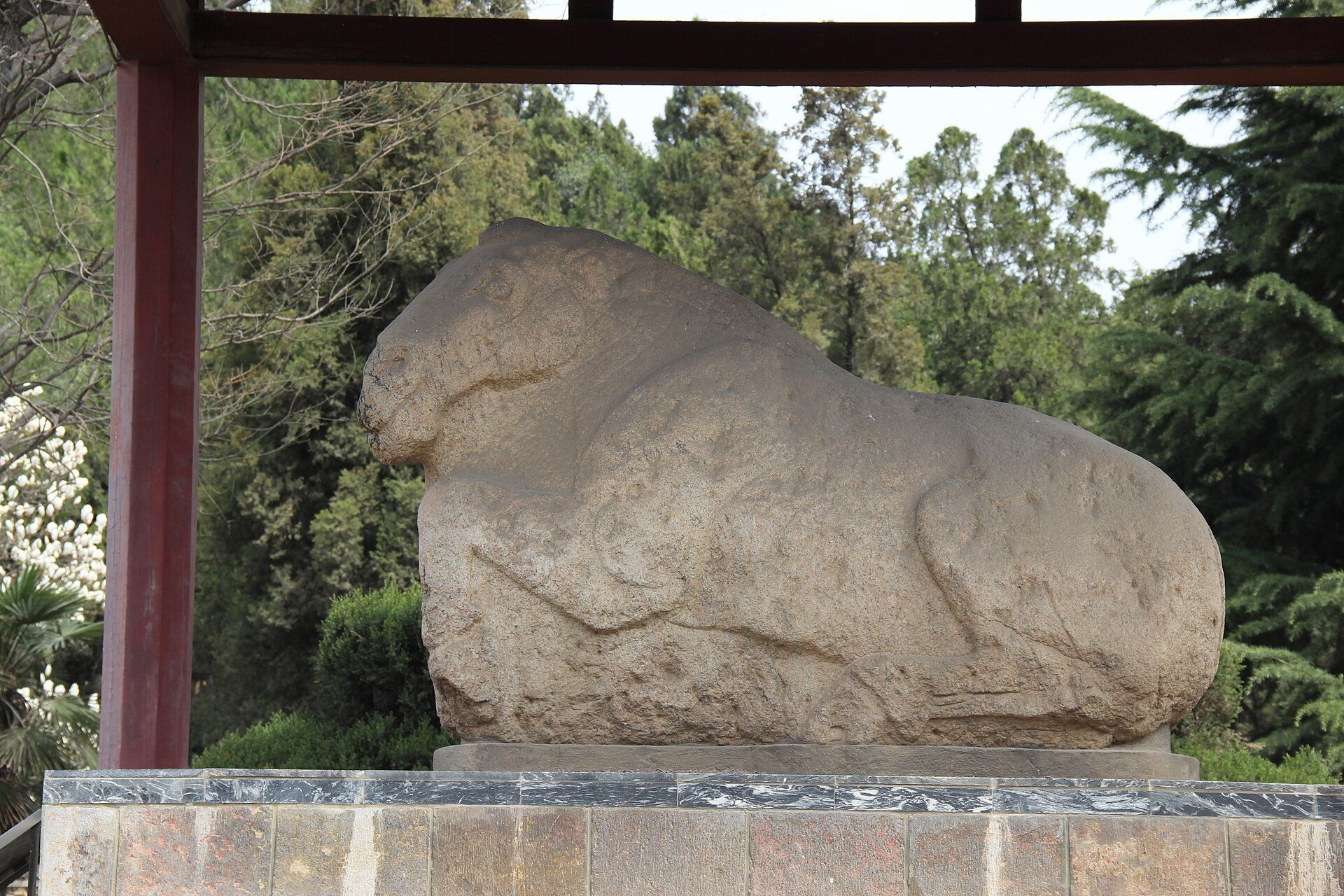
A group of reclining animals includes a bull measuring about 160 by 260 centimeters, a tiger measuring approximately 84 by 200 centimeters, a horse measuring about 62 by 163 centimeters, and an elephant measuring roughly 58 by 189 centimeters and about 58 centimeters high. Despite the hardness of the granite, the carvers worked details such as ears, eyes, and nostrils. The tiger’s open, snarling mouth gives the figure an especially forceful expression.
The elephant is made from dark gray stone with a smooth surface. Its trunk descends over its forelegs, and its proportions have led to its usual interpretation as a young elephant rather than a fully grown animal. The reclining forms differ in detail and treatment, but together they show the range of approaches used across the sculptural group.
Struggling and predatory creatures
More complex compositions show animals engaged in violent encounters. A horned monster with a squat body and long legs holds a sheep in its mouth. The sculpture measures approximately 274 centimeters high and 280 centimeters wide. Another work, about 277 centimeters high and 172 centimeters wide, depicts a bear struggling with a monkey-like creature. The monkey grips the bear as it attempts to escape, giving the scene a strong sense of tension and movement.
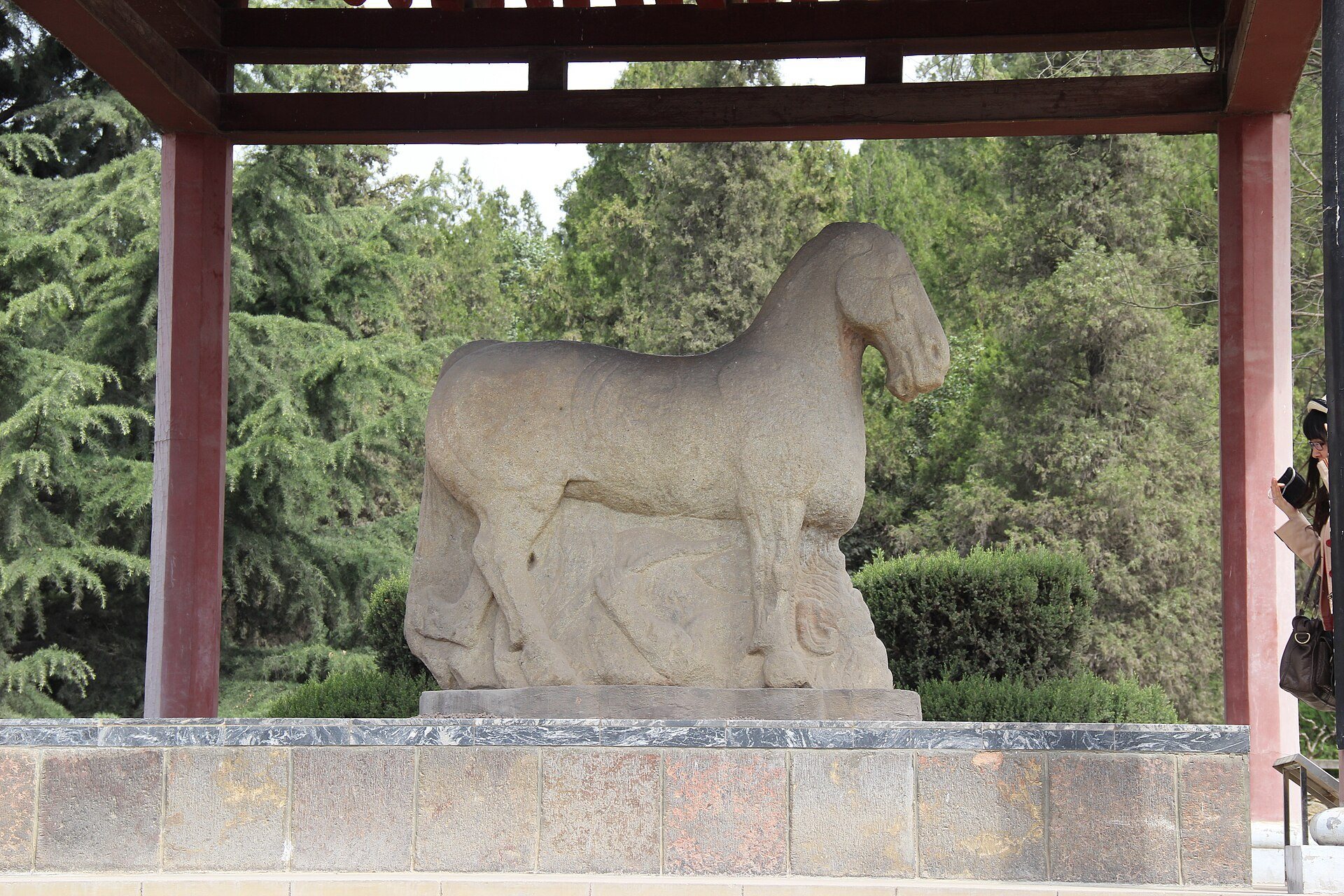
Horse Trampling the Xiongnu
Horse Trampling the Xiongnu shows a horse standing over a contorted Xiongnu figure. The horse’s strained body conveys violent exertion, while the figure beneath its hooves expresses terror. The sculpture’s original position and meaning remain uncertain. It has been read both as a memorial to Huo Qubing’s victories over the Xiongnu and as an allegory of the opposing forces of yin and yang.
Human and supernatural figures
A standing human figure is approximately 222 centimeters high. It has a massive head, unusually large round eyes, and a broad mouth that appears to smile. These features have led to its interpretation as a spirit or deity. Several other sculptures are too badly preserved to identify securely.
Additional recorded motifs include a strange human figure, an unusual animal eating a sheep, a reclining ox, a person wrestling with a wild animal, a reclining pig, a leaping horse, a seated horse, a seated tiger, several kinds of fish, an otter, and a bat. The works’ original symbolic organization and the precise position of individual sculptures remain unresolved. Earlier Chinese funerary practice did not normally place above-ground stone sculpture of this kind at tombs, raising the possibility that foreign artistic or religious traditions influenced the monument.