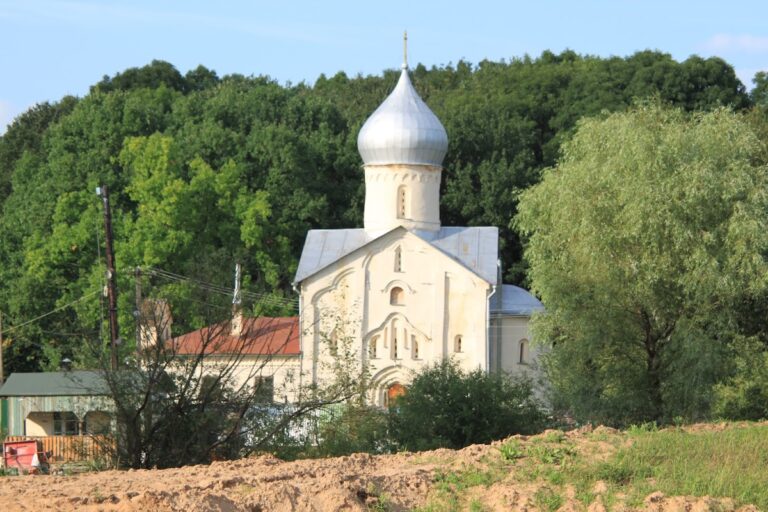
Khutyn Monastery: An Orthodox Monastic Complex in Russia


Site at a Glance
- Rating
- 4.2
- Popularity
- Very Low
- Country
- Russia
- Primary era
- Medieval
- Eras represented
- Medieval, Early Modern
- Civilizations
- Novgorod Republic, Russian
- Site type
- Religious
- Remains
- Monastery
On this page13 sections
History
Khutyn Monastery is an Orthodox monastery in Russia, founded in 1192 by the monk Varlaam Khutynsky near Veliky Novgorod. Formally called the Varlaam-Khutyn Saviour-Transfiguration Monastery, it belongs to the Novgorod Diocese and is associated with Old Russian and Neoclassical architectural traditions. It began as a male cenobitic monastery, whose members lived under a common rule and shared communal resources, and became a women’s monastery after its restoration in the twentieth century.
Foundation and Medieval Development
Foundation tradition places Varlaam, formerly Oleksa Mikhailovich, at a site called Khutyn, traditionally understood as a “bad place.” He built a monastic cell there and overcame the evil forces believed to inhabit the area. A wooden church dedicated to the Transfiguration of the Saviour was followed by a stone church. Archbishop Gregory of Novgorod consecrated the monastery’s Transfiguration church on 6 August 1192 and granted the community official monastic status, with Varlaam as its first hegumen, or monastic superior.
A fifteenth-century life of Varlaam relates that he selected the location after seeing a vision of miraculous light. During his lifetime, the community also acquired monks’ cells and a well. The monastery’s spiritual importance centered on Varlaam, whose relics became its principal shrine.
In 1471, Ivan III, the grand prince of Moscow whose reign brought Novgorod under Muscovite rule, visited the monastery to venerate Varlaam’s relics. Tradition states that an attempt to open the saint’s tomb produced smoke and a column of fire, causing Ivan to flee. The event became associated with a staff attributed to Ivan III and with a southern iconostasis door scorched by fire, both preserved in the monastery sacristy.
After Novgorod was incorporated into the Grand Duchy of Moscow, the monastery lost part of its landed property but remained one of the wealthiest communities in the Novgorod Diocese. It ranked second in landholdings after Yuriev Monastery and possessed one of the region’s largest libraries. Donations from the Novgorodian Yuri Onciferovich supported a major building campaign. A gate church dedicated to Saint Anthony the Great was built in 1417, a church dedicated to Saint Elijah followed in 1418, and churches dedicated to Saint Gregory the Illuminator and Saint Varlaam Khutynsky were built in 1445.
Privileges and Early Modern Rule
Grand Prince Vasily III, a prominent devotee of Saint Varlaam, promoted the monastery’s development and ordered the construction of its 1515 Transfiguration Cathedral. From 1532, the hegumen could be judged in ecclesiastical matters only by the Archbishop of Novgorod and in secular matters by the grand prince. The monastery was also exempted from fees for using the saltworks at Russa.
Russian rulers, members of the ruling family, Orthodox bishops, and private donors granted the monastery land, money, and goods. After the secularization of church lands in 1764, it was classified as a first-class monastery, with state funding for 32 monastic positions in addition to that of the superior. Markell Bezborody, a major hagiographer and leading composer of the sixteenth-century Novgorod chant tradition, served as hegumen from 1553 to 1557.
The monastery was drawn into the Time of Troubles, a period of dynastic and political crisis in Russia during the early seventeenth century. Swedish forces occupied it in 1611 and used it as their headquarters during the attack on Novgorod, looting the movable property of its churches. From the mid-eighteenth century, its superiors were generally auxiliary bishops of the Novgorod Diocese, with titles connected with Kexholm and Ladoga, Staraya Russa, Kirillov, and Tikhvin.
Community, War, and Restoration
The monastery housed 58 monks and novices in 1723 and 20 in 1738, while controlling approximately 5,500 peasant households. At the beginning of the twentieth century, 26 monks and novices lived there, and the community operated a parish school from 1890.
The poet Gavrila Derzhavin died in 1816 at his estate of Zvanka. His body and that of his wife, Daria, were transported by barge along the Volkhov and buried in the Transfiguration Cathedral. Their graves were damaged during the Second World War, and the couple was reburied in the Novgorod Kremlin in 1959. Their remains returned to the monastery in 1993 for the 250th anniversary of Derzhavin’s birth.
Soviet authorities closed the monastery in 1920. The Transfiguration and Saint Varlaam churches continued to hold services as parish churches until 1930–1932, while ten elderly monks were permitted to remain for a time. The furnishings were confiscated, and the two functioning churches were transferred to the Novgorod museum. Other buildings were taken over by the military and later included a psychiatric hospital and accommodation for visitors.
Bombardment and artillery fire severely damaged or destroyed the complex during the Second World War, when German forces were stationed there. The monastery remained in ruins for more than forty years. Restoration began in 1976 and was completed in 1993. It was returned to the Russian Orthodox Church in 1991, resumed operation as a women’s community in 1993, and has functioned as a women’s monastery since 20 April 1994. More than 100 nuns lived there in January 2012, and a metochion, or affiliated monastic residence, was maintained in the village of Bykovo in Valdai District. The complex is protected as a nationally significant cultural-heritage site of the Russian Federation.
Remains
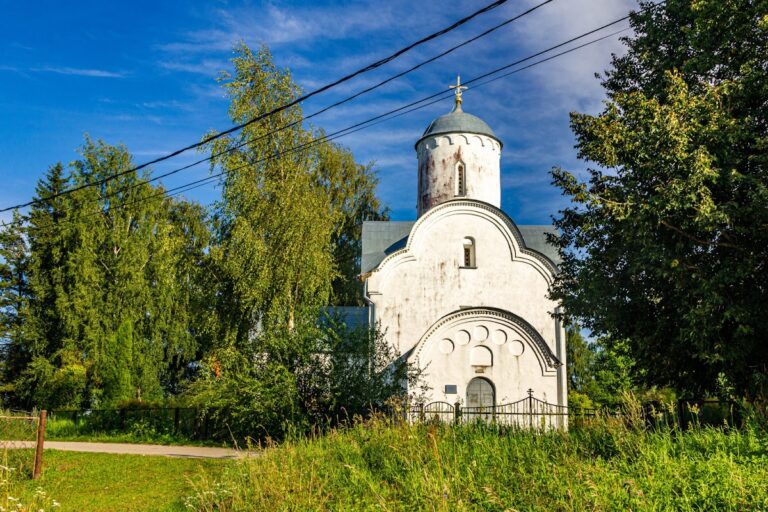
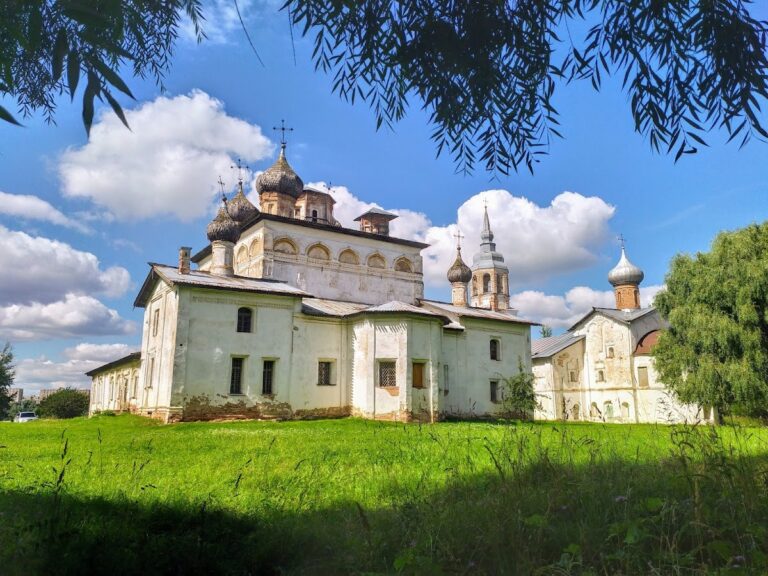
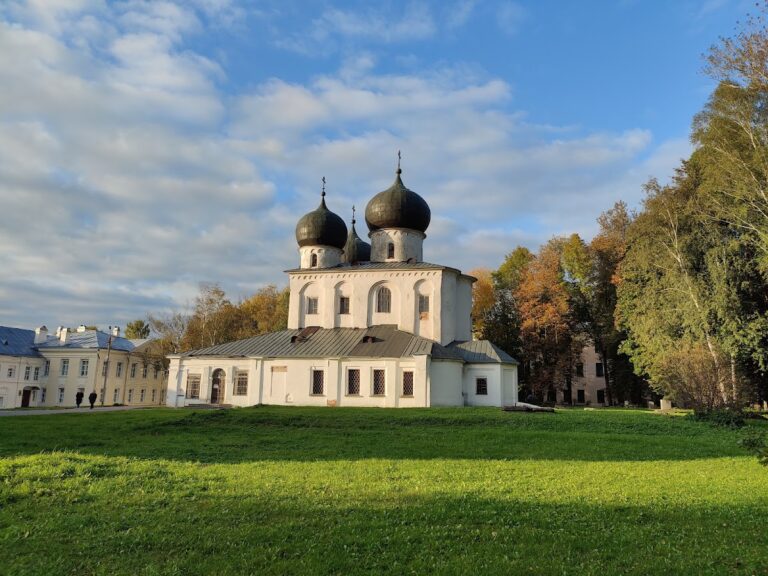
Khutyn Monastery stands on the right bank of the Volkhov River, at the northern edge of Khutyn village. Its surviving complex combines medieval churches, later additions, a gate bell tower, residential buildings, and structures associated with monastic care. The principal buildings reflect the site’s long development from its medieval foundation through eighteenth-century Neoclassical rebuilding and twentieth-century restoration.
Cathedral and Refectory
Transfiguration Cathedral
The Transfiguration Cathedral was built in 1515 on the site of the earlier church commissioned by Varlaam. It is a substantial six-pillared structure whose design has been associated with major cathedral models in Rostov and the Moscow Kremlin. Moscow sculptors made its portals, while Novgorodian builders worked under the direction of an Italian architect or architects. Side altars dedicated to the Protection of the Mother of God and Saint John the Theologian were added in 1646. The frescoes were renewed after a fire, and the cathedral was later remodelled in a late-classical style.
The cathedral contains the burial associated with Saint Varlaam Khutynsky, whose relics form the monastery’s principal shrine. Gavrila Derzhavin and his wife, Daria, were also buried there. Their grave was damaged during wartime destruction, and their remains were later returned to the monastery. Restoration of the cathedral’s side altars was completed by 1998.
Saint Varlaam Refectory Church
The refectory church of Saint Varlaam was built in 1549–1551 on the site of an earlier church associated with the monastery’s founder. It is physically connected with the refectory and has side altars dedicated to Saints Constantine and Helena and to Saint Isidore. The church and refectory were remodelled in 1797, and restoration of the complex was completed by 2003.
Gates, Bell Tower, and Monastic Buildings
Medieval Churches
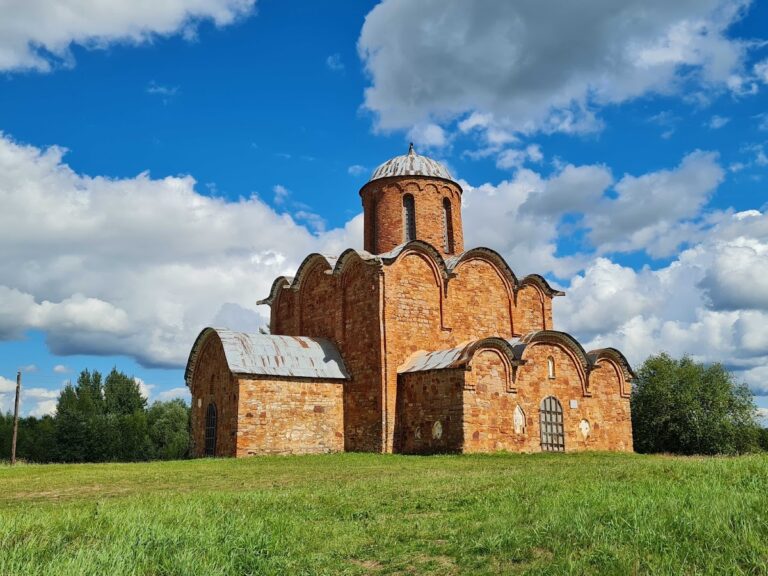
A church dedicated to Saint Varlaam was placed in the upper tier of the monastery’s bell tower in 1445. The gate church of Saint Anthony the Great was built in 1417, followed by the church of Saint Elijah in 1418. The church of Saint Gregory the Illuminator, also built in 1445, was demolished in the eighteenth century.
Southern Gate Bell Tower
A separate bell tower over the southern entrance gate was constructed in 1759–1761. This Neoclassical structure forms one of the later architectural elements of the monastery complex and was restored by 2003.
Hospital and Residential Churches
A hospital building with the Church of All Saints opened in 1787. In 1994, a domestic church dedicated to Saint Leo was established in the nuns’ residential building, linking the restored complex with its renewed female community.
Sacristy and Monastic Collections
The monastery sacristy preserved the staff attributed to Ivan III and the fire-scorched southern iconostasis door associated with the 1471 story of Varlaam’s tomb. Historic icons, ecclesiastical banners, and protective textile covers associated with Khutyn Monastery remain in the collections of the Novgorod museum. These objects, together with the surviving churches and restored buildings, preserve material evidence of the monastery’s religious and artistic history.