Chlewiska Castle: A Historic Palace Complex in Poland


Site at a Glance
- Rating
- 4.5
- Popularity
- Low
- Country
- Poland
- Primary era
- Early Modern
- External website
- Open
- Eras represented
- Medieval, Early Modern, Modern
- Civilizations
- Kingdom of Poland, Polish–Lithuanian Commonwealth, Russian
- Site type
- Domestic
- Remains
- Elite Residence
On this page8 sections
History
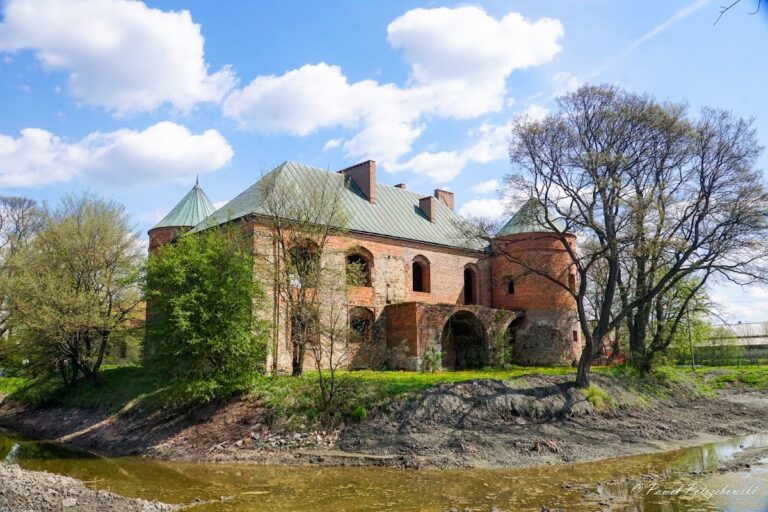
Chlewiska Castle is a historic residence in Chlewiska, Poland, whose origins lie in the medieval estate of the Odrowąż family. The estate was granted to Prędota Stary Odrowąż by Bolesław III Wrymouth, a Piast ruler of Poland, in 1098, and the family built a church there in 1121 and a knightly manor in 1135. These beginnings place Chlewiska among the oldest landed residences in the Polish lands.
The Odrowąż Estate
Chlewiska remained associated with the Odrowąż family through the thirteenth and fourteenth centuries. Saint Hyacinth Odrowąż, a Polish Dominican friar and Catholic saint, visited the family estate in the thirteenth century. Among the later owners was Dobiesław Odrowąż. His sons Jakub, Mikołaj, and Piotr were named in 1360 and adopted the surname Chlewicki from their seat at Chlewiska. The Odrowąż family held land as well as ecclesiastical and political positions in medieval Poland.
In the fifteenth century, Dobiesław Chlewicki, castellan of Czechów, and his brother Strasz Chlewicki were associated with the construction of the masonry castle, or possibly the first stone fortification on the site. Contemporary records described it as stone-built. Dobiesław’s sons, Stanisław and Szymon, took possession of the estate around 1489.
Rebuilding in the Early Modern Period
After Szymon Chlewicki died sometime after 1522, the property passed first to Piotr and then to Piotr’s son Jakub. Jakub’s death in 1594 brought the estate to his sons, including Wawrzyniec Chlewicki. In 1605, Wawrzyniec rebuilt and renovated the castle. A surviving commemorative plaque presents the work as his construction of the ancestral Odrowąż-Chlewicki castle and states that he raised the hill above the surrounding marshy ground. It also describes the castle as having endured the passage of time and as a witness to its own existence.
Wawrzyniec’s son Mikołaj Chlewicki served as a cavalry captain and later became a senator during the reign of King John II Casimir, the seventeenth-century monarch of the Polish-Lithuanian Commonwealth. In the eighteenth century, Józef and Aleksander Podkański owned the castle and began another rebuilding campaign. Their work changed the character of the residence from a defensive stronghold into a palace.
Owners and Modern History
Stanisław Sołtyk purchased the castle in 1801. The property later passed to the Napoleonic general Roman Sołtyk, but the Russian government confiscated it in 1831 because of his participation in the November Uprising, an insurrection against Russian rule in the Polish territories. Marceli Sołtyk owned the estate in 1867. Stables were added in 1886, and Ludwik Broel-Plater purchased the property in 1895. It subsequently passed to his son Konstanty Broel-Plater.
J. Kuczyński and A. Żurowska carried out trial archaeological investigations at the estate in 1973. The castle complex was owned by the Manor House company in 1999. On 12 May 2009, the historic park was entered on the preferential list of historic parks and gardens maintained for Poland’s National Fund for Environmental Protection and Water Management.
On 25 December 2012, a fire destroyed part of the palace attic, which had been adapted for hotel use. Renovation afterward converted the complex into a luxury hotel, its current function.
Remains
The surviving complex is arranged around a palace formed by two buildings joined in an L-shaped plan. A small tower is attached externally to the buildings, and the palace stands on a slight elevation within a historic park containing ponds and natural monuments. Remnants of old basement walls survive near the principal buildings and probably represent parts of earlier structures or defensive fortifications.
Palace and Chapels
The attached tower contains the Chapel of the Blessed Virgin Mary on the ground floor and the Chapel of Saint Hyacinth Odrowąż, patron of the estate, on the upper floor. Two ground-level rooms in the main building retain barrel-and-cross vaults. The palace also preserves a stone Renaissance entrance portal, while the commemorative plaque dated 1605 is set into one of its piers.
Courtyard and Estate Features
The palace courtyard contains the Well of Dobiesław Odrowąż, built between 1460 and 1490. On the northern slope of the hill are the remains of a manor icehouse dating from 1837. An icehouse stored ice for preserving food, and the surviving structure forms part of the estate’s nineteenth-century service facilities.
Park Structures
An eighteenth-century Gothic tower stands within the former game park, an enclosed estate landscape used for keeping and hunting animals. The tower served as a viewpoint and shooting stand before being reconstructed in 2013. The nineteenth-century stables also survive beside the present entrance to the complex, preserving another element of the later palace estate.
Nearby sites