Radom Piotrówka: A Medieval Hillfort and Administrative Centre in Poland
Site at a Glance
- Rating
- 4
- Popularity
- Low
- Country
- Poland
- Primary era
- Medieval
- External website
- Open
- Eras represented
- Medieval
- Civilizations
- Unclassified
- Site type
- Military
- Remains
- Citadel
On this page13 sections
History
Radom Piotrówka is a medieval hillfort in Radom, Poland, established in the second half of the tenth century by rulers of the early Piast state. It served as an administrative and defensive centre for newly incorporated territories, controlling a ford across the Mleczna River and trade routes linking Małopolska, or Lesser Poland, with Mazovia and Rus.
Early Piast Foundation
An earlier settlement at Radom dates from the eighth century and later developed into the fortified centre on Piotrówka. The hillfort helped the Piast state extend and organize its authority near the medieval border between Małopolska and Mazovia. Its position gave it control over movement across the Mleczna valley and over routes running toward the north and east.
Radom became an administrative and commercial centre, and the hillfort was the seat of a castellany. A castellany was a medieval territory governed from a fortified centre by a castellan, who held military and administrative authority. The territory associated with Radom extended along the Radomka and Iłżanka rivers. Its defences helped protect the Piast state from incursions from the east and northeast, including attacks associated with the Yotvingians, Lithuanians, and Tatars.
Coins indicate economic connections with the southern Małopolska zone. A hoard concealed before 1350 contained coins from Bohemia, groschen issued under Wenceslas II, and more than twenty Polish pennies. A groschen was a relatively large medieval coin used in Central Europe.
Church and Medieval Administration
The church of St. Peter stood within the hillfort for several centuries and probably already existed in the eleventh century. In 1222, Bishop Iwo Odrowąż of Kraków granted it to the Benedictines of Sieciechów. The church gave Piotrówka its name and was regarded as the first Christian church in the region. St. Peter, one of the Twelve Apostles, was a central figure in early Christianity.
The first recorded reference to Radom dates from 1155. It occurs in a papal bull issued by Pope Adrian in connection with the bishopric of Wrocław and mentioning the nearby village of Sławno. Thirteenth-century records name four castellans of Radom, confirming the hillfort’s continuing administrative role.
In 1252, the fortified settlements of Sandomierz and Radom were recorded as having returned to the legitimate authority of Duke Leszek the White, a Piast ruler of Kraków and senior Poland. A settlement at the later site of Radom received town rights under Środa law before 1350. Środa law was a medieval system of town law governing settlement organization, property, administration, and municipal privileges. The grant may have been connected with the construction of the Church of St. Wenceslas around the turn of the thirteenth and fourteenth centuries.
Relocation of the Centre
In 1364, Casimir III the Great founded Radom anew under Magdeburg law, a widely used Central European model for urban government and property rights. Construction of a castle in the present Old Town began in 1370. The castle became the castellan’s new residence and the administrative centre, taking over the functions previously performed by Piotrówka.
Piotrówka was abandoned as the principal centre of authority around the middle of the fourteenth century, when the town foundation led to the relocation of political power. The castle portion was destroyed around the time of a Lithuanian attack. Residential and economic buildings again occupied, or continued to occupy, the hillfort during the fifteenth and sixteenth centuries. This later activity may have been connected with stays by members of the royal family and meetings of the Crown assemblies.
Later Use and Archaeological Investigation
A cemetery functioned at Piotrówka from 1790 to 1812. Archaeological work later examined the hillfort and adjoining areas through a ten-year expedition of the Polish Academy of Sciences at the turn of the 1950s and 1960s, including work by the archaeologist Ewa Kierzkowska-Kalinowska. Rescue excavations continued until the end of the 1970s.
A further Polish Academy of Sciences research phase ran from 2009 to 2013 and included a search for the church of St. Peter. This work uncovered a grave dating from the late twelfth or early thirteenth century and the cellar of a burned thirteenth-century house. The cellar contained vessels, coins from the reign of Władysław I the Elbow-high, and human skulls dating from the eighteenth or nineteenth century, probably associated with the former cemetery. The burials and related finds may indicate that a religious building functioned on the hillfort during the early medieval period.
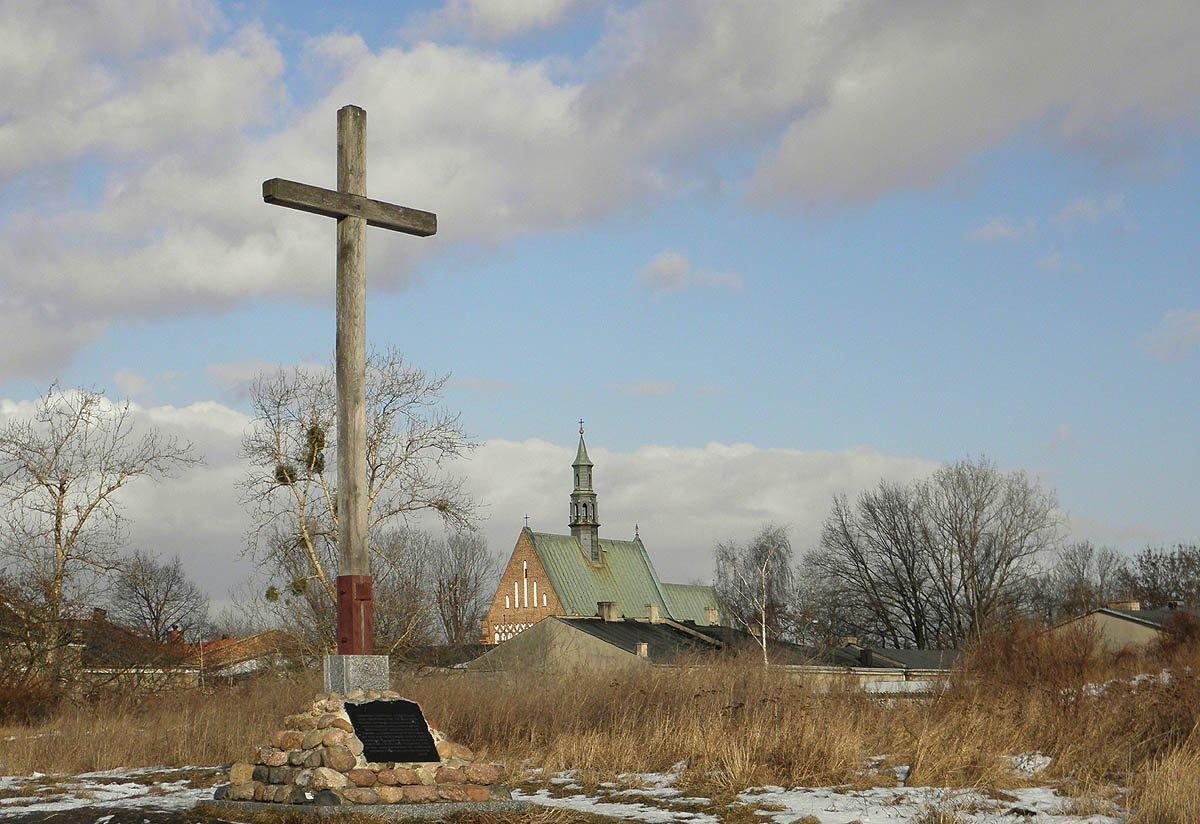
In 2018, deteriorated wooden poles that symbolized the hillfort were removed. Piotrówka remains a protected monument in Poland and is maintained as a park and archaeological site.
Remains
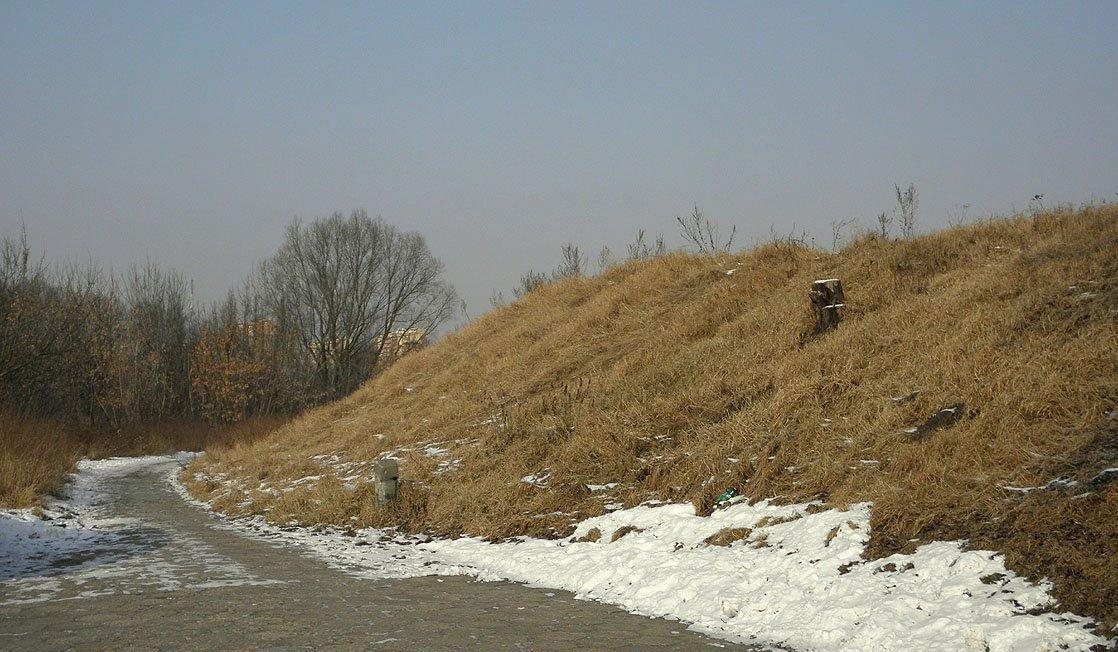
Piotrówka is a flat-topped rise about 5 to 7 metres high, measuring approximately 146 by 136 metres. Archaeological research indicates that the enclosure covered about 1.5 hectares from its beginning. The hillfort formed part of a wider early medieval settlement complex in the Mleczna valley, where fortified, residential, agricultural, production, and commercial activities occupied related areas.
Fortifications and Access
Ramparts and Moat
The most recent archaeological interpretation holds that the ramparts were built in a single operation during the second half of the tenth century on previously undeveloped ground. The builders lowered the ground between the ramparts and the central area as they formed the enclosure. During the eleventh century, wooden buildings appeared beside the ramparts. From the end of the eleventh to the end of the twelfth century, the defences were remodelled, the ground alongside them was raised, and residential buildings were placed 15 to 20 metres from the ramparts.
Earlier interpretations proposed a smaller enclosure, about 80 to 85 metres in diameter, which was expanded during the eleventh century to about 1.4 hectares. In that reconstruction, the enlarged fort had an approximately circular plan and a new ring of defences. The rampart in this earlier reconstruction was about 11 metres wide at its base and approximately 8 to 9 metres high, with a facing of fieldstone.
A moat supplied by springs surrounded the enclosure. Its banks were reinforced with box-like timber structures filled with clay. The approach crossed marshy ground on a road paved with oak beams, linking the fortified rise with the surrounding settlement landscape.
Buildings and Internal Organization
Wooden Settlement
Wooden buildings occupied the area adjoining the ramparts during the eleventh century. Between the end of the eleventh and the end of the twelfth century, residential buildings stood 15 to 20 metres from the defences. In the thirteenth century, the inner part of the hillfort was levelled, and the zone beside the ramparts was used again. The cellar of a burned thirteenth-century house survives as an archaeological feature of this phase. It contained vessels and coins from the reign of Władysław I the Elbow-high, who became king of Poland in the early fourteenth century.
Church of St. Peter
The church of St. Peter stood within the hillfort and gave the site its name. The search for the church during the 2009 to 2013 investigations produced graves and religious objects that may relate to an early medieval sacred building. Oriented grave pits contained copper temple rings, finger rings, and a glass ring.
Among the religious finds was a two-part cross made from copper alloy. Its front shows Christ crucified, while the reverse carries five oval medallions with busts of saints at the ends and centre of the cross. A reliquary cross was designed to contain or commemorate holy relics. These finds help connect the hillfort’s burial area with its early Christian use.
Mleczna Valley Settlement Complex
Associated Settlements
Piotrówka formed one part of a larger early medieval settlement complex in the Mleczna valley. At least three associated settlements have been identified. One was agricultural, another specialized in production that included iron smelting, and a third served commercial purposes. The commercial settlement lay around the Church of St. Wenceslas at Plac Staromiejski. St. Wenceslas was a tenth-century duke of Bohemia venerated as a Christian martyr and patron saint.
Flooding caused the agricultural settlement to move elsewhere. Archaeological traces near the Mleczna were temporarily buried beneath several tens of centimetres of river sediment, while settlement remains appeared near present-day Przechodnia and Limanowskiego streets. Some early medieval remains were destroyed by later construction along Wacław Street and Piotrówka Street.
The wider Radom settlement complex preceded the fourteenth-century Kazimierz town, which was built on previously undeveloped ground about 700 metres from the hillfort. Archaeological evidence also provides information about food consumed by the early inhabitants, including bryja, spinach, and oregano.