Saint Wenceslaus Church in Radom: A Historic Parish Church in Poland


Site at a Glance
- Rating
- 4.7
- Popularity
- Low
- Country
- Poland
- Primary era
- Medieval
- External website
- Open
- Eras represented
- Medieval
- Civilizations
- Kingdom of Poland
- Site type
- Religious
- Remains
- Church
On this page8 sections
History
Saint Wenceslaus Church in Radom is a Catholic parish church in Poland, founded in 1216 by Duke Leszek the White as the first parish church of Old Radom. Dedicated to Saint Wenceslaus, the tenth-century Bohemian duke and Christian martyr who became the patron saint of Bohemia, it replaced the earlier Church of Saint Peter. Leszek’s son, Bolesław the Chaste, provided its furnishings.
Medieval foundation and expansion
Archaeological research places the construction of the oldest surviving part, the presbytery surrounding the main altar, at the end of the thirteenth century. A burial from the late twelfth century beneath the presbytery may point to an earlier wooden church nearby, although no remains of that building have been found. The church was enlarged and partly remodelled in the Gothic style in 1440, followed by another expansion in the middle of the fifteenth century. Gothic architecture was a medieval tradition associated with pointed arches, ribbed vaults, and an emphasis on vertical form.
The church served the local parish community and could hold approximately 800 worshippers. A parish school operated beside it from at least 1688 to 1747. The building was repeatedly robbed, while burials in coffins dating from the sixteenth to the eighteenth centuries took place in its crypts.
Military and institutional reuse
In 1802, Austrian authorities took over the church and converted it into a military storehouse. It was partly rebuilt in 1809 during the period of the Duchy of Warsaw and continued to be used for storage. It may also have served as a flour store that year.
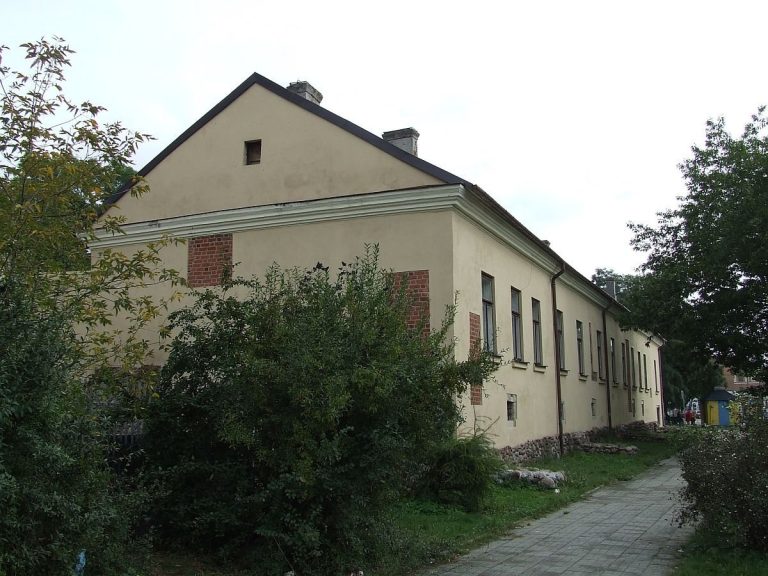
In the mid-nineteenth century, Russian authorities converted the building into a transit prison. Deportees were held there before being sent to Siberia. During Radom’s typhus epidemic in 1922 and 1923, the former church became an epidemic hospital. From 1930 to 1939, during the interwar period, it served as an old people’s home, and it later housed a psychiatric department of the municipal hospital.
Restoration and return to parish use
Religious use resumed in 1978. The church was restored between 1980 and 1986 under the design of Professor Wiktor Zin, and Bishop Edward Materski blessed it on 9 June 1985. From 1985 to 1992 it functioned as a filial church, meaning a church dependent on another parish, under the parish of Saint John the Baptist in Radom. It became an independent parish church again in 1992.
The church’s renewed religious role included several notable observances. Relics of the True Cross, traditionally associated with the cross on which Jesus was crucified, were brought there in 1986 and again in 2010. A figure of the Holy Mother of God visited the church in 2000, followed by a copy of the Miraculous Image of Our Lady of Częstochowa in 2006. Blood relics of Saint John Paul II arrived on 16 October 2011, with their reliquary intended to remain permanently in the parish. Relics of Saint Casimir, a fifteenth-century Polish-Lithuanian prince venerated as a Catholic saint and patron of Radom and its diocese, arrived from Florence on 15 May 2013.
A bust of Pope John Paul II was blessed in 2005. In 2007, the local social and educational organization SCM “Arka” acquired the former old people’s home for a new headquarters and a specially established SNS Academy. The clergy then lived at 2 Old Town Square, where a new parish house was blessed that year. The church is listed on Poland’s register of monuments under entries dated 11 February 1959, 23 June 1967, and 8 April 1981.
Remains
Church building and grounds
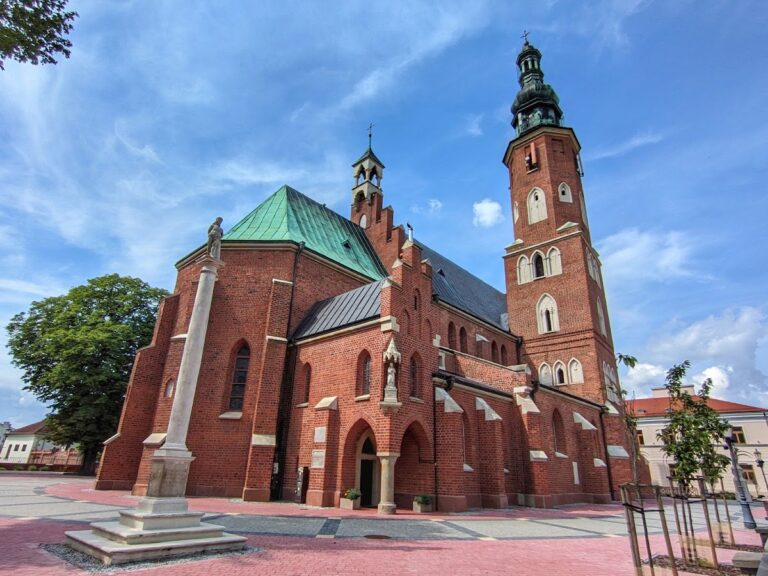
Saint Wenceslaus Church was built originally of fired brick, and its architect is unknown. The oldest identified fabric is the presbytery, constructed at the end of the thirteenth century. The building was enlarged and partly remodelled in the Gothic style in 1440, with a further expansion in the mid-fifteenth century. A cemetery occupied the area beside the church, while a wooden bell tower with a small bell turret stood near the main building. The tower contained three bells.
Crypt burials
The crypts contain numerous skeletal burials in coffins dating from the sixteenth to the eighteenth centuries. These burials form part of the surviving archaeological evidence for the church’s long religious use.
Bell tower and devotional features
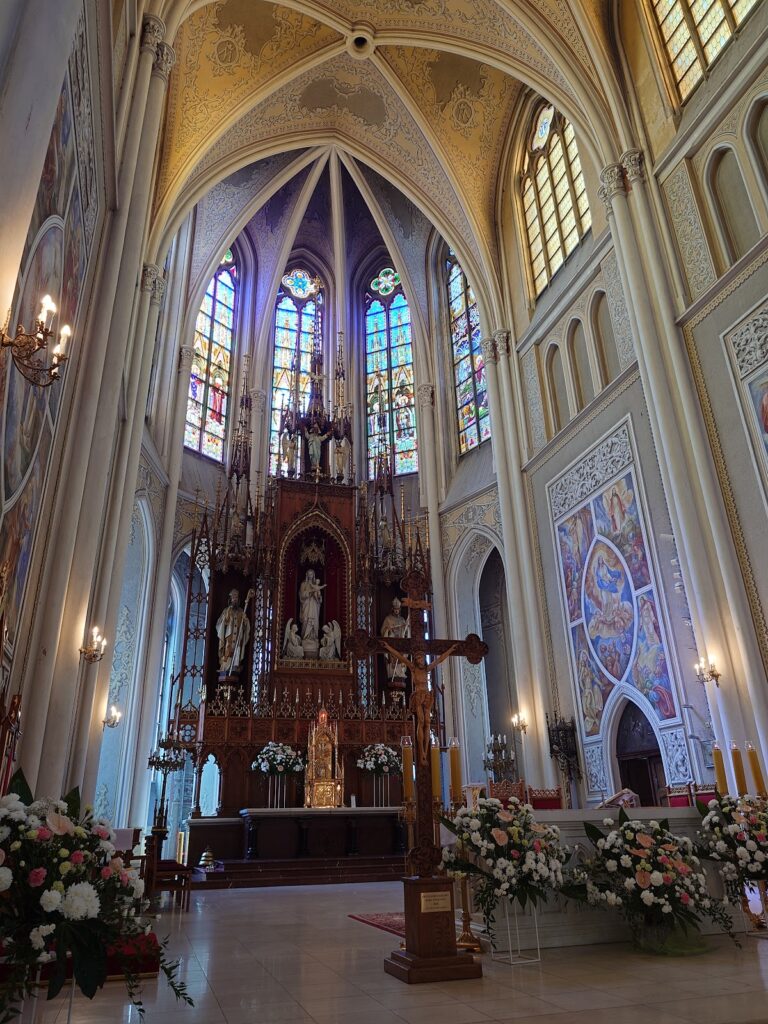
The tower was modernized in 2009 with a sound system and four bells, and the church received architectural illumination. The bells can play almost one hundred different occasional melodies. Inside the church, a permanent reliquary holds the blood relics of Saint John Paul II, while relics of Saint Casimir were brought to the parish from Florence in 2013. A bust of Pope John Paul II, blessed in 2005, is also installed in the church.