Upper Castle in Vilnius: A Lithuanian Fortress on Castle Hill


Site at a Glance
- Rating
- 4.7
- Popularity
- High
- Country
- Lithuania
- Primary era
- Medieval
- External website
- Open
- Eras represented
- Medieval, Modern
- Civilizations
- Grand Duchy of Lithuania
- Site type
- Military
- Remains
- Castle
On this page11 sections
History
Upper Castle in Vilnius, Lithuania, stands on Castle Hill at the confluence of the Neris and Vilnia rivers. The site developed from a Lithuanian wooden fortress built in the thirteenth century into a Brick Gothic stronghold rebuilt under Grand Duke Vytautas between 1419 and 1422. Its position made it a major defensive and political centre of Vilnius, and the surviving Gediminas Tower preserves part of that long history.
Early fortress and medieval wars
The hill, formerly called Turza and later known as Castle Hill or Gediminas Hill, was settled as early as the seventh to fifth centuries BC. These early traces are associated with the Stroke-ornamented Pottery culture. A wooden fortress was erected in the thirteenth century, probably between 1216 and 1264, while stone fortifications were already present during the first half of the fourteenth century.
During the Lithuanian–Teutonic Wars, a series of conflicts between Lithuania and the Teutonic Knights, the castle withstood sieges in 1365, 1375, 1377, 1383, 1390, 1392, 1394, and 1402. The penultimate siege lasted three weeks, demonstrating the importance of the hilltop fortress in the defence of Vilnius.
Reconstruction under Vytautas
A fire destroyed the castle in 1419. Vytautas the Great, Grand Duke of Lithuania from 1392 to 1430, ordered its reconstruction between 1419 and 1422 in the Brick Gothic style, a medieval Gothic tradition that used brick as its main structural and decorative material. The rebuilding was probably influenced by the castles of the Teutonic Order, where Vytautas had spent four years.
The reconstructed fortress had military and courtly functions. From the reign of Alexander I Jagiellon, who was Grand Duke of Lithuania and later King of Poland, it housed a bell foundry and a prison for nobles. Sigismund II Augustus, a sixteenth-century King of Poland and Grand Duke of Lithuania, renovated the Castle House and installed his library there.
Decline and Russian occupation
During the sixteenth century, the castle ceased to receive regular repairs and began to deteriorate, although it continued to serve as a prison for nobles. Its first capture by an enemy army came in 1655, when Russian forces led by Prince Daniło Myszecki took the fortress. A Russian garrison remained for six years and repaired buildings that had already fallen into poor condition.
The castle suffered major damage during the Moscow invasion of 1655–1661. In 1661, the garrison commanded by Governor Daniło Myszecki defended the castle until its soldiers imprisoned their commander and surrendered to King John II Casimir on 3 December. The former enemy soldiers entered the service of the Polish–Lithuanian Commonwealth, while Myszecki was executed for crimes committed during the occupation of Vilnius.
Military liquidation and twentieth-century changes
By the end of the eighteenth century, the southern tower on the city side had been dismantled and the western tower had been lowered. The fortress was liquidated and its garrison withdrawn in 1878, after which Castle Hill was opened to civilians. A spiral path was laid out in the mid-1890s to ease the ascent.
Polish conservation authorities altered and reconstructed the western tower during the twentieth century. A wooden square superstructure added in 1830 was removed around 1930, and one storey was rebuilt on the tower in 1938–1939. Political changes surrounding the Second World War were also reflected in its flags. A Polish flag was removed on 20 September 1939, and a Lithuanian flag was permitted there on 27 October. Around 11:00 on 13 July 1944, during Operation Ostra Brama, a Polish Home Army operation in the Vilnius region, Home Army soldiers Jerzy Jensz and Artur Rychter raised a Polish flag on the tower. The new occupying authorities soon removed it and raised a Soviet flag.
The western tower was seriously damaged during the Second World War. It was rebuilt between 1956 and 1960 during the Lithuanian SSR period for use as the Museum of Vilnius Castle. A funicular, a cable railway running on a steep incline, was built in 2003 for the 750th anniversary of the coronation of Mindaugas.
Recurrent landslides have affected Castle Hill. All trees on the hill were cut down between 2013 and 2016 to improve the visibility of the castle buildings, while concerns were also raised that Gediminas Tower might slide downhill. Construction machinery was still operating on the summit in 2019.
Remains
The castle occupied the summit of a 48-metre-high hill above the meeting point of the Neris and Vilnia rivers. The rebuilt fortress followed a Brick Gothic design, with walls approximately 320 metres long and three towers. The western and southern towers were polygonal, the southern tower faced the city, and a gate stood on the northern side. The towers were covered with green roof tiles. Only fragments of the main citadel and the foundation of the southern tower survive.
Surviving castle buildings
Gediminas Tower
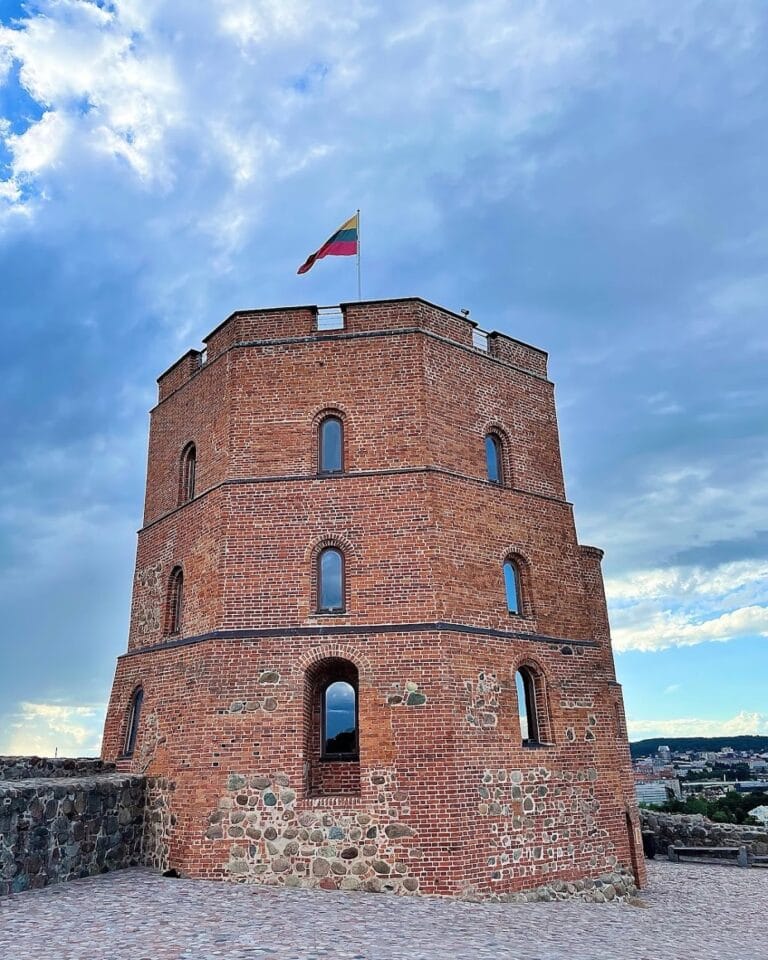
The western tower is the surviving Gediminas Tower, the best-preserved vertical element of the fortress. Only its two lower levels belong to the surviving historic fabric, while the upper part reflects later alteration and reconstruction. The tower now contains a museum and serves as a viewing platform.
Castle House
The eastern part of the fortress contained the Castle House, the principal residential and representational building within the complex. Its ruined Gothic remains survive among the archaeological components of Upper Castle.
Reception hall
The rebuilt fortress included a ceremonial reception hall measuring 10 by 30 metres. Its dimensions indicate the courtly functions that accompanied the castle’s defensive role during the reconstruction ordered by Vytautas.
Burial area on the northern slope
A small area on the northern slope was used in 1863 for the night burial of people executed at Lukiškės Square during the January Uprising, an insurrection against Russian rule that began that year in the former Polish–Lithuanian territories. Antoni Wiwulski designed a wooden cross erected there in spring 1921, and Vilnius authorities placed two Polish-language memorial plaques beside it in 1925. Soviet authorities destroyed the monument in 1940.
The hillside burial area also contains the grave of Polish General Zygmunt Sierakowski, which archaeologists identified at the beginning of 2017. The grave, together with the location of the destroyed cross and memorial plaques, forms part of the commemorative remains associated with the northern slope of Castle Hill.