Château d’Ambleville: A Renaissance Château on Medieval Foundations


Site at a Glance
- Rating
- 4.2
- Popularity
- Low
- Country
- France
- Primary era
- Early Modern
- Eras represented
- Medieval, Early Modern
- Civilizations
- French
- Site type
- Domestic
- Remains
- Castle
On this page14 sections
History
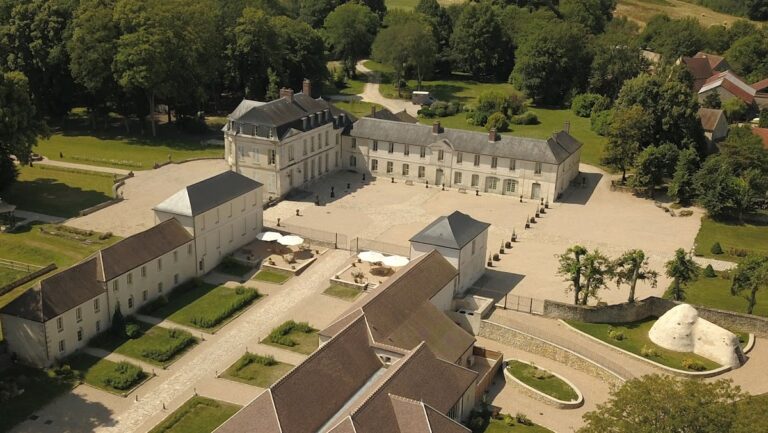
Château d’Ambleville is a Renaissance château in Ambleville, France, built through the transformation of a medieval fortress on the banks of the Aubette. The site stands near the historic boundary between Île-de-France and Normandy. A fortress is documented here from the eleventh century, while the foundations of the château are attributed to the thirteenth century. Its fortified position helped defend the Aubette valley before the residence was reshaped as a more formal Renaissance house in the early sixteenth century.
Medieval fortress and the Essarts lordship
The lordship of Ambleville was first mentioned in the thirteenth century, when it was held by the Essarts family. The family retained it until 1470, when the estate passed by marriage to the Mornay family. The medieval residence was a fortified château, a noble dwelling equipped with defensive features such as moats, strong walls, and a principal fortified tower. Its position along the Aubette gave the fortress a military role in the surrounding valley.
The Renaissance transformation
Louis de Mornay commissioned the architect Jean Grappin to transform the medieval château in the early sixteenth century. Rather than replacing the entire complex, the work applied a Renaissance façade to its north side. The Renaissance was a European artistic and cultural period that revived Classical forms, symmetry, and ancient models. At Ambleville, this approach adapted a fortified medieval residence to the ceremonial and residential expectations of the period.
The Mornay family continued to own the estate until 1711. Madame de Maintenon, a French court figure who later became the morganatic wife of Louis XIV, stayed at nearby Villarceaux with the “Children of France.” She may have visited Ambleville, which belonged to the cousin of her protector, but the visit remains uncertain.
Eighteenth-century changes and ownership
The medieval keep was demolished in the mid-eighteenth century. A wing replaced it at the end of that century, and the château was also remodeled in the Classical style. These changes altered the surviving relationship between the medieval stronghold and the later residence.
After the Mornays, the Marolles family owned Ambleville from 1711 to 1737, followed by the Labbé family until 1774. Grégoire Alexandre Dupuis de Gerville, the last owner under the Ancien Régime, retained the estate until 1818. The Ancien Régime was the French political and social order that existed before the Revolution of 1789.
Nineteenth- and twentieth-century restoration
The château was sold at auction in 1819 to the Filleul d’Amertot family. They sold it to the Cavelier de Montgeon family in 1860. Antoine-René Hamot acquired the estate in 1886 and sold it the following year to Ernest Leprêtre, who acted as a nominee in the transaction. The farms and the château’s inventory were excluded from that sale.
Charles Sedelmeyer purchased the château in 1893. A prominent art dealer, he undertook an expensive restoration, installed a theater, and brought sixteenth-century fireplaces and Venetian balconies back into the building. After Sedelmeyer’s death in 1925, the Tulle de Villefranche family acquired Ambleville three years later. They already owned Villarceaux and retained the château until 2003.
The gardens were remodeled in 1928 by the Marquise de Villefranche. Her design drew on the gardens of the Villa Gamberaia in Florence, restored in 1906, and produced an accomplished Italian-style formal garden. In 2003, the Coutau-Bégarie family became the owners and began a major campaign to reconstruct the original gardens and restore the château in cooperation with the historic-monuments authorities.
The château’s façades and roofs were classified as historic monuments on 20 June 1945, while the remainder of the building had been listed in 1926. The park and the façades and roofs of the outbuildings were listed in 2006. The estate also lies within the Regional Natural Park of the Vexin français and holds the Jardin remarquable designation of the French Ministry of Culture.
Remains
Château d’Ambleville combines a medieval fortified foundation with a Renaissance transformation and later Classical alterations. The complex includes the château, its park, and associated outbuildings. The former defensive setting was shaped by moats and by the château’s position beside the Aubette, while the north façade preserves the Renaissance facing commissioned by Louis de Mornay.
Château and gardens
Renaissance façade and later wing
The north side retains the Renaissance façade added in the early sixteenth century under Louis de Mornay and Jean Grappin. It forms the visible Renaissance treatment of an older fortified residence. The medieval keep was removed in the mid-eighteenth century, and a replacement wing was built at the end of that century. The building consequently retains evidence of three principal phases, medieval fortification, Renaissance remodeling, and Classical-era change.
Terraced Italian-style park
Behind the château, the gardens form a terraced Italian-style park. An Italian Renaissance garden is a formal landscape arranged through terraces, geometric divisions, sculpture, and controlled views. The grounds draw on the design of the Villa Gamberaia in Florence and preserve the character of a formal Italian Renaissance garden. Their present form also reflects the 1928 remodeling by the Marquise de Villefranche and the later campaign to reconstruct the original gardens.
Interiors and collections
Architectural and decorative elements
The interiors contain sixteenth-century fireplaces and Venetian balconies brought back during Charles Sedelmeyer’s restoration. A theater was also installed during that campaign. The rooms include a portrait of Louis XVIII in coronation robes, produced in the workshop of Baron Gérard around 1814, as well as other portraits dating from the seventeenth and eighteenth centuries.
Several important cabinets survive inside the château. The Cabinet of Cephalus and Procris is an ebony cabinet made by Pierre Gole around 1645. Another ebony cabinet, the Chariot of Ceres and Pluto, was made in Paris around 1650. Ebony cabinets by Jean Armand, dating from around 1640, came from Château de Beaumesnil and had been commissioned by Jacques Le Comte, Marquis of Nonant and Baron of Beaumesnil.
Furniture and woodwork
The furniture represents several periods of French craftsmanship. It includes a marquetry commode in the tombeau form from the Régence period, around 1730, and a Boulle-marquetry writing table attributed either to a son of André-Charles Boulle or to Oppenord, also around 1730. Marquetry is decorative inlay made from contrasting materials, while Boulle marquetry commonly combines tortoiseshell, metal, and other materials. A small ebony writing table also dates from the Régence period, the French Regency between the reigns of Louis XIV and Louis XV.
Other pieces include a Louis XIV table veneered with red tortoiseshell and inlaid with flowers and birds, attributed to Pierre Gole; two Louis XIV oak consoles with stretchers; and Louis XIV commodes veneered in rosewood. A Louis XVI mahogany table has ten legs and accommodates twenty-four place settings. The collection also contains an eighteenth-century mahogany and citronwood console from the end of the century and a Louis XIV two-body buffet.
Seating and bedroom furnishings include a large Renaissance-style oak library, Northern Italian Louis XIV armchairs, Louis XIII seating, and a pair of Louis XIII tapestry armchairs. A small traveling sofa from around 1750 converts into a bed and is upholstered in wool velvet. Other pieces include a Louis XIII canopied bed in damask with Hungarian-point embroidery, Louis XV-style chairs in figured velvet, and Louis XIV-period salon furniture with silk covers dating from around 1700.
Wall hangings, mirrors, and sculpture
Decorative furnishings include a gilded leather wall hanging from Avignon, probably made by Boissier around 1670, with matching chairs in Cordovan leather. Gothic-style display cases dating from around 1850 contain Limoges enamels, and an engraved ebony mirror belongs to the Louis XIV period.
The sculptural works include marble busts of Roman emperors mounted with their columns, a large bronze group based on the ancient Farnese Bull from the period of Napoleon III, and a plaster bust of Henry IV dating from around 1830. The collection also contains a pair of white-marble statues by Charles-Antoine Bridan and a large colored-marble bust of Cosimo de’ Medici based on the work of Benvenuto Cellini.
Oudenaarde tapestries
The textiles include an Oudenaarde tapestry from around 1580 depicting the reconstruction of the Temple of Jerusalem. Oudenaarde was a historic tapestry-producing center in present-day Belgium. A set of six Oudenaarde tapestries from around 1610 depicts pastoral festivities and the loves of Gombault and Macée, adding a series of woven historical and pastoral subjects to the château’s interiors.