Yu Aw Synagogue: A Former Orthodox Jewish House of Worship in Herat, Afghanistan


Site at a Glance
- Rating
- 4.1
- Popularity
- Very Low
- Country
- Afghanistan
- Primary era
- Medieval
- Eras represented
- Medieval
- Civilizations
- Timurid
- Site type
- Religious
- Remains
- Synagogue
On this page8 sections
History
Yu Aw Synagogue is a former Orthodox Jewish synagogue in Herat, Afghanistan, in the western part of the country. Orthodox Judaism is a Jewish movement centered on traditional Jewish law and ritual practice. The building stands in the old city’s Momanda neighborhood, an area formerly called Mahalla-yi Musahiya, meaning the “Neighborhood of the Jews.” Its construction date is uncertain, although some researchers place its establishment or construction in 1393. Yu Aw was one of four synagogues once located in Herat and retains the greatest proportion of its original features.
Herat’s Jewish community
Archaeological excavations in 1978 uncovered four historic synagogues in Herat’s Bar Durani and Momanda quarters, including Yu Aw. The discoveries provided evidence of the Jewish religious and residential districts that had existed within the old city. The quarter also included a Jewish ritual bath, later converted for Muslim use, and a cemetery containing approximately 1,000 graves.
When Israel was founded in 1948, the approximately 280 Jewish families living in Herat began leaving the city. Afghanistan had no Jewish residents by 2021, and the last Jewish resident reportedly left the country in September of that year. Yu Aw Synagogue consequently became an abandoned religious building, preserving part of a community that no longer maintains a permanent presence in Herat.
Reuse and modern conservation
At an uncertain date, the synagogue was converted into an infant school. It housed a kindergarten in 2009, when the local government restored part of the complex with funding from the Aga Khan Trust for Culture, a cultural-development organization that supports historic preservation and related urban projects. Local craftsmen later restored the blue, hand-painted interior dome with funding from the Islamic Republic of Afghanistan. That work largely halted after the government fell during the 2021 Taliban offensive. The synagogue remains badly damaged and in disrepair, although it is the Herat synagogue that has preserved most of its original characteristics.
Remains
Building and courtyard
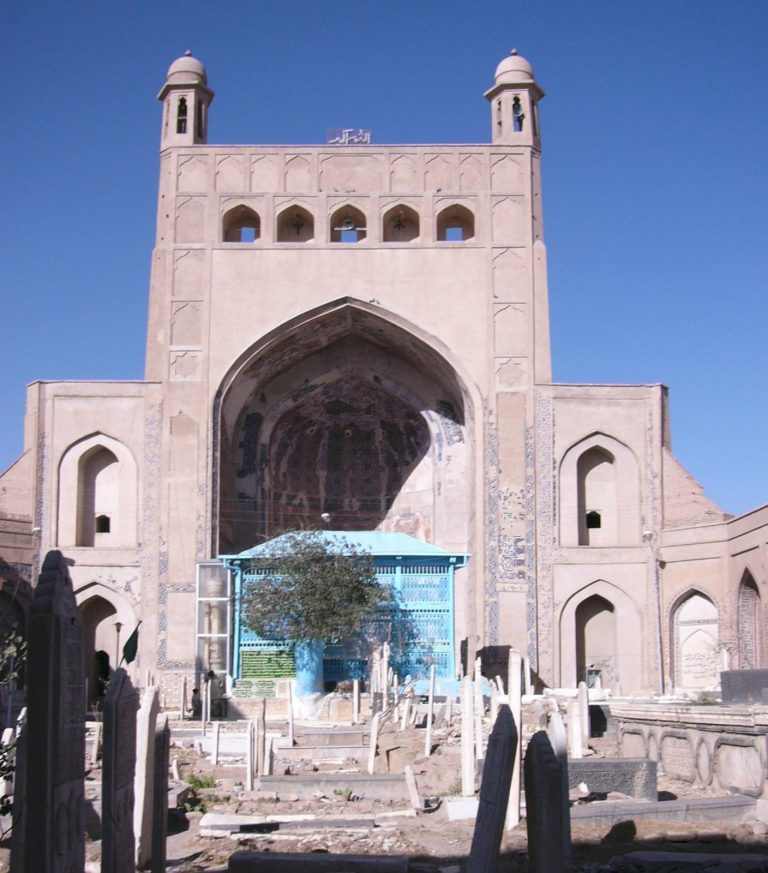
Yu Aw Synagogue is a two-story mud-brick building on a brick base, arranged around a courtyard and marked by a strongly Persian or Iranian architectural character. Its façade faces west. Structures or remains along the east, north, and south sides of the courtyard are now used as family housing. A basement room in the west-side structure serves as housing for an employee of the Herat Department of Historic Monuments Preservation, while the rest of the complex is in a precarious condition.
Prayer hall
The main prayer hall is octagonal and has painted stucco decoration, a plaster-like finish that can be modeled, painted, or carved. Floral designs dominate the interior, including flowering “trees of life” and paisley motifs beside the Torah ark. The ark, the cabinet where Torah scrolls are kept, stands high in the western wall, faces Jerusalem, and is reached by stairs. Three Hebrew inscriptions or sentences appear on the north wall above the stairway.
An arcade along the southern side of the prayer hall contains a partition with small decorative openings. This was the women’s gallery, a designated area separated from the main prayer space for women’s participation in worship. Beneath the central dome, a low open bimah remains intact. A bimah is the raised platform used for reading the Torah. The dome retains blue, hand-painted decoration on its interior.
Associated ritual bath
The associated mikveh survives near the synagogue. A mikveh is a Jewish ritual bath used for religious purification. Formerly called Hamman-e Yahudiha, the bath was converted into a hammam for Muslim men, preserving a later use of a structure connected with the former Jewish quarter.
Excavated synagogue remains
Yu Aw was one of the four historic Herat synagogues excavated in 1978. The best-preserved Torah ark from those four buildings was transferred to Beth Hatefutsot, a Tel Aviv museum devoted to Jewish history and the Jewish diaspora.