Herat Citadel: A Historic Fortress and Seat of Power in Afghanistan




Site at a Glance
- Rating
- 4.5
- Popularity
- Medium
- Country
- Afghanistan
- Primary era
- Medieval
- Eras represented
- Medieval
- Civilizations
- Timurid
- Site type
- Military
- Remains
- Citadel
On this page13 sections
History
Herat Citadel is a historic fortress in Herat, Afghanistan, associated with a fortified settlement that may have included a stronghold established by Alexander the Great around 330 BC after his victory over the Achaemenid king Darius III at Gaugamela. Known locally as Qal’a-i Ikhtiyar al-Din and also as the Citadel of Alexander, it stands beside the northern side of Herat’s old city.
Early Herat and the Kartid rebuilding
The area around Herat belonged to the Achaemenid satrapies, provincial territories governed within the Achaemenid Empire. It later passed under Seleucid, Parthian, Kushan, Sasanian, Hephthalite, Umayyad, Tahirid, Saffarid, Samanid, Seljuk, Ghaznavid, and Ghurid rule. Herat’s position on the Silk Road, a network of long-distance routes linking western, central, and eastern Asia, brought prosperity and helped the city become important under the Ghurids around 1175.
The Mongol conquest destroyed Herat in 1221. The citadel served as a refuge during Genghis Khan’s campaign, but it was captured after a long siege the following year. Twelve thousand soldiers were executed, and a later revolt reportedly left only 40 soldiers and 12 inhabitants alive. The city and citadel were rebuilt under the Kartids, a Persianate ruling house that governed from Herat during the thirteenth and fourteenth centuries. The Kartids established their government at Herat in the mid-thirteenth century.
Kartid Amir Fakhr al-Din strengthened the citadel’s towers, walls, ramparts, and moat in 1299–1300. He also added a walled field to the west for use as an open-air mosque. His successor, Ghiyath al-Din, built two palaces in the eastern part of the citadel. The name Ikhtiyar al-Din, applied to the eastern and western compounds, is believed to come from the name or epithet of a Kartid emir or military commander.
Timurid reconstruction
Timur, the Central Asian conqueror also known as Tamerlane, destroyed the citadel for a second time around 1380. After his son Shah Rukh transferred the Timurid capital to Herat, he rebuilt and strengthened the fortress. The principal reconstruction took place from 1415 to 1417 and employed about 7,000 workers. During the fifteenth century, the citadel served as the stronghold of the Timurid capital, while Herat became a major centre of art and culture.
Later military and royal use
Uzbek forces captured the citadel in 1507. It subsequently served at different times as a garrison, a seat of political power, and a prison. Nadir Shah captured Herat in 1732 and attacked the citadel. During the eighteenth century, under the Hotaki dynasty and the Durrani Empire, the fortress was used as a royal residence, treasury, prison, and arsenal.
The citadel was damaged during the unsuccessful siege led by Mohammad Shah Qajar in 1837–1838. A separate modern citadel was built immediately to the north in the mid-nineteenth century to take over the older fortress’s defensive role. Herat was later taken by Dost Mohammad Khan after a ten-month siege against Pashtun tribal forces.
Twentieth-century decline and conservation
Changes to Herat’s fortifications continued in the twentieth century. The walls were bypassed by the 1931 “Yellow Cruise,” and sections were demolished during the 1940s, particularly toward the newer northwestern part of the city. The army stopped occupying the citadel in 1953, after which civil authorities took control. Materials had already been removed for military construction and through local depredation, leaving the monument in very poor condition by 1963. Public concern led Mohammad Zahir Shah to order measures to stop its dismantling.
Archaeological work and restoration supported by UNESCO, the United Nations Educational, Scientific and Cultural Organization, took place from 1976 to 1979. Soviet bombardment damaged the citadel in 1979 during the Soviet-Afghan War, but repairs followed. The Afghan Institute of Archaeology worked with Soviet experts at the site until 1983, and an artillery shell damaged the decoration of a tower in 1993.
A local museum opened in May 1994. After the Taliban captured Herat in 1995, the citadel was used by the secret police. The Northern Alliance retook it in 2001, and military authorities still occupied the site in 2007. A major reconstruction and conservation programme ran from 2006 to 2011, involving hundreds of Afghan craftspeople and support from the Aga Khan Trust for Culture. The Ministry of Information and Culture of Afghanistan administers the complex. The restored citadel houses museums and archaeological displays after surviving threatened demolition, prolonged deterioration, wartime damage, and periods of neglect.
Remains
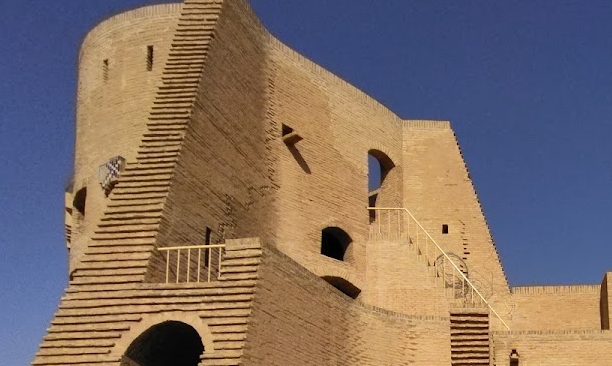
The present citadel consists of two walled compounds on different levels. The older eastern compound, known as the Upper Citadel, occupies higher ground, while the western Kartid addition is called the Lower Citadel. The current overall plan dates from Shah Rukh’s fifteenth-century rebuilding. Walls about 2 metres thick and 16 metres high enclose the complex, which contains 22 towers in total.
The two fortified compounds
Upper Citadel
The Upper Citadel is built of fired brick and has an approximately rectangular plan measuring about 18 by 42 metres. Thirteen semicircular towers protect it, with two flanking a gate that faces west. Excavation removed some of the debris that had accumulated within the compound and revealed two courtyard structures. Its northern section was reconstructed as a traditional residence, while the wider Upper Citadel was opened as an open-air archaeological museum.
Lower Citadel
The Lower Citadel has a polygonal plan measuring approximately 25 by 60 metres. It contains military structures dating from the Timurid period. Nine circular towers formed part of its defences, and six survive along the southern and western walls. The lower walls are built of fired brick.
Walls, towers, and decoration
Timurid surfaces
Shah Rukh’s rebuilding used stone and fired brick, with glazed tiles covering the exterior. The towers were decorated with ceramic mosaics and calligraphy. Most of this decoration has disappeared, although portions remain on the northwestern tower.
Malik Tower
The tall Malik Tower stands on the western wall and is believed to have been named after a Kartid malik, or ruler. It preserves sections of Timurid glazed-tile decoration, including parts of a band carrying Kufic inscriptions. Kufic is an angular early form of Arabic script frequently used for monumental writing and architectural ornament.
Associated spaces and museum collections
The western Kartid addition included a walled maidan, an open public field, intended for use as an outdoor mosque area. Two palaces constructed by Ghiyath al-Din were located in the eastern compound. A training ground once lay near the citadel, but it was transferred to residential use when the new city began to be built from 1928.
After restoration work in the 1970s, the Lower Citadel contained an ethnographic museum, a military museum, craft workshops, and an archaeological museum. The complex stores approximately 1,100 objects from Herat Province, of which 250 are currently displayed.