Friday Mosque of Herat: Afghanistan’s Historic Congregational Mosque



Site at a Glance
- Rating
- 4.6
- Popularity
- Medium
- Country
- Afghanistan
- Primary era
- Medieval
- Eras represented
- Medieval, Modern
- Civilizations
- Ghurid, Timurid
- Site type
- Religious
- Remains
- Mosque
On this page16 sections
History
The Friday Mosque of Herat is a Sunni congregational mosque in Herat, Afghanistan, built and repeatedly transformed by successive Islamic dynasties. It was the city’s first known congregational mosque and remains an active Friday mosque. The site has served religious purposes for many centuries, beginning with a Zoroastrian fire temple that was converted into a mosque in the seventh century.
Early Mosques and Ghurid Rebuilding
The early Islamic building was enlarged under the Turkic Ghaznavids. Under the Khwarazmian dynasty, a mosque was established on the site during the second half of the eleventh century. It was smaller than the later complex and had a wooden roof. An earthquake in 1102 almost destroyed it, and although it was rebuilt, a later fire again left the building in ruins.
Ghurid forces seized Herat in 1175. At the end of the twelfth century, Sultan Ghiyath al-Din Muhammad ibn Sam began rebuilding the main mosque on the burned structure’s plot and adjoining land. The mosque stood in the north-eastern administrative quarter, probably on raised ground, and had a direct water supply from the Joy-i-Enjil canal for its fountain. Its reconstruction expressed Ghurid architectural patronage and political authority, and may also have been commissioned for Imam Fakhr al-Razi.
Ghiyath al-Din laid the foundation around 1200 and died in 1203. His son, Sultan Ghayath al-Din Mahmud, continued the project, which was completed in 1210. Ghiyath al-Din was buried in a mausoleum within the mosque, while the Ghayathiyya madrassa, an Islamic religious school, was added to the north. Historical inscriptions found during restoration in 1964 and stylistic analysis associate the principal early structure with the Ghurids, a medieval dynasty that controlled Herat in the late twelfth and early thirteenth centuries.
Mongol and Kartid Reconstruction
In 1221, Mongol forces under Genghis Khan conquered the province. The conquest, which brought much of Herat under Mongol control and caused widespread destruction, left the mosque in ruins. Rebuilding began after 1245 under Shams al-Din Kart, a Kartid ruler appointed governor by the Mongols. The Kartids, also called the Kart dynasty, ruled Herat as Mongol-appointed governors and kings during the thirteenth and fourteenth centuries.
A devastating earthquake in 1364 left the mosque almost destroyed, prompting further rebuilding efforts. In 1375, the Kartid ruler commissioned a large bronze basin specifically for the mosque. The basin survives within the complex and is one of the material links to the Kartid period.
Timurid Patronage
After 1397, Timurid rulers directed Herat’s urban growth northward and built a new congregational mosque in the Musalla of Gawhar Shad. Royal support for the older Friday Mosque consequently declined for a time, although Shah Rukh repaired it between 1405 and 1444. The Timurids made Herat a major political and cultural center, and their architectural style was associated with elaborate glazed-tile mosaics and monumental iwans.
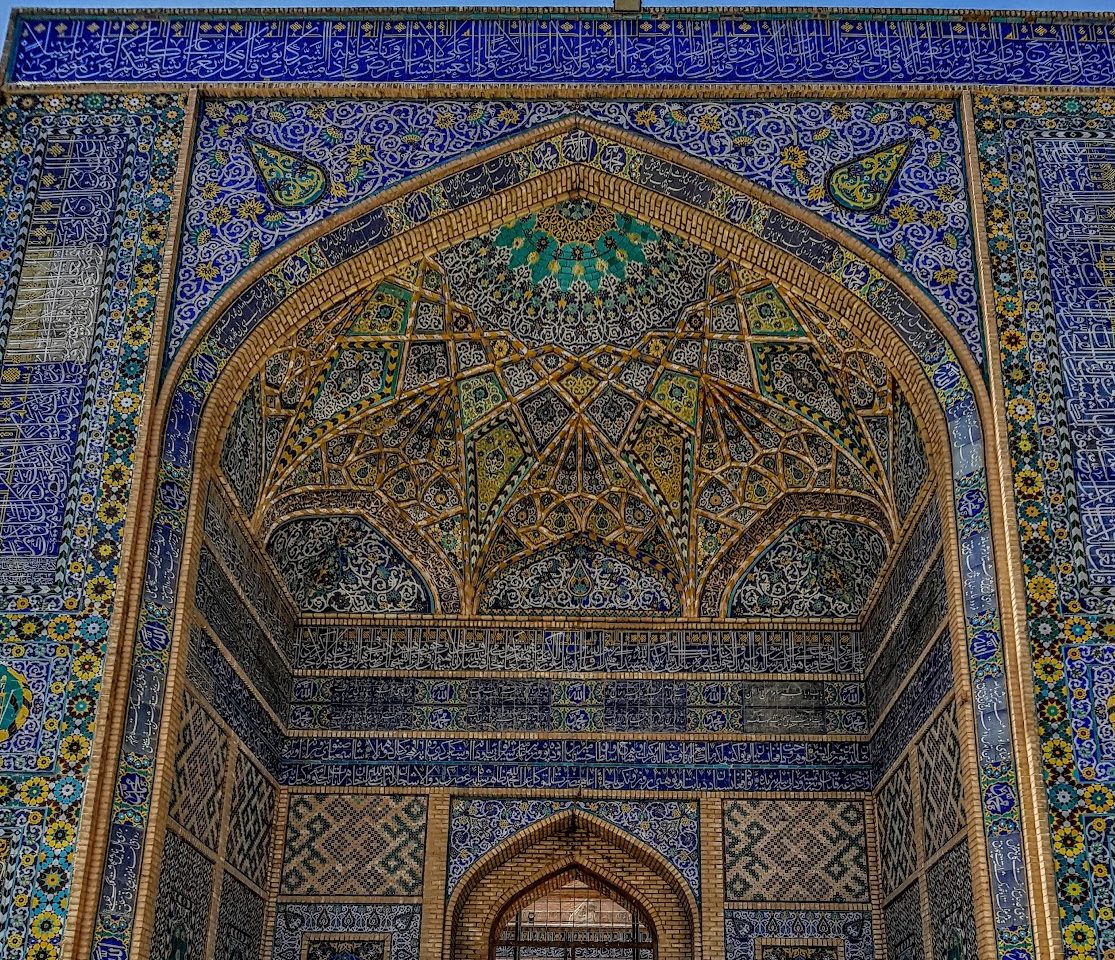
Shah Rukh retained the mosque’s ground plan but altered its exterior. Glazed-tile mosaics bearing his name were applied to the courtyard facades, and a marble mihrab, a wall niche indicating the direction of prayer, was installed west of the mosque. This Timurid phase is regarded as the mosque’s period of greatest magnificence.
During the reign of Sultan Husayn Bayqara, his adviser Mir Ali-Shir Nava’i directed further remodeling. The Ghurid archway at the south-eastern corner was lowered, additional arches were built at roof level, and geometric mosaic tiling was extended across other parts of the complex. A nine-step marble minbar, the pulpit used for sermons and prayers, replaced the earlier wooden one.
Mughal and Afghan Repairs
The mosque was renovated again under the Mughal Empire. During Prince Khurram’s struggle for control of the region against Uzbek forces associated with the Safavids, both the mosque and the city of Herat suffered considerable damage. Afghan rulers later repaired the building repeatedly. In the eighteenth century, the frontal facade of the principal Timurid iwan collapsed and was rebuilt, while other interventions sought to preserve the mosque’s established form.
Twentieth-Century Reconstruction and Conflict
Repairs in 1913 were followed by extensive renovation in 1942 and 1943. Adjacent buildings were demolished to leave the mosque free-standing, and a new eastern entrance with a high arch and two minarets was constructed. A ceramic-tile studio established by UNESCO operated at the mosque until 1979, helping preserve its tile decoration and mosaic techniques.
A more comprehensive reconstruction took place between 1951 and 1973. It brought major structural alterations, including the rebuilding and integration of the Ghurid mausoleum dome, changes to the eastern wall and maqsura iwan, the addition and heightening of minarets, renewal of the porch, and the relocation of the madrassa to the north-east with a separate entrance. A park was also created in front of the mosque. These changes left much original Ghurid plasterwork and Timurid decoration concealed from view.
During the Soviet-Afghan War from 1979 to 1989, Soviet soldiers and tanks caused damage around the mosque. In 1986, a rocket struck a minaret, which collapsed into the courtyard, killing many people and damaging the eastern wing. Soviet specialists began repairs that were not completed until 1995. Bullet holes and other traces of the conflict remained, while the Ghurid portal escaped serious damage.
Replacement of the courtyard’s stone plaster began in 1992 with private funding. The work used alternating broad white-marble and narrow black-marble strips, but insufficient donations delayed its completion until 1998. During Taliban rule in Herat from 1996 to 2001, all non-Muslims, including United Nations personnel, were prohibited from entering the mosque.
Recent Conservation
All roofs were repaired in 2002 because of excessive interior humidity. Restoration of the facades in 2004 and 2005 uncovered portions of older Ghurid decoration, which were then displayed in frames within the wall cladding. Modern conservation has involved engineers, tile makers, and calligraphers, while twentieth-century restoration revived traditional mosaic-tile production and historic building techniques. A local tradition holds that work on the mosque can never be completely finished.
Remains
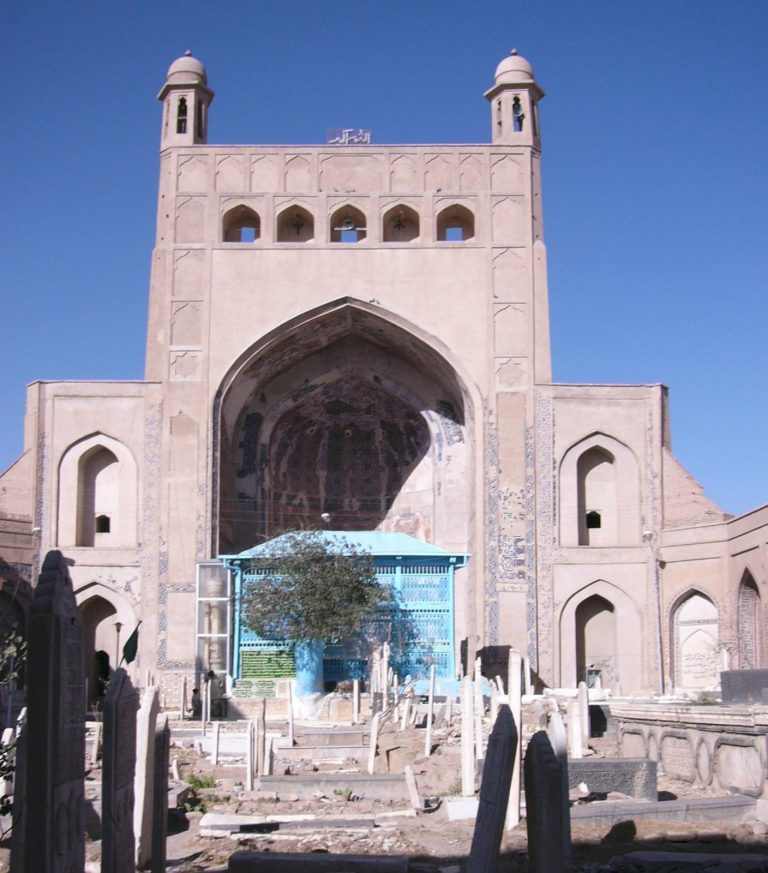
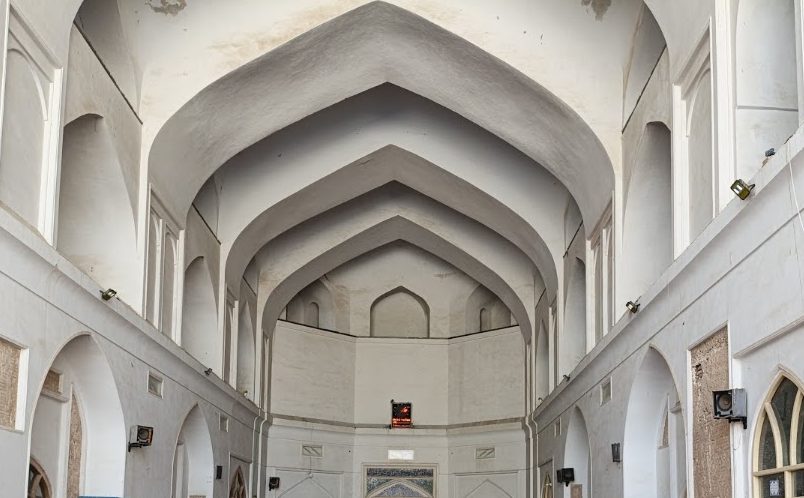
The Friday Mosque of Herat is a large brick complex organized around a central courtyard and four vaulted iwans, halls open on one side. It measures approximately 180 metres from east to west and 120 metres from north to south, covering about 21,600 square metres. The courtyard measures approximately 82 by 60 metres. The complex contains four large iwans, about 460 domes, 444 pillars, 130 arcades, four gates, three smaller courtyards, 12 minarets, a library of about 4,000 books, and an ablution facility.
Courtyard and Iwan Plan
Four-Iwan Layout
The original Ghurid mosque was built entirely of brick on a four-iwan plan. The four vaulted iwans face the internal courtyard, with the principal iwan forming an axial cross with the other three. The three secondary iwans served as meeting and teaching places for smaller audiences. The mosque’s qibla, the direction of prayer, faces west, approximately 20 degrees away from the correct direction toward Mecca.
The depth of the iwans and their pishtaq gateways, monumental arched entrances, provide broad surfaces for ornament. Much of the present mosque is covered in brightly coloured glazed tiles in the Timurid tradition, including seven-colour mosaic work on the courtyard facades. The courtyard floor was paved with light-brown baked bricks during the twentieth-century reconstruction, and parts of its plaster were later replaced with alternating wide white-marble and narrow black-marble strips.
Ghurid Features
Sultan Ghiyath al-Din’s Mausoleum
The mausoleum of Sultan Ghiyath al-Din was originally covered by a square dome. After severe damage, the dome was replaced by an octagonal construction and incorporated into the northern front of the mosque. The rebuilding preserved the ruler’s burial place within the complex while adapting the structure to later phases of the mosque.
South-Eastern Portal
The Ghurid portal stands at the south-eastern corner. Its archway has not functioned as an entrance for a long period, but both sides preserve Kufic inscriptions, an angular style of Arabic script frequently used for early Islamic writing. The vertically arranged inscription bands are made of terracotta set into the mortar like mosaic. Their fronts are glazed blue against light-red brick, while the side walls contain geometric brick mosaic with blue glazed-tile inserts.
Ghurid-period stucco, a mouldable plaster-like material used for architectural ornament, survives inside the southern and western iwans. It carries stamped floral and geometric patterns. Other parts of the early decorative scheme were revealed during the 2004 and 2005 facade restoration and are displayed in frames within the wall covering.
Timurid and Later Additions
Eastern Entrance and Ruler’s Enclosure
The eastern wall was transformed into an iwan flanked by minarets. The maqsura iwan, an enclosed area reserved for a ruler or other high-ranking authority, was raised, and its adjacent minarets were heightened to 35 metres. Ten additional minarets were added during the reconstruction between 1951 and 1973. The eastern entrance built in 1942 and 1943 has a high arch and two minarets, contributing to the mosque’s later eastern frontage.
Mihrab, Minbar, and Bronze Basin
The Timurid marble mihrab is located west of the mosque. Nearby, the marble minbar has nine steps and replaced an earlier wooden pulpit. The bronze basin commissioned in 1375 by the last Kartid ruler has a diameter of 1.74 metres. It survived later demolitions with only a few scratches and remains within the mosque.