Ytterselö Church: A Medieval Parish Church in Sweden
Site at a Glance
- Country
- Sweden
- Primary era
- Medieval
- Eras represented
- Medieval, Early Modern, Modern
- Civilizations
- Swedish
- Site type
- Religious
- Remains
- Church
On this page17 sections
History
Medieval foundation and growth
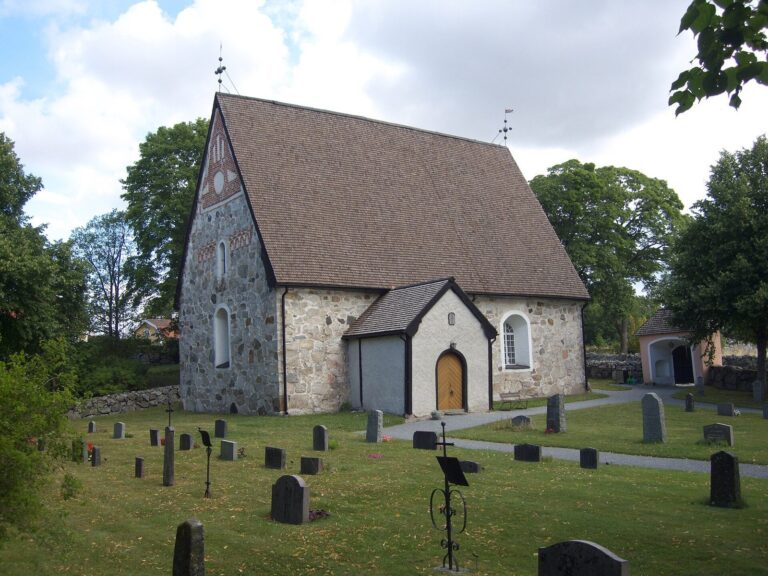
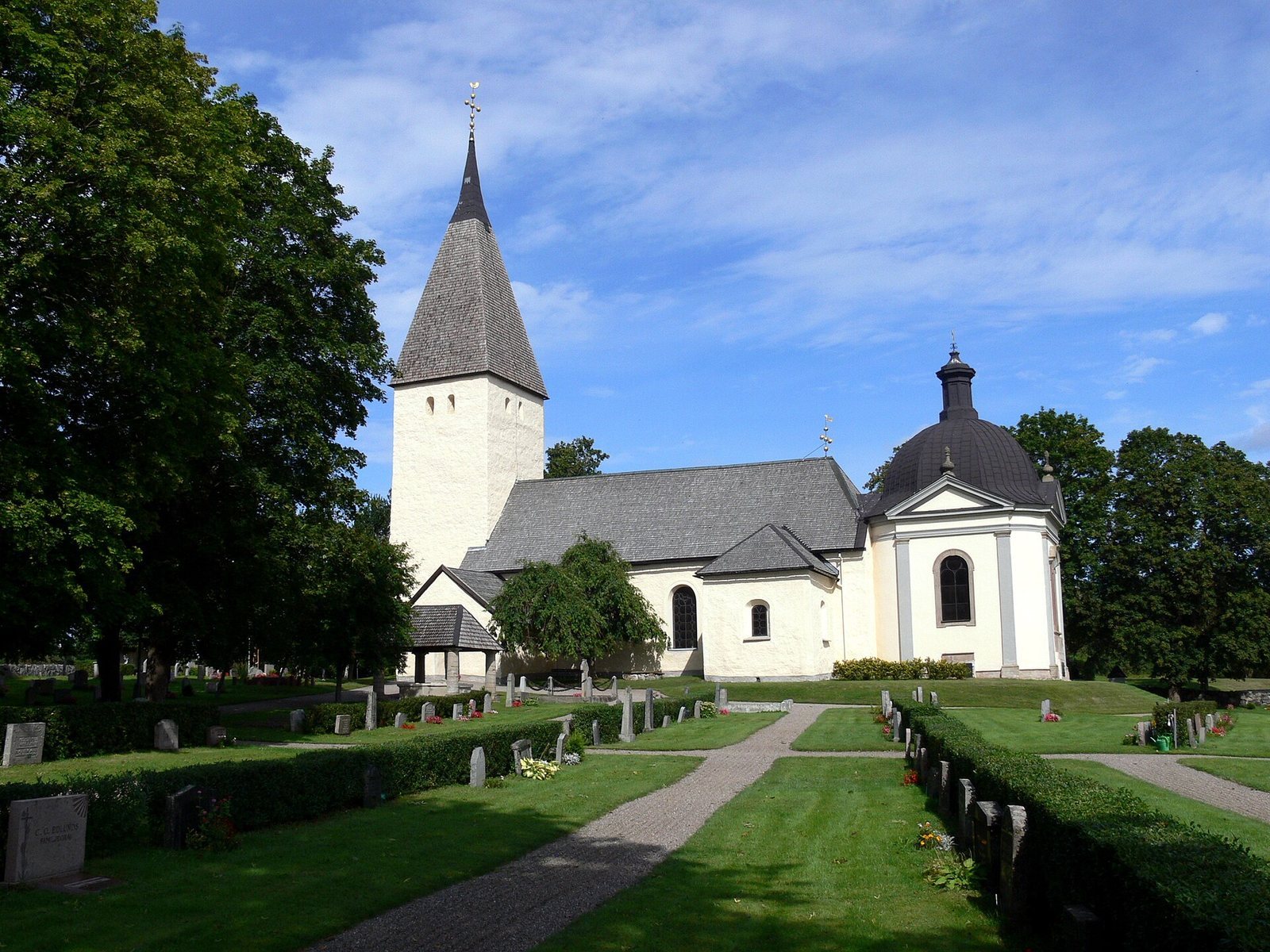
Ytterselö Church is a medieval parish church on the southeastern corner of Selaön in Stallarholmen, Sweden. It serves Stallarholmen parish in the Diocese of Strängnäs, part of the Lutheran Church of Sweden, an institution organized into dioceses and local parishes. The church was probably built with a western tower and consecrated during the twelfth century.
It was extended eastward, perhaps in the fourteenth century, when a sacristy was added. By about 1500, the church had acquired a porch and taken on the form of its present nave. Olav Haraldsson, a Norwegian king who came to be venerated as Saint Olaf, is said to have been the church’s patron saint.
Patronage and early modern changes
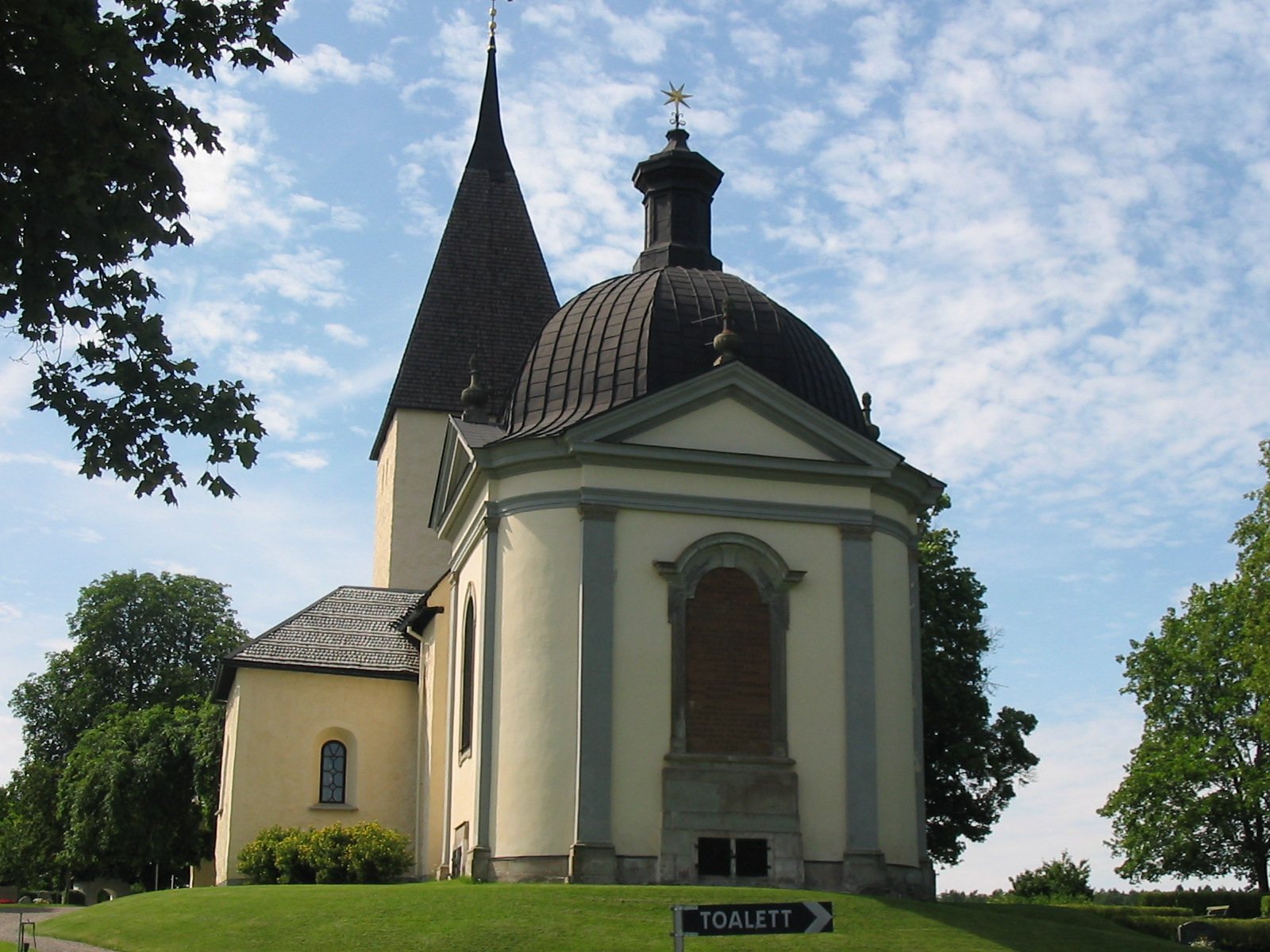
In 1650, a burial chapel for the Soop family of Mälsåker was built on the south side of the church. A drawing made in 1684 by Swedish antiquarian Johan Peringskiöld shows that the tower’s tall pyramidal spire was already in place by then.
The high chancel was built in 1728. A burial vault beneath it served the owners of Mälsåker. Those buried there included Anna Maria Soop, her children, and her husbands, Count Axel H. Wachtmeister and Count Carl E. Gyllenstierna.
Cemetery and later changes
The cemetery’s north and south gate piers were erected in 1794, replacing earlier gates on the same sites. The southern gate dated from 1679 and followed a medieval roofed cemetery gateway, while the northern gate dated from 1699.
The church’s pews date from 1909. In 1938, an eastern cemetery entrance was built to match the pattern of the north and south gates, and a mortuary chapel was added in the cemetery’s northeast corner. The church’s triumphal crucifix was restored in 1964, and its present organ was built in 1965 by Grönlunds Orgelbyggeri AB.
Remains
The church stands within a cemetery enclosed by a dry-stone wall. Its building combines a white-plastered main body and patterned wooden-shingle roof with a distinct high chancel. The interior preserves medieval brick vaults, carved religious furnishings, and later objects associated with worship and burial.
Church building and furnishings
Exterior and chancel
Except for the chancel, the church is coated in white plaster and roofed with tarred wooden shingles arranged in a pattern. The tower has small bell openings set high in its walls and a tall pyramidal spire. Round-arched windows in the nave date from the nineteenth century. The high chancel has a copper-covered domed roof topped by a small lantern. It follows Carolinian architecture, a Swedish style associated with the late seventeenth and early eighteenth centuries and the reigns of Charles XI and Charles XII.
Vaults and interior
The nave has three brick vault sections with star-shaped patterns, dating to around 1475. In the western section, the vaults rest on pillars; farther east, they rise directly from the walls. Intersecting vaults, known as cross vaults, cover the tower chamber, the southern burial chapel, the sacristy, and the porch. The church interior is whitewashed. A pulpit against the north wall is said to date to around 1600 and was originally painted, probably with Evangelists in its framed panels.
Two of the church’s twelve consecration crosses survive. Such crosses mark places anointed during a church’s consecration. A fragment of wall painting remains on the north wall and may be an epitaph. It has been tentatively attributed to Anders Jordansson Ryttare, also known as AIR, who painted Glanshammar Church in Närke in 1589.
Baptismal font
The oldest furnishing is a baptismal font made from Mälar sandstone in the twelfth century. Its cylindrical bowl slopes inward toward the base and is carved with animals and curling foliage. On the foot, a complete animal in profile alternates with a forward-facing animal head in low relief. A semicircular ring joins the foot to the bowl. Comparable fonts occur elsewhere in the Mälaren region.
Altarpiece and carved images
The altar is dominated by a carved cabinet altarpiece made in Antwerp, Flanders, around 1500. Its central section rises in a rounded form characteristic of Antwerp work. Mary holds the infant Jesus at the centre, with Saint Botvid, a saint venerated in the medieval Mälaren region, shown with an axe and fish, and Saint Eskil, a bishop and regional saint, carrying three stones. An upper figure in eastern-style dress probably represents Isaiah, a prophet in the Bible. The carved faces are notably lifelike. Mary holds an open book and is crowned as Queen of Heaven; the naked infant Jesus, covered below the waist by a cloth, plays with the book and crumples a page. The back has late-medieval Swedish foliage scrolls. Intertwined vines, two male figures, and a Marian hymn decorate the base; the vines are of a type dating to around 1520.
A large image of Olav Haraldsson, made in the late fifteenth century, shows him seated, bearded, and holding an orb. A statue of Mary with the infant Jesus dates to the second half of the fifteenth century; Mary wears a metal crown, and Jesus is represented as a naked infant. The triumphal crucifix, a late work from around 1510, hangs in the centre of the church. Christ has crossed feet and a short knotted loincloth, and is depicted with open wounds and visible blood. Symbols of Mark and Luke remain on the arms of the cross. Two angels made for processions date from around 1500.
Vestments and altar frontals
The church’s recorded furnishings include two velvet priestly vestments from 1803, one red and one black. One altar frontal is dark violet velvet with attached gilded coats of arms, letters, and the date 1625, linking it to Mattias Soop and his wife Anna Gyllenstierna. Another combines red and brown velvet with strips of white patterned brocade and attached silver letters and numerals. Carl Gyllenstierna and Anna Maria Soop donated it.
Communion vessels and silver
A gilded-silver chalice has a medieval stem and foot, while its bowl was made in Stockholm in 1785 by goldsmith Daniel Lundström. The foot depicts the Annunciation, the apostle John, Saint Olaf, Saint Martin, the apostle Andrew, and Mary with the infant Jesus. Its communion-bread plate was made by Stockholm goldsmith Anders Bengtsson Starin, active from 1694 to 1715. Two pear-shaped wine jugs were made in Stockholm in 1706 by Petter Henning and in Strängnäs in 1845 by Johan Petter Ahlforss. A communion-wafer box made in Stockholm in 1708 bears Anna Maria Soop’s initials and is decorated with rings and bands of beads. The church also has a portable communion set for the sick, made in 1773 by Lars Boye, and a gilded-silver bridal crown made in 1740 by Ferdinand Sehl the Younger.
Lighting, bells, and organ
A small solid-silver chandelier was donated in 1723 by Carl Gyllenstierna and Anna Maria Soop. Its inscription curses anyone who removes or exchanges the crown from the church. One of two six-armed bronze chandeliers was given by the same donors in 1729 and made in Stockholm by Johan Andreas Klos; the other was donated in 1650 by master of ordnance Samuel Örn. Two silvered-brass candle plates, decorated with childlike figures and foliage, were donated under district judge Elias Dalin’s will in 1718 and were probably already twenty to thirty years old. A pair of silver candlesticks with fluted stems and square bases bears Carl Gyllenstierna’s monogram and was made by Didrik Hysing, a Stockholm goldsmith active from 1676 to 1715. The large bell was recast by Gerhard Meyer in 1766. The smaller bell was recast by K. G. Bergholtz & Co. in 1862; it had first been cast as a church bell in 1633. The 1965 organ has a hand-played keyboard ranging from C to g3 and a foot-operated keyboard ranging from C to f1.
Cemetery and burial monuments
Boundary and entrances
The cemetery’s dry-stone enclosure follows the extent shown on a burial-ground plan from 1771. A roofed gateway, or lychgate, stands on the west side and may be medieval. The later entrances comprise the north and south gate piers and an eastern entrance patterned after them. A mortuary chapel stands in the northeast corner of the cemetery.
Soop family memorial and cemetery graves
One unusual grave monument has four limestone pillars supporting a roof of wooden shingles over a grave slab. The slab bears a deeply raised image of a reclining couple. Its inscription names them as Hans Åkesson Soop, who died in 1619, and his wife Elin Eriksdotter Kagg, who died in 1615. Other graves in the cemetery include those of Barbro Alving, Hjalmar Alving, Fanny Alving, and Uno Stallarholm.
Burial vault beneath the chancel
The burial vault beneath the high chancel contains a sarcophagus surrounded by columns, made of brown limestone and light sandstone. Its lid carries an inscription for Baroness Anna Gyllenstierna (1588–1625). An inscription intended for her husband, Mattias Soop, was left unfinished. Their coats of arms appear at the short ends, while the sides carry sixteen ancestral coats of arms for each. The monument was probably made by Henrik Damer, a sculptor of funerary monuments who also produced the tomb of Carl Carlsson Gyllenhielm in Strängnäs Cathedral and worked at Mälsåker in the 1630s.