Palacio Cousiño: A Historic Mansion and Municipal Museum in Santiago
Site at a Glance
- Country
- Chile
- Primary era
- Modern
- Eras represented
- Modern
- Civilizations
- Unclassified
- Site type
- Domestic
- Remains
- Elite Residence
On this page19 sections
History
Palacio Cousiño is a French-style mansion in Santiago, Chile, built as a residence for Luis Cousiño and Isidora Goyenechea. Designed by French architect Paul Lathoud, construction began in 1870, was completed in 1878, and the palace opened in 1882. In the late nineteenth century, it was regarded as one of the most luxurious mansions in the Americas.
Construction and family residence
The Cousiños’ wealth included interests in the Lota coal mine, the Chañarcillo silver mine, and the Cousiño-Macul vineyard. Luis Cousiño died of tuberculosis in Peru in 1873, while the palace was still being built. The residence later housed three generations of the family until 1928.
The palace was also used to accommodate visiting dignitaries. Among its guests were Mexican President Adolfo López Mateos, German President Heinrich Lübke, Italian President Giuseppe Saragat, French President Charles de Gaulle, Belgian King Baudouin, and Golda Meir of Israel. The family’s separate Cousiño-Goyenechea Palace in Lota, in the Biobío region, was built between 1885 and 1898. It was badly damaged by the 1960 earthquake and demolished in 1964.
Palacio Cousiño was the first building in Chile and South America to have its own electricity generator, acquired from American inventor Thomas Alva Edison, a friend of the family. Isidora Goyenechea also supplied electricity to the surrounding neighborhood. The house had a heating system that could provide hot and cold water at the same time.
Municipal ownership and reconstruction
In 1940, after the property and some of its contents were put up for auction, Santiago mayor Rafael Pacheco arranged its transfer to the municipality for three million in bonds, effectively as a donation. The agreement required the building to be preserved as a palace.
A fire on 12 October 1968 destroyed the entire second floor and much of its furniture. Queen Elizabeth II had been expected to stay at the palace during a visit planned for November, but after the fire she was accommodated at the former Hotel Carrera. Some important furnishings survived because they had been sent away for repair in preparation for her visit. Reconstruction took place from 1970 to 1980. The rebuilt palace later hosted Brazilian President João Baptista Figueiredo in 1980 and Uruguayan President Gregorio Álvarez in 1982.
The municipality opened the palace as a museum in 1977, during mayor Patricio Mekis’s administration. On 12 January 1981, during the military dictatorship led by Augusto Pinochet, it was declared a National Historic Monument. It continues to serve as a municipal museum.
Remains
The palace and grounds
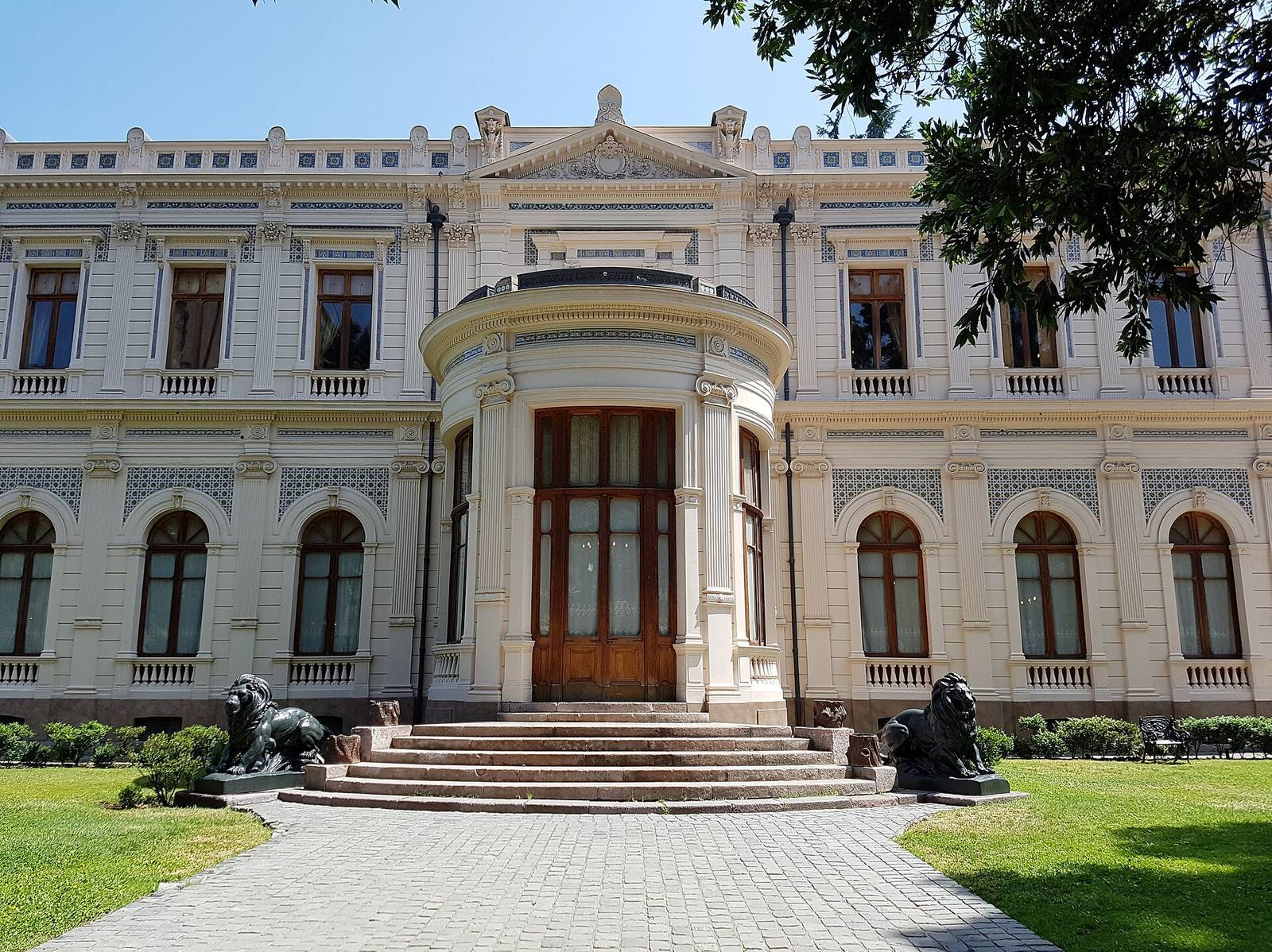
The two-storey palace stands at 438 Dieciocho Street on an 11,000-square-metre plot, with about 3,500 square metres of built space and twelve rooms or salons. Its overall design is French, while its interiors use a range of styles. Gold-edged exterior paintings depict the twelve signs of the zodiac. Parque Almagro lies behind the building, which forms part of the Almagro-Bulnes urban axis, alongside Paseo Bulnes, the Presidential Palace of La Moneda, and the Church of the Sacramentinos.
The grounds retain their original trees and boundaries and now include the area of the former Plaza Las Heras. Two iron lions face toward the Cousiño-Macul vineyards. The grounds also contain the servants’ house, which accommodated twenty-five people who served the household’s seven residents.
Interior rooms
Imported materials and decoration
European furnishings and decorative materials were brought to the palace on the family’s ships. These included velvet and brocade, porcelain from Sèvres, Limoges, and Meissen, French tapestries, crystal, stained glass, Carrara marble, and furniture from Paris. Hand-carved wood flooring used walnut, mahogany, American oak, ebony, German beech, and other woods. French curtains were embroidered by hand, and Italian majolica, a glazed earthenware, was used for floors and wall decoration. The family commissioned twenty large paintings from French artist Georges Clairin.
Entrance
The entrance floor is paved with Italian majolica. Eight oil paintings by Clairin decorate the space: four upper panels show floral arrangements, while four lower ones depict the seasons against European landscapes. Two bronze vases attributed to China’s Ming dynasty (1368–1644) stand behind the paintings; they were described as 400 years old.
Reception salon
The reception salon contains gilt furniture in the French Louis XVI style, a decorative style associated with that king’s period. Its upholstery was restored after the fire. Three paintings in the room are The Domestic Disaster by Fermín Girard, The Night Train by Enrique Swinburn, and a seascape by Swinburn.
Golden Salon
Also called the Hall of Mirrors, the Golden Salon was used as a ballroom. Its mirrors were arranged to make the room appear larger, following the example of the Hall of Mirrors at the Palace of Versailles. The furniture is in the French Louis Philippe style, including a three-person seat known as The Indiscreet, designed for a man, a woman, and a chaperone. French cloistered nuns hand-sewed the appliquéd silk curtains. French painter Joany Domaire decorated the ceiling, which Chilean painter Miguel Venegas later restored.
Oval music salon
The oval music salon is decorated in French Regency style, an early eighteenth-century transition between Baroque and Rococo. It retains its original Erard grand piano, and a platform was installed for twelve family musicians. Each section of the ornamental frieze features a different musical instrument. Behind the piano is Lucia, a painting by Italian artist Romano Rossini.
Tea salon
The tea salon, intended for women, has Louis XVI-style furnishings. Its paintings include Bust of a Woman by Marcial Plaza, The Maid in Blue by Pedro Lira, The Girl with a Flower Crown by Pablo Marzzalini, and Winter Landscape by Giovanni Ghisolfi. Two rosewood chests with French porcelain inlay stand beneath the Italian paintings.
Games salon
Opposite the tea salon, the games salon draws on artistic traditions associated with Islamic societies. Its frieze bears star and crescent designs. The room retains its original gaming tables and the house’s most valuable curtains, made of velvet embroidered with gold and silver threads. Reserved for men, it was the only room in the house where smoking was allowed. It also contains gifts exchanged between Santiago’s mayors and foreign countries.
Conservatory
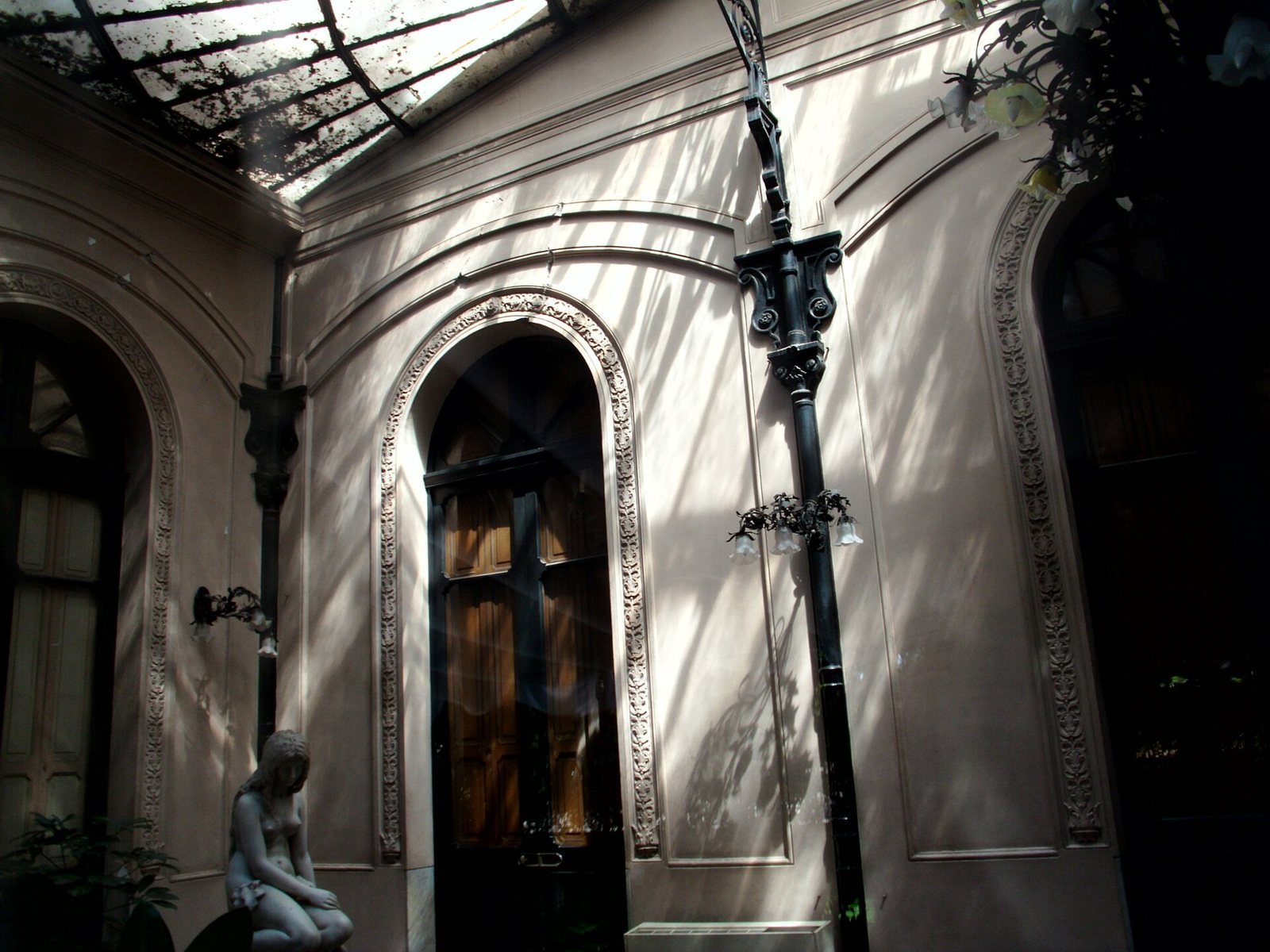
The iron-and-glass conservatory is in Art Nouveau style, a decorative movement popular around the turn of the twentieth century. Cobalt-blue stained glass colours the space. Part of the original heating system remains in the floor, where heat emerged through a rectangular wrought-iron grille. Two marble sculptures, Eve and Mignon, face one another.
Main dining room
The main dining room uses Bavarian Baroque, a regional form of Baroque design. Its original tableware includes Baccarat and Val Saint Lambert crystal glasses and Chilean silver cutlery made in England. The carved walnut furnishings include two French sideboards and a larger piece at the front of the room. The walls are covered in leather decorated with designs burned into its surface. Concealed doors beside the large piece led to servants’ passages and provided access to a children’s dining room.
Central hall and staircase
The neoclassical central hall has Ionic columns, a classical column form, and walls covered in Italian majolica. A majolica planter at one side once served as a fountain, and the hand-embroidered curtains are original. The central chandelier weighs half a tonne and holds about 13,800 crystals and 60 bulbs. It is a twin of the chandelier in Santiago’s Municipal Theatre. The staircase uses twenty-two kinds of marble. Before the fire, a skylight formed the hall’s ceiling. Photographic reproductions of oil portraits of Luis Cousiño and Isidora Goyenechea hang at the far end.
Arms room
The arms room holds objects from Luis Cousiño’s personal collection, including swords, a Mapuche axe, a Japanese scimitar, weapons associated with the conquest of Chile, suits of armour, and other items. Young men in the household practised fencing there. Chile’s first elevator is also located in the room.
Picture gallery
The picture gallery also served as a library and billiards room. It is called the Monvoisin Salon after five oil paintings by French painter Monvoisin: Ali Pasha and Vasiliki, Charlotte Corday in Prison, Heloise at Abelard’s Tomb, Greek Warriors, and The Girondins’ Last Night. After Monvoisin returned to France, the family acquired additional works, including The Shipwreck of the Young Daniel and Caupolicán Prisoner of the Spaniards, now held by the O’Higginiano and Fine Arts Museum of Talca.
The gallery also contains a table given by Italy to Chile, bearing the Chilean coat of arms. An English painter unfamiliar with local wildlife designed the arms with a horse and an eagle instead of the condor and huemul.
Everyday dining room
The family used this room for ordinary meals. A concealed double door connected it to a corridor leading to the service area. The room contains a German-beech cuckoo clock.