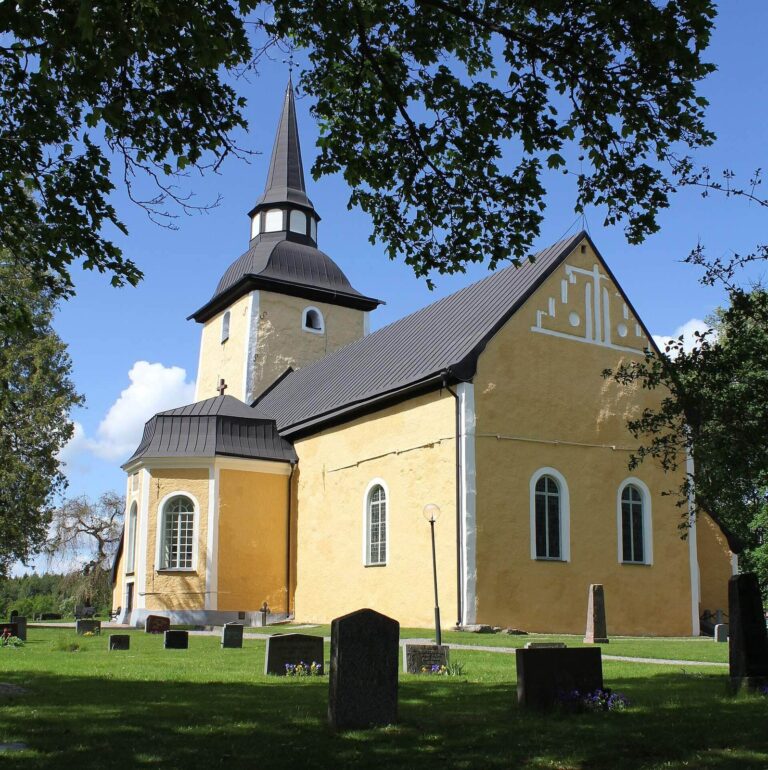
Torsvi Church: A Medieval Church in Sweden
Site at a Glance
- Country
- Sweden
- Primary era
- Medieval
- Eras represented
- Medieval, Early Modern, Modern
- Civilizations
- Swedish
- Site type
- Religious
- Remains
- Church
On this page18 sections
History
Torsvi Church is a medieval church in Torsviby, Sweden. Its origins are uncertain, and its nave, the main body of the church, was once dated to the late 13th century but is now placed in the 15th century. The sacristy, a room for clergy preparation and the storage of religious objects, was added in the last quarter of the 15th century.
Medieval origins and 17th-century gifts
The late-medieval altarpiece cabinet was given to the church by Magnus Gabriel De la Gardie, a Swedish nobleman and statesman. In 1645, Governor Johan Persson Utter donated the pulpit. Utter’s coat of arms appears on its canopy, which helps project the speaker’s voice.
An open bell frame, probably built in 1653, preceded the present bell tower. A weather vane bearing that year preserves a clue to the earlier structure’s date.
Repairs and changes in the 18th century
A small medieval wooden porch once stood at the church. It was replaced by a new porch in 1696, which in turn gave way to the present one in 1812. A north-facing window was opened in 1724. Two roof vanes dated 1741 mark an extensive repair to the roof, and a more substantial repair followed a fire in 1763.
Between 1767 and 1771, the present bell tower was built using material from its predecessor. The churchyard wall was constructed between 1777 and 1780 by workers from Dalarna, replacing an enclosure that was probably wooden; the eastern gate was built during the same period.
A major restoration in 1784 and 1785 enlarged all the window openings to their present form and established the interior’s current character. The pulpit was moved from the south side of the nave to its present position during this work.
Later repairs and parish history
Lightning damaged the interior and furnishings in 1811. Another strike hit the church during a service in 1858. Smaller improvements followed, including the installation of lightning conductors.
The organ was built in 1846 by Pehr Gullbergson of Lillkyrka and inaugurated on August 16 that year. In 1946, Åkerman & Lunds Nya Orgelfabriks AB added a Subbas 16-foot stop, a set of pipes producing a particular pitch. The church was restored in 1926 and 1954. Work on the late-medieval altarpiece in 1949 included making a replacement for one of its apostles.
Until a parish merger in 2006, the church belonged to Torsvi Parish. It is now part of Veckholm Parish, a local congregation in the Diocese of Uppsala, a regional church district. The church belongs to the Church of Sweden, a Lutheran church.
Remains
Main church building
Setting and exterior plan
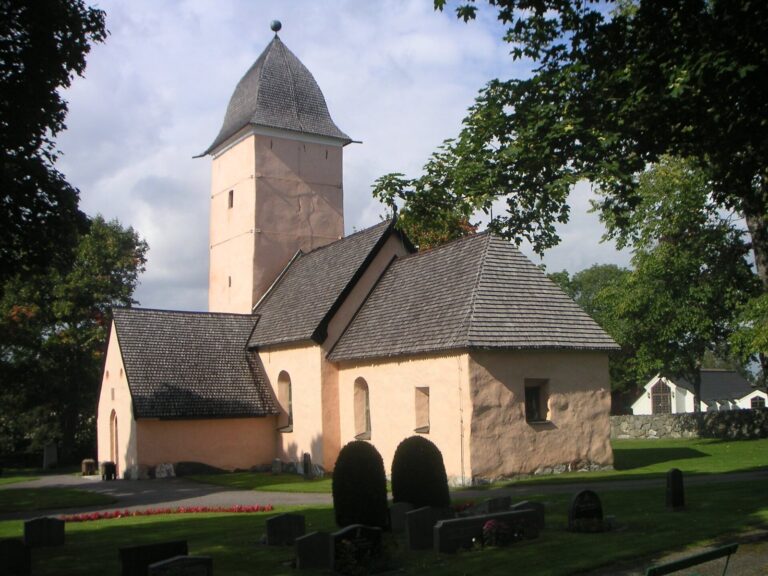
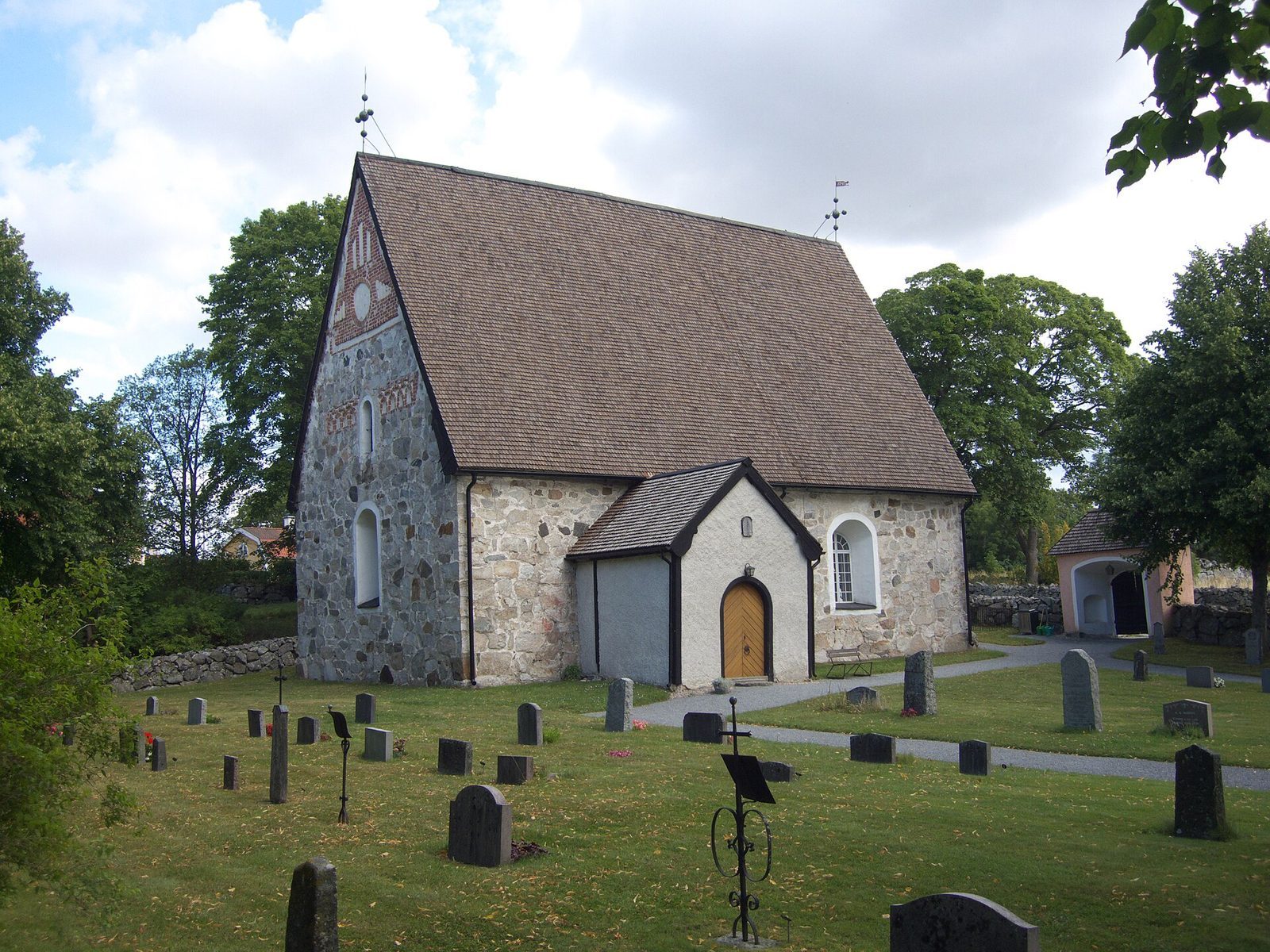
The church stands on the south side of a rocky slope, about 25 kilometres southeast of Enköping. Torsvi Farm occupies higher ground just to the north; its main building dates to the 1780s. The church is a hall church, with one broad main interior, arranged around a rectangular nave. A sacristy stands to the northeast and a small wooden porch to the southwest. The nave and sacristy are built from large, selected and split grey-stone blocks, while the porch is wooden.
The building has high, pointed gables decorated with blind brickwork, brickwork that does not form an opening. Its south entrance has a tall Romanesque profile, a form associated with a medieval European architectural style, and a brick surround. The original window openings faced south and east and may also have included one to the west; the north wall originally had none.
Interior
The nave has a wooden barrel vault, and its ceiling is described as plastered boards dating to 1758. The form of the original ceiling is uncertain; it may have been brick-vaulted or have had another kind of vault. In the sacristy, the brick ribs of the ceiling form a star-shaped pattern, known as a star vault. The closed pews date to 1759, although the front bench in each row is older.
Furnishings and religious objects
Late-medieval altarpiece cabinet
Made in eastern Germany, the cabinet has a central group of sculptures showing Mary, the Virgin Mary, with the Christ Child, or Jesus. Saint Hedwig and Saint Elizabeth flank them. Its doors carry figures of the twelve apostles, Jesus’s early followers. The figure at the far left of the upper row on the right-hand door is a replacement.
Painted altarpiece
A separate altarpiece, painted in oil on wood, is kept in the sacristy. It has a central panel and two hinged wings. The central panel depicts events at Golgotha and includes an inscription tablet dated 1628. Each wing shows a woman standing on a globe. The figure on the right has a radiant halo, a crown and a palm branch; the globe bears the inscription “THEAKEL.” The figure on the left holds a scepter and palm branch, and the globe is inscribed “MITTARON.” The work came from Eastern Europe and is thought to have been acquired as war booty.
Crucifix and sculptures
A processional crucifix, a cross bearing Christ’s figure for use in religious processions, hangs on the north wall of the choir, the area around the altar. Made in Sweden in the early 15th century, it is accompanied by three late-medieval sculptures on the south wall.
Pulpit and memorials
The pulpit has a richly carved, many-sided body. Its panels depict Christ and the four Evangelists, traditionally identified as the writers of the four canonical Gospels, while figures of apostles stand at the corners. Utter’s funeral coat of arms hangs on the north wall. His grave lies in the choir beneath a gravestone carved from red limestone.
Baptismal and communion objects
A gilded-silver baptismal bowl made by Stockholm goldsmith Johan Lund in 1700 bears an inscription recording its donation to the church in 1759. A wooden stand for the bowl was acquired in 1761. The communion vessel has a six-lobed foot and dates to the late 16th century; its bowl was remade in 1724. The associated paten, a plate for holding communion bread, is also from the late 16th century. Other objects include a 17th-century collection bag and an 18th-century red chasuble, an outer garment worn by clergy.
Organ
The organ stands on a platform at the west end of the church. It is mechanical and uses a slider chest, a mechanism that directs air to sets of pipes. Its stated range is 54/27.
Churchyard and bell tower
Enclosure and eastern gate
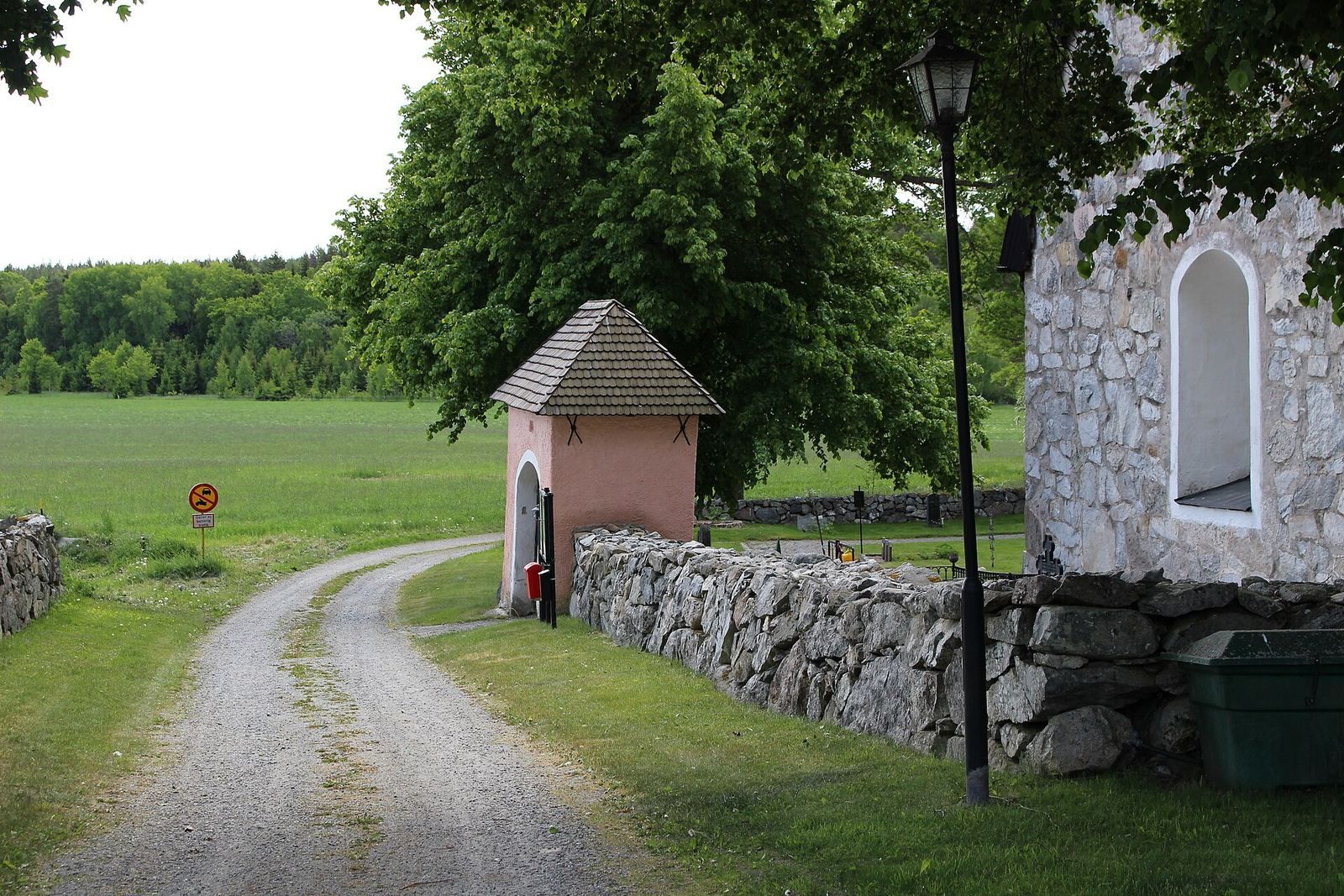
A wall encloses the churchyard, with a roughcast-brick gate on its eastern side. Two weather vanes stand on the church roof.
Bell tower
The bell tower stands just northeast of the church. Its shingle-clad pyramidal roof is topped by a small lantern. The large bell was cast in 1709 and the small bell in 1647.