Yelizarov Convent: A Historic Russian Orthodox Monastic Community


Site at a Glance
- Rating
- 4.8
- Popularity
- Low
- Country
- Russia
- Primary era
- Early Modern
- External website
- Open
- Eras represented
- Medieval, Early Modern, Modern
- Civilizations
- Pskov Republic, Russian
- Site type
- Religious
- Remains
- Fortified Monastery
On this page15 sections
History
Yelizarov Convent is a Russian Orthodox women’s convent in Russia, in the village of Yelizarovo north of Pskov. It began in 1425 as a hermit’s cell founded by the monk Euphrosyn, formerly the peasant Eleazar of Videlibye and previously a monk of Snetogorsky Monastery. Set beside the Tolva River on the road between Pskov and Gdov, the cell soon attracted disciples and developed into a medieval monastic community.
Foundation and Early Community
A wooden church dedicated to the Three Holy Hierarchs was built in 1447, with a chapel for Onuphrius the Great. The Three Holy Hierarchs are Basil the Great, Gregory the Theologian, and John Chrysostom, three major fourth-century bishops and theologians honored together in Eastern Orthodox tradition. The monastery took the name Yelizarov from Euphrosyn’s former secular name, Eleazar, and 1447 is also given as the foundation date of the monastery.
Euphrosyn composed one of the oldest known named communal monastic rules between 1461 and 1464. Yelizarov was the first alms-supported monastery in the Pskov region, meaning that new entrants were not required to provide a contribution. His associate, the schemamonk Serapion, also helped develop the settlement. Euphrosyn died in 1481 and was buried within the church precinct. He was canonized as an all-Russian saint at the Stoglavy Council in Moscow in 1551, a major Russian Church council concerned with administration, religious practice, and discipline.
After Euphrosyn’s death, the wooden church became a cemetery church, and the monastic community moved farther down the hill. A stone church dedicated to the Three Holy Hierarchs was then built for the monastery.
Philotheus and the Pskov Religious Centre
During the early sixteenth century, the elder and hegumen Philotheus lived and worked at Yelizarov. A hegumen is the superior of an Orthodox monastery. From 1510 to 1547, the monastery became a center of the spiritual life of the Pskov region. During this period, a life of Euphrosyn was composed, the Pskov First Chronicle was edited, and a copy of the Lay of Igor’s Campaign was produced. Some scholars believe that a local monk made the copy at Philotheus’s request.
Philotheus was associated with the formulation of the Moscow Third Rome doctrine, which presented Moscow as the successor to Rome and Constantinople as a center of Orthodox Christian authority. He was also credited with authorship of the Legend of the White Cowl. The monastery became known for its school of icon painters, adding an artistic role to its religious and literary activities.
Fortification and Early Modern Changes
Yelizarov was repeatedly attacked by Lithuanians, Poles, and the Livonian branch of the Teutonic Order. In the mid-sixteenth century it was heavily fortified and gained considerable religious importance and renown. The stone Three Holy Hierarchs Cathedral was built in the second half of the sixteenth century, around 1574, during the tenure of the builder Ferapont. The cathedral became an important example of medieval Pskov architecture.
Church reorganization in 1764 reduced the monastery to the third class, but it remained open. In 1766, monks from the abolished Spaso-Velikopustynsky Monastery were transferred to Yelizarov, which adopted the name Spaso-Velikopustynsky. The former monastery’s state establishment was transferred to Yelizarov, and its monks were assigned there. The cathedral received a Transfiguration altar, and the monastery became a center for veneration of the Yelizarov Christ Pantocrator icon.
In 1804, the remaining monks of the abolished Snetogorsky Monastery were transferred to Yelizarov. In 1813, the monastery was elevated to the second class and received corresponding state support. It also maintained a compound on Spasskaya Street in Pskov. Porphyry Karabinevich served as superior from 1855 to 1859.
Twentieth-Century Closure and Renewal
On 3 October 1906, the Holy Synod changed the monastery from a state-supported institution to a cenobitic community. In such a community, monks or nuns live under a common rule, share property and work, and worship together. On 6 October, Bishop Arseny Stadnitsky of Pskov raised the superior, Hieromonk Juvenaly Maslovsky, to the rank of hegumen.
The elder Gabriel Zyryanov, a disciple of Ambrose of Optina and a figure reputed for spiritual insight, lived at Yelizarov from 1908 until 1915. He had been transferred there after being removed as superior of Sedmiozernaya Hermitage. By 1917, the monastery had 18 monastics, 15 novices, and 338 desyatinas of land. It was officially abolished in 1918, although monastic life continued informally for a time.
From 1 September 1921, the buildings were assigned to a sanatorium for children with tuberculosis, and the monastery finally closed in November 1923. The complex was subsequently used as a farm, a people’s house, a facility for children with disabilities, a tuberculosis sanatorium, a recreation center, and housing. A children’s sports camp and residential buildings occupied the grounds until 1999, while the former monastic buildings deteriorated substantially.
In 2000, the complex was transferred to the Pskov Diocese of the Russian Orthodox Church and re-established as a women’s convent by order of Archbishop Eusebius Savvin. The renewed community began continuous recitation of the Psalter on 5 May 2000. On 28 May, Bishop Eusebius held a hierarchical service and consecrated the chapel of Saint Martyr Elizabeth Feodorovna. Elizabeth Belyaeva served as the first superior of the restored convent from 2000 until her death on 4 June 2010. Maria Korkh then served as acting superior, and Tatiana Pashkova was appointed abbess on 15 May 2025.
Restoration brought a particle of Gabriel Zyryanov’s relics to the convent. On 19 August 2010, Patriarch Kirill visited Yelizarov, and the Pskov Museum-Reserve transferred the fourteenth-century Yelizarov Christ Pantocrator icon to the convent. In 2006, two buildings of the former Pskov compound, together with the Church of the Mid-Pentecost on Detskaya Street, formerly Spasskaya Street, were also transferred to the convent. The architectural ensemble is protected under a 1960 decree and is listed as a regional cultural-heritage property of the Russian Federation. Yelizarov remains a functioning women’s convent under the jurisdiction of the Pskov Diocese.
Remains
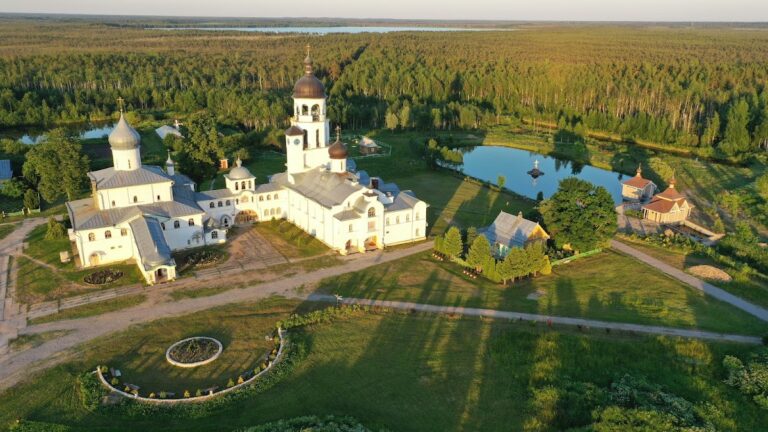
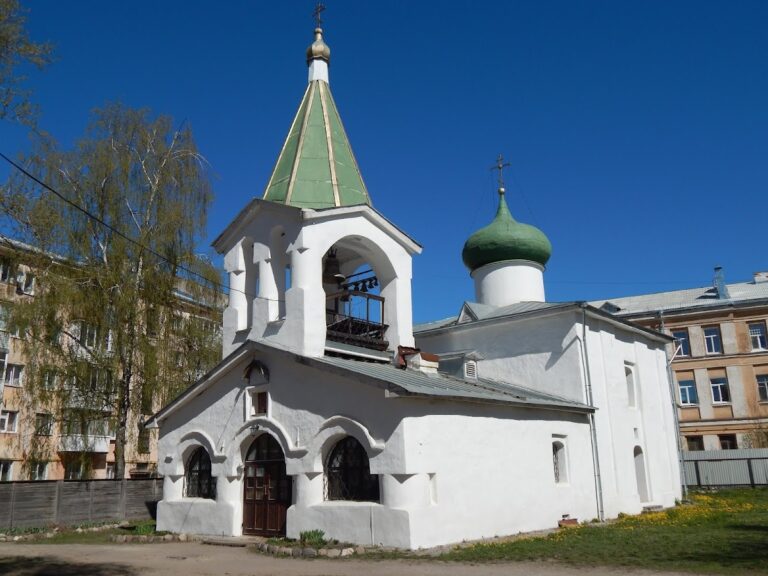
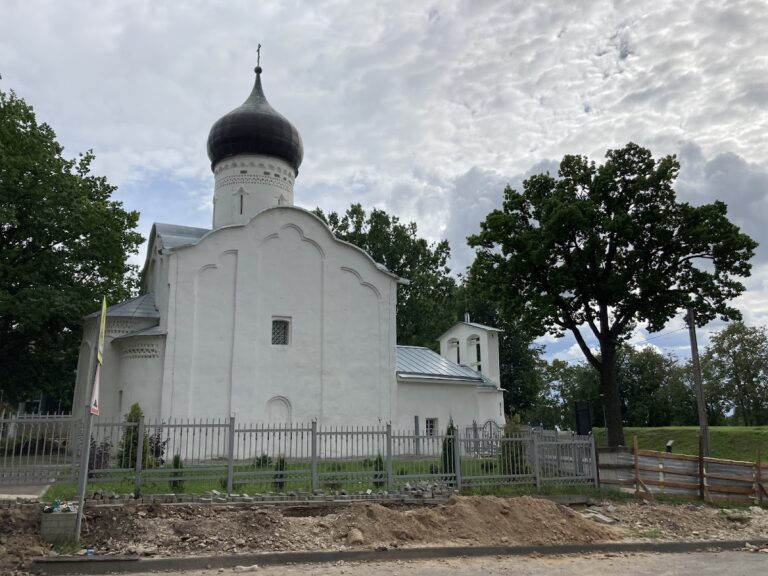
The surviving ensemble stands near the Tolva River in Yelizarovo, along the historic road to Gdov. Its principal elements are the stone Three Holy Hierarchs Cathedral, a Nativity of the Virgin chapel, a monastic cells building, a stone enclosure, and an abbot’s building. The cathedral and cells building were repaired during the convent’s restoration, while the abbot’s building was constructed as part of that work.
Cathedral and Chapels
Three Holy Hierarchs Cathedral
The Three Holy Hierarchs Cathedral, built around 1574, is the central surviving monument of the ensemble and an example of medieval Pskov architecture. Its dedication honors Basil the Great, Gregory the Theologian, and John Chrysostom. The cathedral complex includes the Nativity of the Virgin chapel, built in the Moscow style. Following the arrival of the Spaso-Velikopustynsky community in 1766, a third altar dedicated to the Transfiguration was installed in the cathedral.
Nativity of the Virgin Chapel
The first floor of the Nativity of the Virgin chapel contains the chapel of Saint Martyr Elizabeth Feodorovna, consecrated when the convent was renewed in 2000. A venerated gravestone icon of Euphrosyn, made in the second half of the nineteenth century, is located on the chapel’s eastern wall. The original burial place of Euphrosyn was lost after 1920.
Elizabeth Chapel Icons
Venerated icons of Euphrosyn and Serapion, dating from the late nineteenth or early twentieth century, are located in the vestibule of the Elizabeth chapel. These objects preserve the memory of the monastery’s founder and of the schemamonk who helped develop the early settlement.
Monastic Buildings and Enclosure
Cells Building
The monastic cells building forms part of the surviving architectural ensemble. It was repaired during the restoration of the convent and remains associated with the community’s renewed monastic use.
Stone Enclosure
The stone enclosure belongs to the fortified monastery developed during the sixteenth century. It survives as part of the restored ensemble and defines the architectural setting of the cathedral and monastic buildings.
Abbot’s Building
An abbot’s building was constructed during the restoration of the convent. It stands among the repaired and surviving elements of the former monastery and reflects the continued institutional use of the complex.
Pskov Compound and Sacred Objects
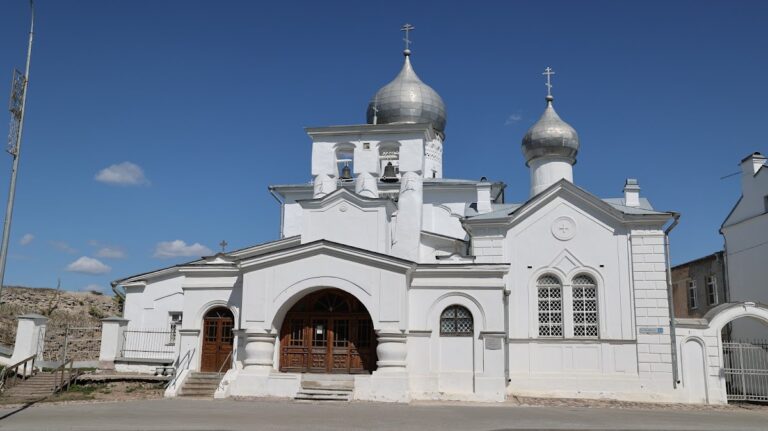
The convent’s associated buildings in Pskov include two former compound buildings and the Church of the Mid-Pentecost on Detskaya Street, formerly Spasskaya Street. The complex is also connected with the fourteenth-century Yelizarov Christ Pantocrator icon, transferred from the Pskov Museum-Reserve in 2010, and with a particle of Gabriel Zyryanov’s relics brought to the convent during its restoration.
Nearby sites