Reichenbach Abbey: A Benedictine Monastery in Bavaria


Site at a Glance
- Rating
- 4.6
- Popularity
- Low
- Country
- Germany
- Primary era
- Medieval
- External website
- Open
- Eras represented
- Medieval, Early Modern
- Civilizations
- Duchy of Bavaria, Electorate of Bavaria, Holy Roman Empire
- Site type
- Religious
- Remains
- Fortified Monastery
On this page16 sections
History
Reichenbach Abbey is a former Benedictine monastery in Reichenbach, Germany, founded in 1118 in the Romanesque period by Margrave Diepold III of Vohburg and his mother, Liutgard. Dedicated to the Assumption of the Blessed Virgin Mary, it was settled by monks from Kastl Abbey near Amberg and became an important religious foundation in the Diocese of Regensburg.
Foundation and medieval development
The monastery enjoyed an early period of prosperity. Its church was consecrated in 1135 by Heinrich I, Bishop of Regensburg. Diepold III died in 1146 and was buried in the church, while his daughter Adela later married the future Emperor Frederick I Barbarossa.
A fire damaged the monastery in 1181, but rebuilding followed quickly. Papal and imperial confirmations issued in 1182 renewed the monastery’s legal protection and status. In 1204, the Wittelsbachs assumed the monastery’s bailiwick, the authority responsible for protecting and representing an ecclesiastical foundation. Reichenbach then lost much of its regional importance and developed into a rural monastery.
The abbey’s fortunes improved during the fourteenth century under Abbot Friedrich II Heinrichsreutter. He served as confessor to Emperor Louis IV and was entrusted with establishing or settling Ettal Abbey. In 1394, Johannes Strolenfelser, a monk from Kastl, became abbot and made Reichenbach a center of the Kastl Reform, a Benedictine movement that sought stricter monastic discipline. The reform influenced the community’s religious life, building activity, and intellectual work.
Scholarship, dissolution, and confessional change
Under the reformed abbots, Reichenbach became known for scholarship. Mathematics and astronomy were especially cultivated until the end of the fifteenth century, while theology and the humanities were also pursued. The monastic library contained more than 1,000 volumes. This intellectual activity formed part of the abbey’s late medieval identity alongside its religious observance and construction projects.
Reichenbach was dissolved for the first time in 1556 after Elector Ottheinrich introduced the Reformation, the religious movement that established Protestant church organization in parts of Germany, in the Electoral Palatinate. The last abbot, Michael Katzberg, became Lutheran, married, and remained at Reichenbach as administrator of the former monastery property. Around 1570, iconoclasts destroyed many works of art.
After Maximilian of Bavaria conquered the Upper Palatinate in 1621 on behalf of the Catholic emperor, Reichenbach returned to Catholic use. Jesuits established a pastoral station there in 1632 and received two-thirds of the income from the former monastery property. The remaining third was divided among the bishops of Regensburg, Eichstätt, and Amberg. Swedish troops occupied the monastery in 1633 and again in 1641, temporarily restoring Protestant worship.
Return of the Benedictines and later dissolution
Benedictines returned in 1661, initially under Bavarian-electoral administration. From 1669, Saint Emmeram Abbey in Regensburg administered Reichenbach, and in 1695 the monastery became independent again. Saint Emmeram paid 8,000 guilders to the three bishoprics so that they would relinquish their claims to income from the abbey.
During this second Benedictine period, the monastery buildings were rebuilt from their foundations, replacing the medieval conventual complex, and the church was transformed in the late Baroque style. In the second half of the eighteenth century, the monks continued active scholarly and literary work. The church’s Rococo transformation began in 1742 and was completed in 1747.
The abbey was dissolved again in 1803 during the secularization of Bavaria, when church property was transferred to the state. The property became state-owned, and the church became a filial church of Walderbach parish, meaning that it remained attached to that larger parish for pastoral administration. The monastic buildings were auctioned in 1820 and subsequently served various purposes. Among them was a stoneware factory founded by Heinrich Waffler in 1841, which operated until 1863.
Religious and charitable uses since the nineteenth century
Benedictine life briefly returned in the late nineteenth century. Georg Dengler, a cathedral canon and arts official of the Diocese of Regensburg, acquired the monastery in 1883 and made it available to Father Andreas Amrhein of Beuron Abbey for the formation of a Benedictine missionary community. The community left in 1887 and established Saint Ottilien Abbey near Lake Ammersee. The property returned to Dengler in 1888.
The Brothers Hospitallers of Saint John of God acquired the complex in 1890 and established a care institution for people with mental and physical disabilities in 1891. This Catholic order had a longstanding mission of caring for sick, disabled, and socially vulnerable people. Its institutional work at Reichenbach continues alongside schools for disability care in Reichenbach and Tegernheim. The Tegernheim branch has operated since 2014, while the Reichenbach schools developed from a specialist school founded in 1972.
The monastery church remains under the pastoral care of Walderbach parish as its filial church. The former abbey is therefore associated both with its long Benedictine tradition and with the charitable work of the Brothers Hospitallers since the late nineteenth century.
Remains
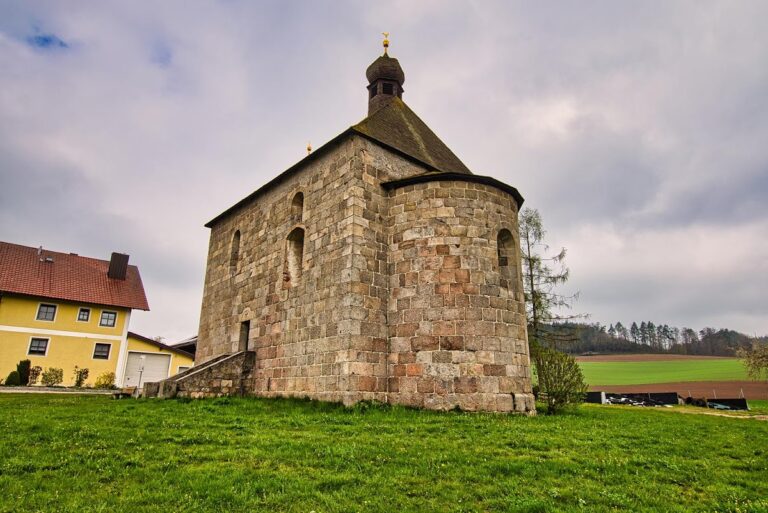
The surviving complex brings together a Romanesque basilica, Gothic alterations and fortifications, and extensive Baroque and Rococo rebuilding. The former abbey church has a nave, two aisles, and two towers. Its plan reflects the Hirsau school, a Romanesque architectural tradition associated with the reform monastery of Hirsau and known for basilican churches and restrained monastic design.
Church structure and medieval features
Romanesque basilica
The church’s Romanesque westwork, the monumental western entrance block of a medieval church, stands behind a Baroque facade built in 1716. The original three eastern apses were replaced by a Gothic choir around 1300. The choir belongs to this period, as do the raised church towers, while the aisles received their vaults in the fifteenth century. Two door knockers on the exterior portal preserve Romanesque metalwork.
Gothic choir and astronomy tower
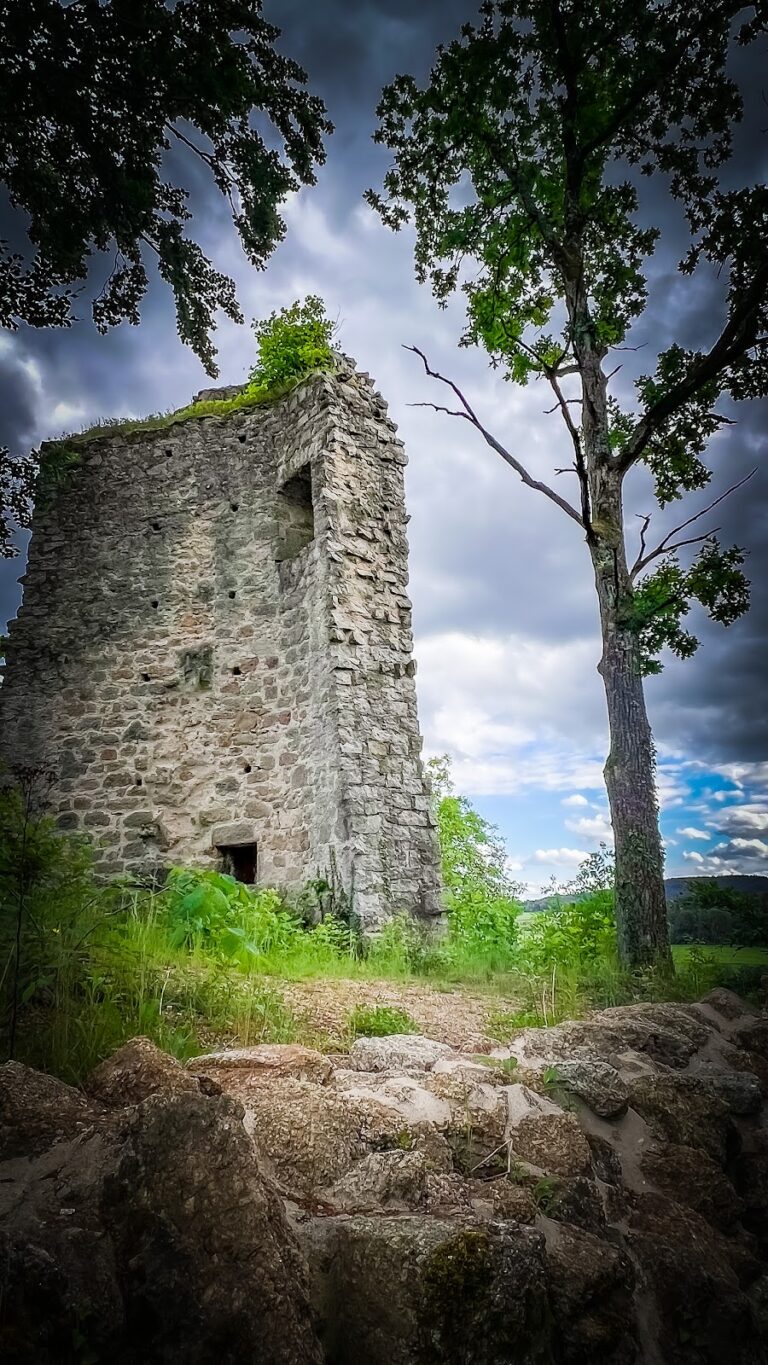
The Gothic rebuilding of the monastery at the beginning of the fifteenth century included fortifications. These defenses prevented the monastery from being captured by Hussite forces in 1428 and 1433. The astronomical tower northeast of the church survives as a visible reminder of the abbey’s medieval study of astronomy. Parts of the Gothic choir stalls dated 1416 remain in the monks’ choir.
Baroque and Rococo interior
Ceiling and stucco decoration
The church interior was transformed in the late Baroque and Rococo periods. Ceiling frescoes extend across pairs of bays and are framed by four medallions in the curved sections beside the vaults. Dating from the seventeenth and eighteenth centuries, the paintings include King David, the Adoration of the Shepherds, and the Adoration of the Magi. The central ceiling painting incorporates a modeled horse’s foreleg in the stucco and a dog whose eyes can be viewed from all sides.
The stucco decoration uses abundant forms and carefully coordinated colors. It includes bandwork with C-shaped curves, green foliage, shellwork, flower garlands, and lattice patterns. The groin vaults of the aisles are decorated as richly as the vestibule. The stucco is attributed to Jakob Appiani, who lived from 1687 to 1742.
Altars
The Baroque high altar is dedicated to the Assumption of the Blessed Virgin Mary and is attributed to Otto Gebhard, an eighteenth-century Bavarian artist associated with Baroque church decoration. Saint Benedict stands to the left of the tabernacle and Saint Scholastica to the right.
The Marian altar and Cross altar follow related designs, with twisted columns echoing those of the high altar. A late Gothic statue of the Virgin survived the iconoclasm and continues to be venerated as a devotional image. The black ebony crucifix from the seventeenth century is described as unique of its kind.
In the south aisle, the Sebastian Altar carries neoclassical ornament and dates from 1716 to 1718. The Holy Kinship Altar stands opposite it in the north aisle and refers in its design to the Sebastian Altar. The south aisle also contains the eighteenth-century Rococo Benedict Altar, paired with the Guardian Angel Altar in the north aisle.
Burial chapel and commemorative monuments
Diepoldinger family chapel
A historically important burial chapel stands at the front left of the nave. Eight members of the Diepoldinger noble family are buried there. Their coats of arms surround a marble epitaph, which is surmounted by the family arms of the Diepoldinger-Rapotonen. The grave slab of the founder, Diepold III of Vohburg, lies in front of the epitaph. A separate tomb monument for Diepold III dates from 1304, while monuments also commemorate Liutgard and other members of the founding family.
Johann of Palatinate-Mosbach
The chapel also contains an epitaph for Johann, Prince of Palatinate-Mosbach, a cathedral canon who died during a pilgrimage to Jerusalem in 1486. The monument includes a skeletal memento mori, an artistic reminder of human mortality. Johann lived from 1443 to 1486.
Surviving sculpture and furnishings
A Madonna and Child dating from about 1420 stands at the first pillar of the south nave. The Romanesque sculpture of an enthroned Christ, regarded as an important example of Bavarian Romanesque art, is preserved in the Bavarian National Museum in Munich rather than at Reichenbach Abbey.
Nearby sites