Church of Saint Varlaam of Khutyn, Pskov: An Orthodox Church Founded in the Fifteenth Century


Site at a Glance
- Rating
- 4.8
- Popularity
- Very Low
- Country
- Russia
- Primary era
- Medieval
- Eras represented
- Medieval, Early Modern, Modern
- Civilizations
- Pskov Republic, Russian
- Site type
- Religious
- Remains
- Church
On this page12 sections
History
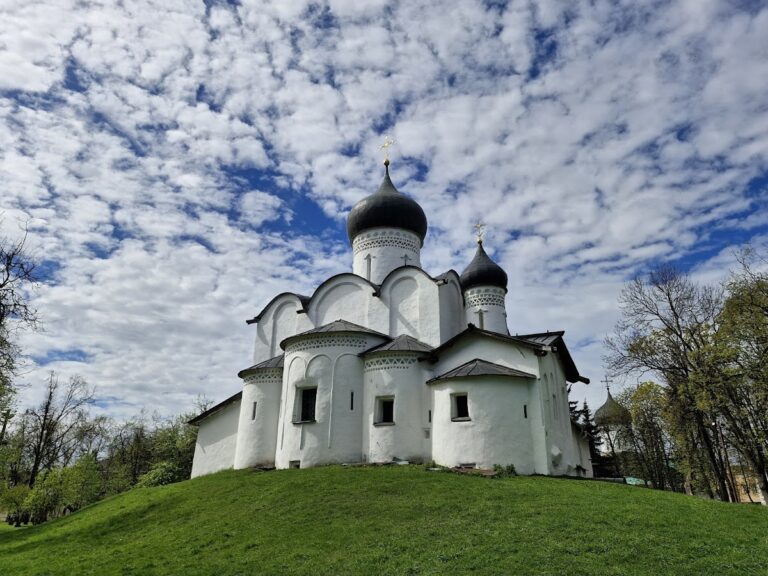
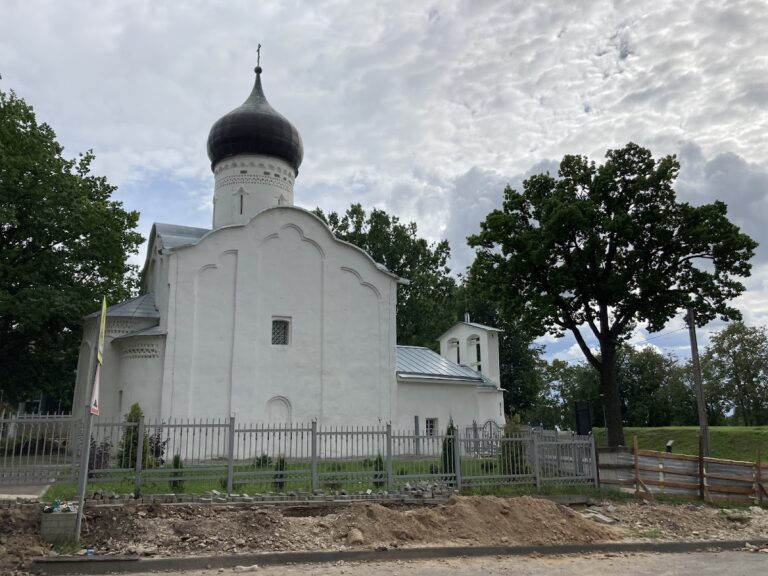
The Church of Saint Varlaam of Khutyn is an Eastern Orthodox church in Pskov, Russia, dedicated to the twelfth-century ascetic who founded the Transfiguration Monastery at Khutyn near Novgorod. Its history began with a wooden church built in 1466, and a stone church followed in 1495. The building is now recognized as a federally significant cultural-heritage monument of the fifteenth to nineteenth centuries and remains an active church of the Pskov Diocese.
Foundation and Early History
The first church was built in a single day in 1466 as a vow during an epidemic. A permanent stone building was erected in 1495, but fire damaged it in 1521. The church also took part in Pskov’s military history. During the Swedish assault on the city on 9 October 1615, defenders fired at the attackers from the church’s dome.
In 1788, the nearby Church of the Resurrection at Stadishche was attached to Saint Varlaam’s as a subsidiary church. The anniversary of the stone church was marked on 6 November 1895 with a 400th-anniversary celebration and a procession from Pskov’s Trinity Cathedral.
Nineteenth-Century Alterations
The church underwent extensive changes during the nineteenth century. A choir loft was installed in 1851, and the southern Chapel of Saint Nicholas was rebuilt in 1858–1859. The piers beneath the main dome were rounded in 1860. In 1875, the southern chapel was rebuilt or altered, while a northern extension and a porch were added or reconstructed. The final architectural changes took place around 1900.
Wartime and Religious Use
The church closed in the 1930s and was converted to non-religious use. During the German occupation of Pskov from 1941 to 1944, it served as a mechanical workshop. Worship resumed in 1942 under the priest Konstantin Shahovsky. The church was one of eight Pskov churches reopened through the Pskov Orthodox Mission, a church organization active during the occupation and wartime period. It returned to religious use after 1944, even while many other churches remained closed under Soviet authorities.
On 30 August 1960, the building received state protection as a monument of republican significance. Eight new bells were consecrated on 25 August 2006. Cast at the Shuvalov Foundry in Tutaev, they have a combined weight of 900 kilograms, and seven bear the names of Nicholas II and members of his family.
Remains
The surviving church has a rectangular main body measuring approximately 9.25 by 9 metres. A narthex, the entrance space adjoining the worship area, measures 5.25 by 11.5 metres. The building also includes a southern chapel, a northern extension, and a porch, forming the architectural complex shaped by the medieval foundation and later rebuilding.
Main Church and Dome
Central Building
The main body is covered by a dome whose cylindrical drum, the structure supporting the dome, was heightened in the late seventeenth century. It carries a belt made from two rows of green glazed ceramic tiles. The church originally had an eight-sloped roof; the date when it was changed to a four-sloped roof is uncertain. The piers beneath the dome were rounded in 1860.
Choir Loft
The choir loft installed in 1851 is reached by an ornamental cast-iron spiral staircase. Its elevated position provided the interior platform for singers.
Chapels and Extensions
Chapel of Saint Nicholas
The southern Chapel of Saint Nicholas measures approximately 25 by 7.5 metres. It was reconstructed in 1858–1859 and remodeled in 1875. During the later work, the chapel’s drum windows were enlarged.
Northern Extension and Porch
The northern extension measures approximately 15 by 6.25 metres. The extension and the porch were rebuilt or added during the 1875 alterations, alongside the work on the southern chapel.
Icons and Bells
Two icons formerly belonging to the church’s iconostasis survive in the exhibition of the Novgorod State United Museum-Reserve. One is a sixteenth-century local icon of Saint Varlaam of Khutyn with 26 narrative panels. The other is a seventeenth-century icon of the Old Testament Trinity with 21 narrative panels.
The church’s eight bells were consecrated in 2006. Seven are named for Nicholas II and members of his family, while the complete set weighs 900 kilograms.