Trinity Cathedral in Pskov: The Mother Church of the Pskov Eparchy
Site at a Glance
- Rating
- 4.9
- Popularity
- Low
- Country
- Russia
- Primary era
- Early Modern
- Eras represented
- Medieval, Early Modern
- Civilizations
- Novgorod Republic, Pskov Republic, Russian
- Site type
- Religious
- Remains
- Cathedral
On this page8 sections
History
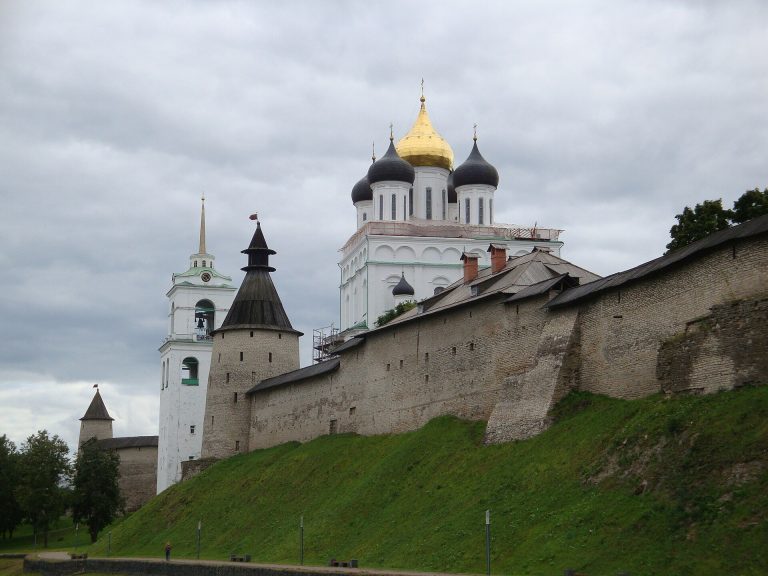
Trinity Cathedral in Pskov, Russia, is an Orthodox cathedral of the Pskov Eparchy, an Eastern Orthodox ecclesiastical jurisdiction comparable to a diocese. The present building was constructed between 1682 and 1699 in the Moscow architectural tradition of the seventeenth century and forms the principal structure of the Pskov Krom, the city’s historic fortified citadel. Since 1589, it has served as the mother church of the Pskov Eparchy.
Origins and the early churches
Tradition connects the choice of the site with Princess Olga of Kiev, a tenth-century ruler traditionally regarded as an early Christian ruler of Rus. During a visit to Pskov in 957, she was said to have seen three rays of light directed toward the place where the church would stand. The story’s historical basis remains uncertain, since Olga’s personal conversion came before the Christianization of Rus. The church was dedicated to the Life-Giving Trinity.
The first church was probably built in the tenth century or shortly afterward. It was made of wood and burned during the first half of the twelfth century. A second church was traditionally begun in 1138 by Prince Vsevolod Mstislavich, who was associated with both Pskov and Novgorod, although architectural studies place its construction in the late 1180s or early 1190s. Builders from Smolensk may have taken part, since a distinct Pskov architectural school had not yet formed. The vaults of this church collapsed in 1363.
The medieval cathedral and Pskov’s independence
A third stone cathedral was begun on the earlier foundations in 1365 under the direction of Master Kirill. One chronicle states that the work was completed by 1367, with the rebuilding blessed by Archbishop Aleksei of Novgorod. The cathedral commemorated Pskov’s liberation from Novgorodian rule in 1348 and expressed the city’s political independence from Novgorod.
The cathedral stood beside Pskov’s veche square, the medieval communal assembly place where officials were elected and princes were summoned. It was also used for concluding alliance treaties among Russian principalities, preserving treaty documents, and administering oaths on the cross. The building housed the city’s treasury, chronicles, and archive. The sword of Dovmont-Timofey, a Lithuanian-born prince who ruled Pskov after his baptism, was kept at the altar and presented as a blessing to princes summoned to govern the city. The sword is now displayed in the Pskov museum-reserve.
Religious and military traditions are closely associated with the cathedral. Alexander Nevsky prayed there with the people of Pskov before the Battle on the Ice in 1242, a victory traditionally associated with the defeat of Teutonic forces. His brother Yaroslav Yaroslavich also prayed there. Dovmont-Timofey prayed in the cathedral before battles and gave thanks there after victories. The crypt became a burial place for princes, clergy, and later Pskov bishops. It also contains the burial of the holy fool Nicholas Salos, who tradition credits with saving Pskov from Ivan the Terrible’s punitive expedition in 1570.
Fire, rebuilding, and the present cathedral
A fire that devastated Pskov in 1609 destroyed the cathedral’s interior. The tomb of Dovmont-Timofey and the relics of Vsevolod-Gavriil survived, and the cathedral was subsequently repaired. The fourth and present cathedral was then begun on the same foundations in 1682. Construction continued for seventeen years, and the building was completed and consecrated in 1699. Its height was substantially increased over that of its predecessors.
The cathedral was closed in 1935 and converted into an anti-religious museum. During the German occupation from 1941 to 1944, worship resumed, and the building remained in religious use after the war. It had also been associated during the 1920s with the Living Church, a Soviet-backed reform movement that challenged the authority of the traditional Orthodox hierarchy. Restoration began during the occupation and continued afterward. Trinity Cathedral is now a federally protected cultural-heritage monument of Russia and forms part of the UNESCO World Heritage property “Churches of the Pskov School of Architecture,” inscribed in 2019.
Remains
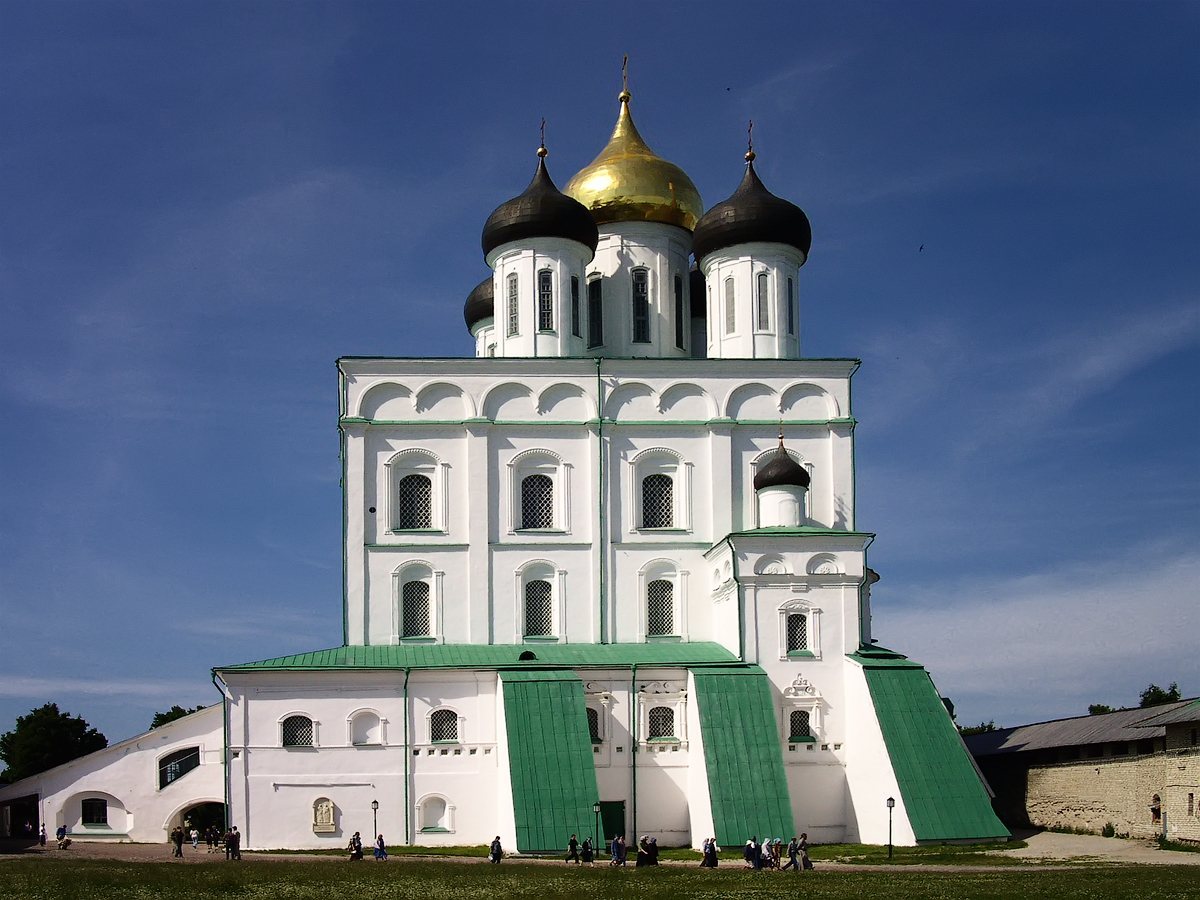
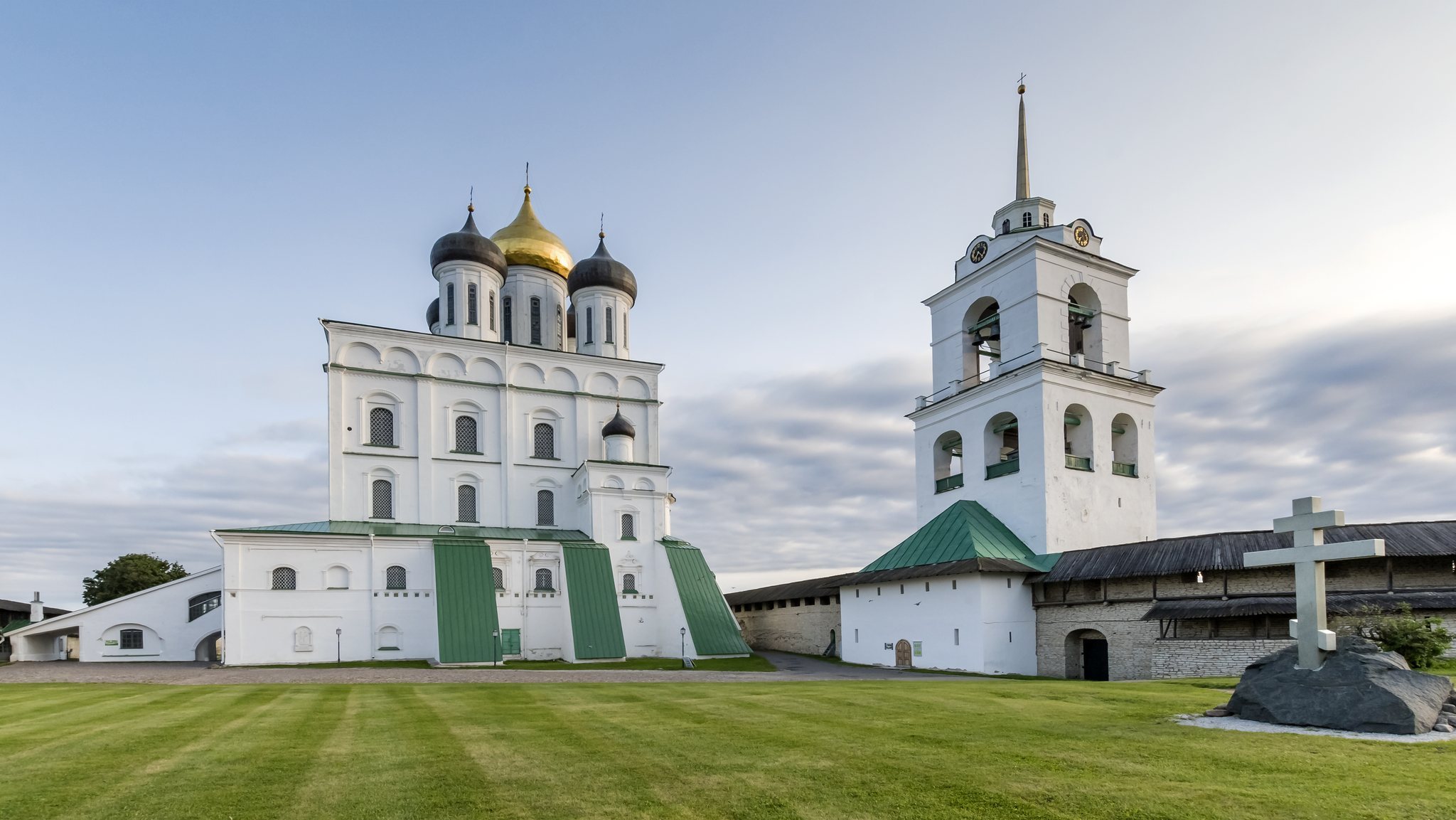
Trinity Cathedral is a tall brick building whose large, centralized volume follows the Moscow architectural tradition of the seventeenth century. Its elongated four-sided main structure is supported by six massive internal pillars and crowned by five cupolas. A central cupola and four subsidiary cupolas represent Christ and the four Evangelists. The building reaches approximately 72 metres in height, with descriptions of its upward extent giving 78 metres, and it has no separate towers.
Structure and chapels
The six pillars carry the supporting arches. Two side chapels and a covered gallery connect with the vestibule, while a broad staircase leads to the upper level. Four chapels are currently open for worship: the Trinity, Kazan, and Alexander Nevsky chapels on the upper level, and the Seraphim of Sarov chapel below. Behind the altar of the lower chapel, a burial chamber survives from the earliest periods of the cathedral’s history. The chapel’s iconostasis, the screen separating the sanctuary from the main worship space, was painted in 1988 by Archimandrite Zinon.
Evidence of earlier construction
The third cathedral, built from 1365, had two side chapels and three cupolas. Its walls carried frescoes, and its construction used local limestone together with techniques developed substantially from wooden architecture. Its rich decoration and strong vertical form distinguished it from the austerity associated with Pskov architecture and helped distance the city’s building tradition from nearby Novgorodian models. Cracks caused by uneven settlement led to the insertion of enclosed side galleries and the addition of buttress-like supports at the end of the eighteenth century. The exterior was plastered in 1894 and 1895.
Relics and sacred images
The cathedral houses the relics of Vsevolod-Gavriil, Dovmont-Timofey, Nicholas Salos, and Joasaph of Snetogorsk in a large silver reliquary, a container made to preserve and display sacred relics. A fragment of the Veil of the Mother of God was added in 2012. Among its principal religious images is a miracle-working Trinity icon dating from the late sixteenth or early seventeenth century. It depicts the Hospitality of Abraham, with three angels representing the Trinity at its center and additional biblical scenes in the surrounding panels. Other important images include the sixteenth-century Chirskaia and Pskov-Pokrov icons of the Mother of God, a myrrh-streaming icon of the great martyr Panteleimon from the seventeenth or eighteenth century, and a twentieth-century icon of Princess Olga painted by Archimandrite Alipy of the Pskov Caves Monastery.