Krypetsky Monastery: A Russian Orthodox Monastic Complex in Russia


Site at a Glance
- Rating
- 4.9
- Popularity
- Low
- Country
- Russia
- Primary era
- Early Modern
- Eras represented
- Early Modern, Modern
- Civilizations
- Russian
- Site type
- Religious
- Remains
- Monastery
On this page12 sections
History
Krypetsky Monastery is a Russian Orthodox male monastery in Russia, founded in 1485 by Savva Krypetsky, a Serbian monk who had lived in monasteries on Mount Athos, the major Orthodox monastic center in northeastern Greece. Dedicated to St John the Theologian, it was established in a marshy area about 22 kilometres from Pskov. The monastery was among the last foundations created while Pskov remained an independent polity.
Foundation and the independent Pskov
In 1487, the Pskov veche, the medieval assembly that exercised important political and legal authority in Pskov, formally confirmed the monastery’s rights and granted land to its community. Prince Yaroslav Obolensky, the Pskov governor, supported the construction and arranged a bridge or pilgrim road through the marshes to the Holy Gates, the monastery’s principal ceremonial entrance.
Savva Krypetsky died on 28 August 1495 and was buried in the original timber cathedral. In 1505, St Nilus of Stolobny entered monastic life at Krypetsky. About ten years later, he left to live as a hermit and eventually founded the Nilov Monastery. During the mid-sixteenth century, the future hermit Nikandr was tonsured there, meaning that he formally entered monastic life. Krypetsky was also associated with the hagiographer and presbyter Vasily-Varlaam.
The monastery’s privileges and early development took place before Pskov was annexed to Moscow in 1510. A stone cathedral dedicated to St John the Theologian was built in the mid-sixteenth century, replacing the timber church in which Savva Krypetsky had been buried.
Later imperial-era development
In the seventeenth century, the Russian statesman and diplomat Afanasy Ordin-Nashchokin took monastic vows at Krypetsky under the name Antony. By the end of that century, the monastery had become impoverished and entered a prolonged decline. Restoration in the early eighteenth century enabled it to regain strength by the middle of the century. In 1764, its estate was recorded as supporting 366 peasant souls, and the monastery was classified as having no regular staff establishment. In 1805, it was placed in the third class.
During the early nineteenth century, Metropolitan Evgeny Bolkhovitinov, an Orthodox bishop and ecclesiastical historian, visited Krypetsky and left a description of the monastery. The former refectory, the communal dining building, was converted into the abbot’s quarters for that visit.
In the second half of the nineteenth century, the monastery was home to the blessed monk Cornelius Polyakov, who became known locally for his ascetic life and reputed prophecies. He foretold the monastery’s destruction and asked to be buried facing east. His disciple Vasily Grafov petitioned Vladimir Sabler, the chief imperial official overseeing the Russian Orthodox Church, in 1913. Grand Duchess Elizabeth Feodorovna later raised the matter with Patriarch Tikhon, but the requested burial arrangements were not completed.
Closure, protection, and revival
At the beginning of the twentieth century, Krypetsky was among the wealthiest monasteries in Russia. Its community included about 40 monks and 21 novices, while its estate covered approximately 3,602 desyatinas, a pre-revolutionary Russian land measure indicating a very large landed holding.
The monastery was closed in 1918. In 1922, more than five poods of gold were removed from the sacristy, and many objects later disappeared. Divine services in the cathedral ceased in 1923. The complex was converted into an agricultural estate after its closure and briefly revived during the German occupation in the Second World War. It later faced the threat of complete demolition, but a decision to destroy it with explosives was canceled after scholars and enthusiasts intervened.
On 30 August 1960, the monastery ensemble was designated a monument of republican significance and placed under state protection. It is now listed in the Russian Federation as a protected cultural-heritage site of federal significance. The monastery returned to the Russian Orthodox Church in 1990. Restoration and reconstruction then repaired damaged buildings and rebuilt some structures that had been dismantled because of severe deterioration, allowing monastic life to resume.
The monastery’s modern community has included monks, novices, workers, pilgrims, and resident sisters. In the 2010s, it included several dozen men and about 20 resident sisters, eight of whom had taken monastic vows by April 2016. A monastery courtyard opened in Pskov’s Ivanovsky Cathedral in February 2007. Since 2009, the Monastery of St John the Baptist in Pskov has been attached to Krypetsky, and another courtyard was established when a stone Church of St Nicholas opened in the village of Toroshino in May 2012. Hieromonk Vsevolod Sikanov has served as abbot since 24 July 2025.
Remains
Krypetsky Monastery stands in an area historically described as an impassable marsh, about 7 kilometres from the village of Krypetskoye and about 22 kilometres from Pskov. The surviving ensemble is organized around stone and wooden religious buildings, ceremonial entrances, connecting passages, and bell structures. Restoration after 1990 repaired the damaged fabric and reconstructed structures that had been dismantled after severe deterioration.
Cathedral and associated chapels
St John the Theologian Cathedral
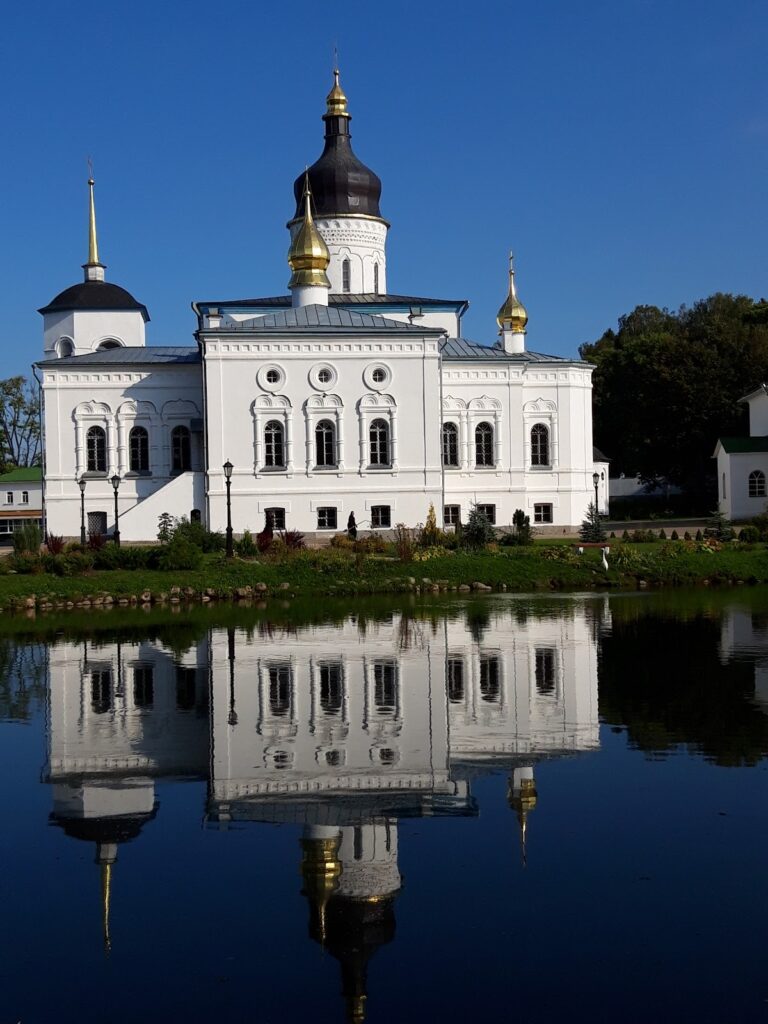
The principal building is the stone Cathedral of St John the Theologian, constructed in the mid-sixteenth century. It replaced the monastery’s original timber cathedral, where Savva Krypetsky had been buried, and still stands. A chapel inside the cathedral was dedicated to Savva of Serbia, with the tomb of Savva Krypetsky beneath it.
A description from 1586–1587 presents the cathedral as a stone building with a stone porch. Its cross was wooden and carried a gilded dove finial. In the early nineteenth century, a crypt, a chamber within or beneath a church, received a chapel dedicated to the Five Martyrs: Eustratius, Auxentius, Eugenius, Mardarius, and Orestes.
St Savva shrine and lower church
A new shrine for the relics of St Savva was made in 1855 by the craftsman Fyodor Verkhovtsev. The monastery preserves relics attributed to St Savva Krypetsky and St Cornelius Krypetsky.
The lower church dedicated to St Savva Krypetsky was used as a cattle yard and stable until the 1950s. In May 1958, a wooden church with an iconostasis, the screen of icons separating the sanctuary from the nave in an Orthodox church, a dome, and a cross was erected over Cornelius Polyakov’s grave. That structure was dismantled and burned in September of the same year.
Refectory, passage, and entrances
Church of the Dormition and refectory
The complex included a stone Church of the Dormition of the Virgin Mary that served as the monastery’s refectory. Its upper chapel was dedicated to John Climacus, the seventh-century Christian monk associated with The Ladder of Divine Ascent.
Passage and Holy Gates
A passage carried on pillars connected the church and the refectory. A wooden clapper tower stood beside it and contained an iron clapper. The Holy Gates were built of stone and had three upper sections, whose front surfaces bore painted sacred images.
Bell tower
A wooden bell tower stood beside the Church of St John the Theologian. During the early nineteenth century, a fifth tier was added to the tower, altering its height and form within the monastery ensemble.
Nearby sites