Yburg: A Residential Castle in Kernen im Remstal


Site at a Glance
- Rating
- 4.5
- Popularity
- Low
- Country
- Germany
- Primary era
- Medieval
- Eras represented
- Medieval, Early Modern
- Civilizations
- Holy Roman Empire
- Site type
- Domestic
- Remains
- Castle
On this page6 sections
History
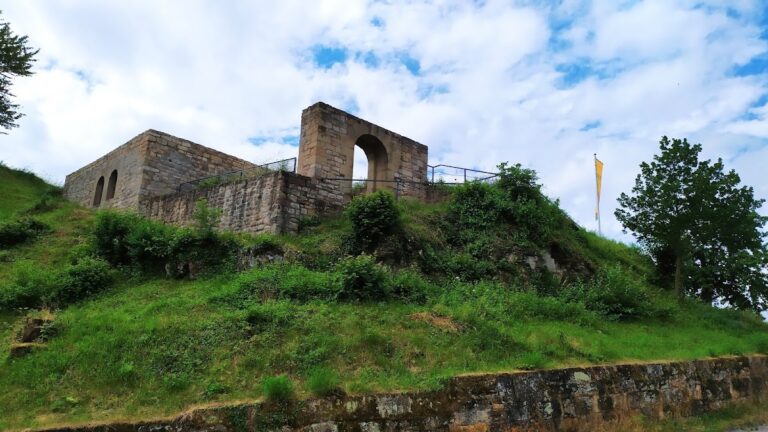
Yburg is a fourteenth-century residential castle in Germany, above the district of Stetten in Kernen im Remstal. Built by the Truchsessen of Stetten around 1300–1350, it served as their hill-slope residence among the vineyards of the Remstal. A Truchsess was originally a senior court official responsible for supervising a ruler’s household, and the title later became associated with noble families such as the Truchsessen of Stetten.
From Stetten residence to Württemberg possession
Yburg was built as a residential castle rather than as a military stronghold. Its importance to the Stetten lordship declined after Stetten Castle was constructed in the valley between 1384 and 1387. In 1443, Hans von Yberg, who co-owned Yburg and a share of the village, sold both interests to the House of Württemberg. The dynasty ruled Württemberg, a major territorial state in southwestern Germany.
Repairs, demolition, and preservation
By 1598, the castle was described as dilapidated. Repairs carried out in 1659 added a fourth storey, but the complex was later demolished by order of Carl Eugen, Duke of Württemberg, in 1760–1761. The demolition left the exterior walls visible today. A plane tree planted in the courtyard in 1845 was removed in 1931 after birds gathered in its crown and fed on grapes in the surrounding vineyards.
In 1969, the municipality of Stetten im Remstal purchased Yburg from the House of Württemberg and opened the ruin to the public. The masonry was renovated in 2018. Sculptures by the German artist Karl Ulrich Nuss, known for figurative and public art, have stood at Yburg since 17 April 2011.
Remains
Castle structure
Yburg is built into a slope rather than placed on a summit, and its roughly cube-shaped form rises among vineyards at about 330 metres above sea level. The plain exterior walls form the principal surviving shell of the building, while the ceilings of the upper storeys and the roof have disappeared. The entrance gate stands on the west side, facing down the slope toward the valley.
Immediately inside the entrance, a doorless room on the left has a vaulted ceiling and extends to the north wall, where a narrow window opens through the masonry. Two further vaulted rooms occupy the east side. Their pointed-arch entrances face toward the main entrance, and each room reaches the exterior wall, where it has a narrow window. A staircase in the southwest corner, to the right of the entrance, leads to the next storey.
Landscape and surviving evidence
The castle is surrounded by vineyards associated with the sites known as Pulvermächer, Lindhälder, and Brotwasser. Water for the residence was carried up from the valley along the castle path. Beneath Yburg, a museum displays a model of the castle, while a brush drawing made in 1840 preserves an image of its historical appearance.
The vineyard area called Brotwasser is linked by tradition to a court lady living in Stetten. According to the story, she secretly dipped her bread in wine instead of water. This local explanation connects the surviving ruin with the cultivated landscape that surrounds it.