Burg Beutelsbach: Ancestral Castle of the Württembergers


Site at a Glance
- Rating
- 4.4
- Popularity
- Low
- Country
- Germany
- Primary era
- Medieval
- External website
- Open
- Eras represented
- Medieval
- Civilizations
- Holy Roman Empire
- Site type
- Military
- Remains
- Castle
On this page5 sections
History
Burg Beutelsbach, also known as the Kappelberg Castle Ruin, is a medieval hilltop castle in Germany near Weinstadt. The Württembergers, the ruling dynasty that later gave its name to Württemberg, probably built it in the tenth or eleventh century as their first ancestral seat. The castle occupied a mountain spur above Beutelsbach and guarded an important route through the region.
The first seat of the Württembergers
Burg Beutelsbach protected the Kaiserstraße, a major medieval road that crossed the Schurwald toward the Filstal. Until about 1080, the Württembergers still used Beutelsbach as their dynastic name. Under Konrad I, they moved to Wirtemberg Castle, their later dynastic seat, and adopted its name.
Decline and later associations
By the time Burg Beutelsbach was mentioned in 1252, it was probably already a ruin. The castle was destroyed in 1312. A chapel beside the ruins later became associated with the Poor Conrad, a popular uprising in Württemberg in 1514 against burdens imposed by the ruling authorities. The surviving evidence for the events connected with the castle is limited.
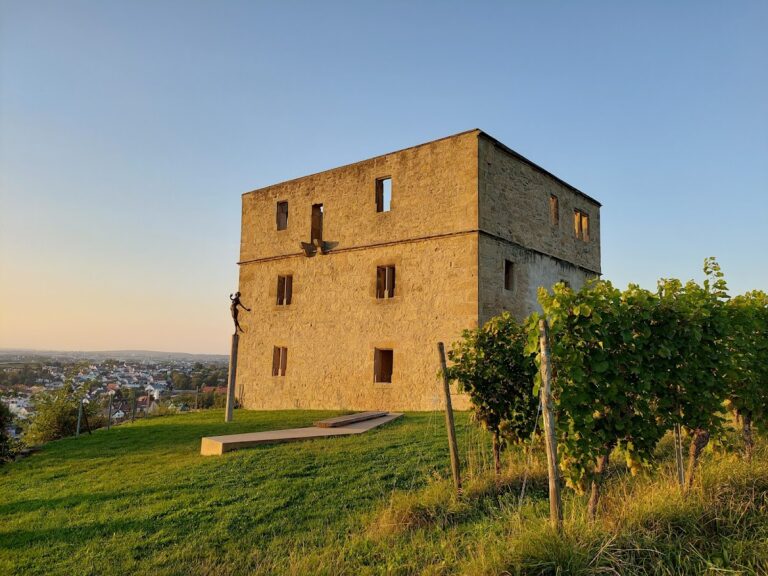
Between 1760 and 1765, the remaining walls were demolished down to their foundations. The foundations and other surviving remains were rediscovered and exposed in 1968 during the reorganization of vineyards on the hill spur. Archaeologists had only two weeks to carry out an emergency excavation, after which leveling work altered the site so extensively that further archaeological results would be unlikely today. The reconstructed ruin does not correspond to current scholarly understanding, but the site remains one of the historically most significant places in the state.
Remains
Burg Beutelsbach was a noble spur castle, a fortification built on a projecting ridge and strengthened by the defensive value of the terrain. It stood on a 310-metre-high mountain spur near Beutelsbach in the city of Weinstadt. The surviving fabric consists chiefly of foundations and wall remains, with the ruin partially restored. A castle chapel stood beside the fortified site.
Foundations and inscribed stone
An incomplete inscribed stone was recovered during the 1968 excavation. Its text says that construction began on 22 May during the pontificate of Pope Innocent IV, whose tenure lasted from 1243 to 1254. The inscription names the venerable Berthold, described with some uncertainty as the first provost, an ecclesiastical officeholder who supervised a religious institution or community, and says the work was undertaken at the instigation of Count Ulrich of Wirtemberg.
The stone gives the year as 1752, but this date is interpreted as a stonecutter’s error caused by the addition of an extra Roman numeral D. The intended date was probably 1252, linking the inscription to the period when the castle was mentioned as a ruin.