Kelburn Castle: The Historic Seat of the Earl of Glasgow


Site at a Glance
- Rating
- 4.6
- Popularity
- Medium
- Country
- United Kingdom
- Primary era
- Medieval
- External website
- Open
- Eras represented
- Medieval, Early Modern, Modern
- Civilizations
- British, Kingdom of Scotland
- Site type
- Domestic
- Remains
- Castle
On this page13 sections
History
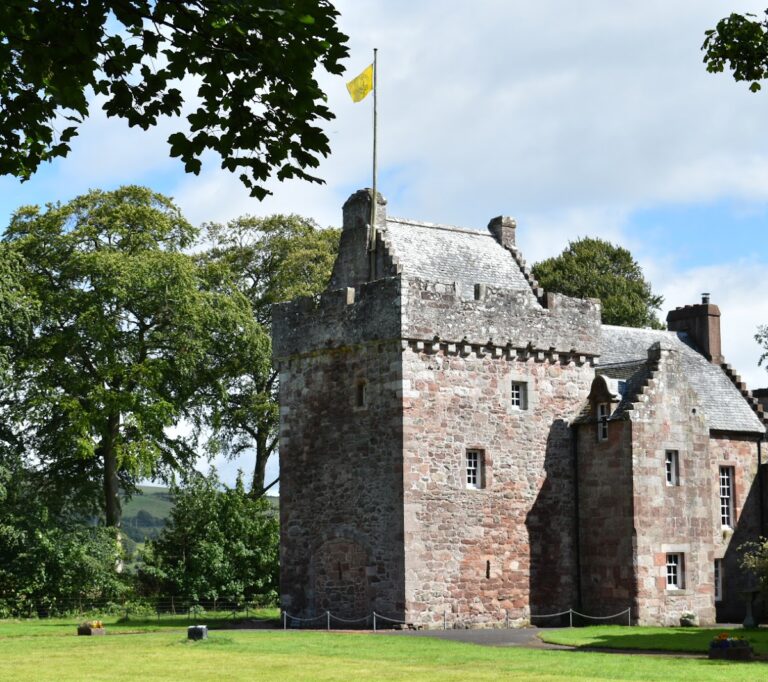
Kelburn Castle is a historic country house in the United Kingdom, near Fairlie in North Ayrshire. It developed from a thirteenth-century Norman medieval castle and remains the family seat of the Earl of Glasgow. The Boyle family has held the lands of Kelburn since the twelfth century, and the castle was already standing during the Battle of Largs in 1263, a conflict between Scottish and Norwegian forces during their struggle for control of the western islands and coastline.
Medieval Origins
The Boyle family was originally known as de Boyville and was of Norman origin. A branch of the family is recorded as taking possession of lands in Ayrshire in 1140. Kelburn Castle is thought to have originated in the thirteenth century, although the date of its first stone construction is unknown. Its earliest structure was a wooden tower, which was replaced during the 1200s by a stone Norman keep, a strongly fortified medieval tower.
The family’s long occupation of Kelburn continued through later changes to the building. The castle is among Scotland’s oldest castles and has remained inhabited by the same family longer than any other Scottish castle. It continues to serve as the seat of the Earl of Glasgow, with the 10th Earl, Patrick Boyle, and his family living there.
From Tower House to Country House
A rebuilding in the late sixteenth century created a tower house, a fortified residence organized around a substantial tower for both domestic and defensive use. The estate’s gardens and orchards were recorded in the seventeenth century, while the house itself was expanded in stages from the late seventeenth into the early eighteenth century.
David Boyle, who served in the Parliament of Scotland, became the 1st Earl of Glasgow in 1703. He initiated major extensions, including the north-west range, which was completed around 1722 and approximately doubled the size of the building. The 7th Earl of Glasgow later became Governor of New Zealand in 1892, creating historical links between the Kelburn estate and Kelburn in New Zealand. Souvenirs connected with those links are kept at the castle and in the estate museum.
George Boyle, 6th Earl of Glasgow, added the north-east range in 1880. Together with the earlier parts of the house, this work produced substantially the form that Kelburn retains today.
Public Use and Conservation
The house and grounds opened to the public in 1977. In 1980, the estate buildings and stables were converted for public-oriented uses, including a tea room, shop, and visitor-information facilities. The grounds and ancillary buildings were also adapted for outdoor recreation and guided access to the castle interior.
In 2007, experts determined that the concrete facing on parts of the exterior would eventually need to be replaced to prevent further damage to the stonework. Lord Glasgow invited four Brazilian graffiti artists, Nunca, Nina, and the twin artists Os Gêmeos, to paint parts of the exterior. Historic Scotland initially permitted the project on the understanding that the work would be removed when the castle was re-harled, meaning coated with a roughcast protective finish. The project was conceived as temporary, but it later led the Earl to seek permission for the graffiti to remain permanently in 2011. Reports in 2010 that Historic Scotland was pressing for its removal were denied by both parties.
On 16 February 2009, an electrical fault caused a fire that engulfed a top-floor room and spread to the roof. About 25 firefighters fought the blaze for more than five hours, and the castle suffered minor damage. Kelburn Castle is protected as a Category A listed building, a designation for structures of national architectural or historic importance in Scotland. The grounds were added to Scotland’s Inventory of Gardens and Designed Landscapes in 1987, a national register for gardens and landscape grounds of special historical, architectural, artistic, or scenic interest.
Remains
Kelburn Castle stands between Fairlie and Largs near the southern shore of the Firth of Clyde. The large house developed around the original keep, sections of which remain in use. Its surviving form combines medieval defensive fabric with later residential ranges, a walled courtyard, gate piers to the north, and adjoining garden walls to the north-west.
Castle Fabric and Later Ranges
Keep and Tower House
The earliest wooden tower was replaced by a stone Norman keep. A late-sixteenth-century tower house with a Z-shaped plan then replaced an earlier structure and may incorporate earlier masonry in its eastern part. These elements form the medieval and early modern core around which the later country house was built.
William-and-Mary Range
The north-west extension is a William-and-Mary-style mansion, a formal classical design associated with the reigns of William III and Mary II. Built onto the castle at a slight angle, it was constructed for David Boyle by the mason Thomson Caldwell and completed around 1722. Its addition substantially enlarged the earlier building.
North-East Range
George Boyle, 6th Earl of Glasgow, added the north-east range in 1880. This range joined the earlier extensions and completed the house in substantially its present overall form. Parts of the exterior have a concrete facing, later covered in places by the 2007 graffiti project. The facing was expected eventually to require replacement in order to protect the stonework beneath.
Gardens and Designed Landscape
John Boyle Monument
The extensive grounds contain gardens, orchards, woodland, outdoor recreation areas, and a themed trail. A monument to John Boyle, 3rd Earl of Glasgow, stands in the gardens. Designed in 1775 by the Scottish architect Robert Adam, an influential figure in the development of British neoclassical architecture, it has a trapezoidal form with an aedicule, blind pilasters, and a triangular pediment. The monument depicts a mourning female figure, and its original designs are preserved in the Sir John Soane’s Museum in London.
Garden Sundials
Two sundials stand in the gardens. One, dated 1707, consists of a square-section shaft rising from a stepped base, followed by a polygonal element that narrows into an obelisk. It is topped by a wrought-iron weather vane, while its gnomons, the projecting parts that cast shadows to indicate the time, are made of bronze.
Kel Burn and the Glen
The Kel Burn has formed the glen over thousands of years. For slightly more than half a mile, the burn rises on the moors more than 800 feet above the castle and descends towards the sea through waterfalls and gorges. The glen contains wild flowers, ferns, shrubs, and trees, forming part of the wider landscape associated with the castle and its grounds.