Taikō-ji Temple: A Shingon Buddhist Temple in Ise, Japan

Site at a Glance
- Rating
- 4.1
- Popularity
- Low
- Country
- Japan
- Primary era
- Modern
- External website
- Open
- Eras represented
- Early Modern, Modern
- Civilizations
- Oda regime, Tokugawa
- Site type
- Religious
- Remains
- Temple
On this page17 sections
History
Taikō-ji Temple, formally Chōonzan Taikō-ji, is a Buddhist temple in Ise, Japan, traditionally founded during the Tenpyo period, from 729 to 749, and associated with the Shingon tradition. It belongs to the Daigo branch, a major lineage of esoteric Buddhism historically associated with Daigoji in Kyoto, and has long-standing connections with Ise Grand Shrine and Futami Okitama Shrine.
Foundation and Shingon development
Tradition attributes the temple’s foundation to Gyoki, an eighth-century Buddhist monk and public religious leader associated with temple foundations and major Buddhist projects. While traveling through the provinces to solicit contributions for the Great Buddha of Nara, Gyoki is said to have received a revelation from Amaterasu, the Shinto sun deity traditionally regarded as the imperial ancestor. At Futamiura, he worshipped the local Okitama deity and encountered a golden Thousand-Armed Kannon, the compassionate bodhisattva shown with many arms to express the ability to respond to beings in many circumstances.
Gyoki founded the temple to enshrine an image carved in the likeness of that Kannon and established Okitama Shrine as its guardian shrine. In 825, Kukai, the monk who established Shingon Buddhism in Japan and was also known as Kobo Daishi, repeatedly visited Taikō-ji while reviving Kongōshō-ji Temple on Mount Asama. He transmitted Shingon teachings at Taikō-ji, after which the temple developed as a Shingon institution.
Imperial patronage and medieval renewal
During the reign of Emperor Daigo, a prayer for the emperor’s recovery from illness was believed to have been answered. The emperor then established a seven-bay, four-sided Kannon Hall as the temple’s main hall and designated Taikō-ji as an imperial prayer temple, a Buddhist institution appointed to conduct prayers for the emperor and the imperial realm. This patronage brought the temple considerable prosperity.
The Kannon Hall was rebuilt during the reign of Emperor Sutoku, but Taikō-ji declined toward the end of the Heian period. During the Bunji period, from 1185 to 1190, a priest of Ise Grand Shrine supported the struggling institution by donating the present principal image of Thousand-Armed Kannon and rebuilding the temple halls. Taikō-ji became prosperous again.
Its fortunes later changed. A Kyoto poet who composed linked-verse poetry visited in 1342 and described the temple’s desolate condition in a pilgrimage diary. The Kannon Hall was rebuilt again in 1537, continuing the repeated cycle of reconstruction that shaped the temple’s later appearance.
Fire, reconstruction, and later changes
A strong wind caused the Kannon Hall to collapse in 1634. Contributions enabled its reconstruction, but lightning struck the temple on June 25, 1686, and all the buildings burned. The principal image was carried to safety. The fire is believed to account for the small number of other old Buddhist images and temple possessions that survive from earlier periods.
With assistance from the Yamada magistrate, the main hall was rebuilt in a smaller three-bay, four-sided form in 1698, and the temple had been revived by 1703. The Niomon, a temple gate guarded by two wrathful guardian kings, was built in 1721. Its guardian statues received an eye-opening consecration ceremony during the Kyōhō era. The present main hall was rebuilt by the temple abbot in 1814.
The Okitama Shrine within the compound was transferred to Futamiura in 1897. Its former site continued to receive worship at Taikō-ji as Moto-sha Okitama Shrine. The Niomon was repaired in 2007. A separate temple called Aijuin conducts memorial services for pets.
Religious and cultural role
Taikō-ji is the eighty-fifth temple on the Mie Shikoku Eighty-eight Temple pilgrimage and the first temple on the Ise Saigoku Thirty-three Kannon pilgrimage. Its principal Thousand-Armed Kannon is an Important Cultural Property. Ise City designates the Amitabha Triad seed-syllable stele and the scroll concerning the construction of the Kannon Hall as tangible cultural properties.
The temple’s religious calendar includes goma fire rituals, in which offerings are burned before a sacred fire, the Setsubun star festival, and a Kannon fire festival with firewalking and the scattering of rice cakes. Seasonal memorial services, ceremonies for Kukai, healing prayers, a lantern festival, and monthly goma rites also continue. The monthly observances include a partial opening of the principal image, which is otherwise a hidden Buddha, a sacred image normally concealed and shown only on prescribed occasions.
The temple’s wisteria festival is associated with a purple wisteria traditionally said to have been planted in the middle of the Meiji period after being transplanted from a bonsai. The plant is reputed to be about 150 years old and is called Ascending Dragon Wisteria. A former abbot compared its shape with a dragon rising from the sacred stone of the Okitama deity near the Meotoiwa, or Wedded Rocks, off Futami’s coast.
Remains
The surviving compound brings together the rebuilt main hall, the Niomon, associated shrines, a Kōshin Hall, and religious objects from several periods. The buildings and features reflect repeated reconstruction after collapse and fire, while the grounds also include a wisteria trellis with purple and white varieties and more than 300 hydrangea plants that flower in early summer.
Main hall and Buddhist images
Kannon Hall
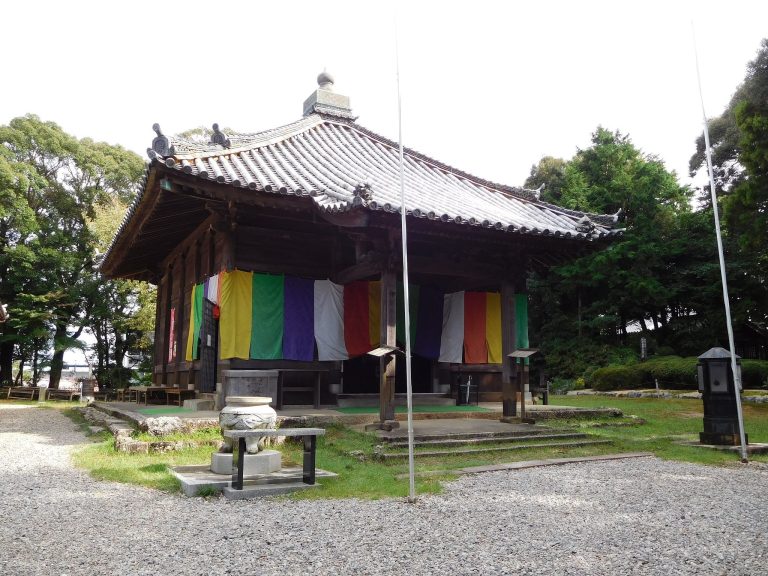
The present main hall, also called the Kannon Hall, is a three-bay, four-sided building rebuilt in 1814. Its form is smaller than the seven-bay, four-sided hall traditionally established under Emperor Daigo. The hall contains the principal image of Thousand-Armed Kannon, together with attendant and devotional images from the Muromachi, Edo, and Genroku periods.
Thousand-Armed Kannon
The principal wooden statue was made during the Kamakura period. It is 176 centimeters high and was carved from kaya wood using joined-wood construction. The image has forty-two arms, with an especially large central Buddhist face above the head. Its crystal urna, the raised mark on the forehead, contrasts with the painted eyes, eyebrows, and lips. The figure has elongated eyes, full cheeks, and relatively shallow folds in the drapery. The halo and pedestal were added later.
An image of Kannon serving as the sacred object of the Okitama deity is traditionally said to be enshrined within the statue’s crown. Ink inscriptions at the arm attachments record repairs commissioned by the abbot from a Kyoto Buddhist sculptor in 1681 and 1689. The statue was repaired again in 1983. As a hidden Buddha, it is displayed during principal-image openings several times a year and through a side-door opening on the eighteenth day of each month.
Attendant and devotional images
A wooden standing Fudo Myoo from the Edo period measures 80 centimeters in height. Fudo Myoo is a wrathful Buddhist wisdom king associated with immovability and protection. The figure stands on a rock pedestal beneath a flame halo, holds a noose in the left hand, and has lost the sword once held in the right. Inside the main hall, it stands to the viewer’s right of the principal image.
To the viewer’s left is a wooden standing Bishamonten from the Edo period, 87 centimeters high. Bishamonten is a Buddhist guardian and one of the Four Heavenly Kings. The figure holds a jeweled staff in the right hand and a pagoda in the left, standing on a demon figure.
A wooden seated Shokannon from the Muromachi period is 40 centimeters high. It uses joined-block construction with a lacquer-and-gold finish, including three sections joined from front to back, horizontally joined knee material, and an inserted neck. Its carefully finished back, Muromachi-style drapery above both arms, and cord knot on the lower abdomen are notable features. The crown fittings and lotus metalwork were added later.
A bronze standing Kangiten image was donated by the Yamada magistrate in 1703. Kangiten is an esoteric Buddhist deity represented here as two human-bodied, elephant-headed figures embracing. The image is treated as hidden and kept inside a bronze shrine cabinet measuring 37 centimeters in height. An engraved inscription on the cabinet names the donor and gives the date.
The main hall also enshrines a wooden seated image of Kobo Daishi, donated during the Genroku era by the mother of an Ise Grand Shrine priest. A ritual gong and its stand carry an inscription dated 1716, while another ritual gong bears an inscription dated May 1763. The cabinet for the principal image has an inscription recording its donation on November 18, 1695, by a donor from Imaisshiki Village.
Gate and associated religious buildings
Niomon Gate
The Niomon dates to 1721 and contains the two guardian-king statues installed during the Kyōhō era. Its framed plaque is traditionally attributed to Kukai. The gate was repaired in 2007, preserving a principal entrance structure from the temple’s period of revival after the seventeenth-century fire.
Shrines and halls
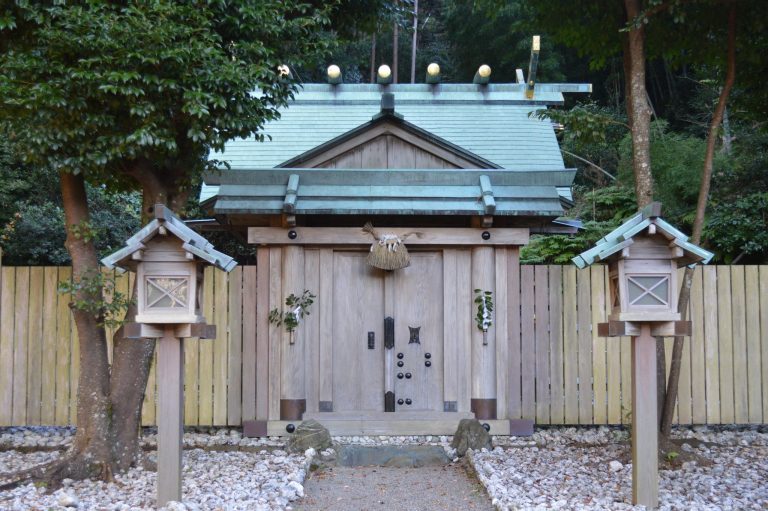
Moto-sha Okitama Shrine occupies the former site of the compound’s Okitama Shrine, which was transferred to Futamiura in 1897. The shrine preserves a sacred stone, a sacred mirror, and the frog-shaped sacred object associated with Futami’s “two frogs.” The grounds also contain Fushimi Inari Shrine, connected with the Shinto tradition devoted to Inari, and a Kōshin Hall associated with rites involving the Three Corpses and the Kōshin deity.
Aijuin is a separate temple within the wider complex, established for pets and used for pet memorial services. Together with the associated shrines and Kōshin Hall, it forms part of the compound’s continuing religious organization.
Stele, scroll, and stone basin
Amitabha Triad stele
The Amitabha Triad seed-syllable stele was made in 1572 from a naturally shaped slab of green schist and is 99 centimeters high. A shallow incised circle more than 32 centimeters across fills the upper part. Inside it, three symbolic Sanskrit letters representing Amitabha and two accompanying bodhisattvas are arranged in a triangle. An inscription below gives the date and records the donor’s respectful dedication, although the donor’s name is unknown.
The stele stands facing south on the rear mountain of the temple, in an area commonly called Goro-yashiki. Its form combines a natural stone slab with esoteric Buddhist signs, linking the physical landscape with the devotional practices represented at Taikō-ji.
Construction scroll
The scroll concerning the construction of the Kannon Hall was produced in 1635. It is a handscroll measuring 30.6 by 110.7 centimeters and records matters connected with the hall’s construction, preserving written evidence from the period of rebuilding before the later fire and the eighteenth-century revival.
Granite basin
A granite hand-washing basin measures 90 by 90 by 40 centimeters. It is traditionally identified as the base of a hōkyōintō, a Buddhist memorial pagoda. Its framed sides contain cusped decorative panels that are heavily worn, while the remaining carved lines suggest a date in the late Kamakura period. The upper surface was cut into a circular basin, with a channel on the north side allowing water to drain outward.