Cerro Tormejón Archaeological Site: A Multi-Period Settlement in Segovia
Site at a Glance
- Popularity
- Low
- Country
- Spain
- Primary era
- Iron Age
- Eras represented
- Iron Age, Classical, Medieval
- Civilizations
- Visigothic
- Site type
- Military
- Remains
- Fortified Town
On this page19 sections
History
The Cerro Tormejón Archaeological Site is a multi-period settlement in Armuña, in Spain’s Segovia province, within the Eresma valley. Its principal ancient community was established by the Vacceans, an Iron Age people of the central Duero basin, during the Second Iron Age. Construction of their fortified settlement dates to the fourth century BC, within a broader occupation that lasted from the fifth to the first century BC.
Early occupation
People occupied the hill in the third millennium BC, during the Copper Age. A later Bronze Age community may have fortified the site; pottery linked with the Cogotas I culture, associated with Bronze Age central Iberia, supports this interpretation.
A separate village stood at Vega del Nogal, less than 500 metres west, during the First Iron Age, an early phase of the period when iron became widely used. Its huts are associated with the formative and mature phases of the Soto de Medinilla culture, an Iron Age culture of central Iberia. Interpretations of ritual evidence from Cerro Tormejón have been used to support a proposed connection between these communities and the later Vacceans.
Vaccean settlement
The Vaccean community built the settlement in the fourth century BC. Finds from a 2020 excavation included an infant burial and an animal deposit beneath a house floor. One interpretation is that the animal was sacrificed when the house was founded to bring good fortune, with the child later placed nearby as protection for the afterlife. Another proposes that both deposits were connected and that the animal was sacrificed in the child’s honor. These interpretations have informed discussion of funerary and protective beliefs and of the possible succession from Soto communities to the Vacceans.
Late Antiquity and the medieval village
A further major phase of occupation began around the middle of the fifth century AD, during Late Antiquity, the period between the Roman era and the early Middle Ages. In the Visigothic period, when the Visigoths ruled much of Iberia after Roman imperial rule ended, the inhabited area shifted toward the western sector. The final stages of this occupation remain uncertain, and the period from the seventh to the twelfth century is difficult to interpret.
By the medieval period, the settlement was the village of Tormejón. It remained occupied until 1476, when it was abandoned and became a deserted settlement within the municipality of Armuña.
Archaeological investigation
An early inventory by Antonio Molinero included wheel-made pottery attributed to the Second Iron Age and to the Roman and Visigothic periods. The first excavations took place in 1977 under Professor Francisco Gozalo Viejo and identified Vaccean and Visigothic activity, including dwellings and storage silos. Work resumed in 2019 through the Eresma Archaeological Project, an initiative promoted by Armuña’s town council. Excavations expanded knowledge of the Vaccean and Visigothic occupations, and investigation of the Vaccean defensive wall began in 2021.
Remains
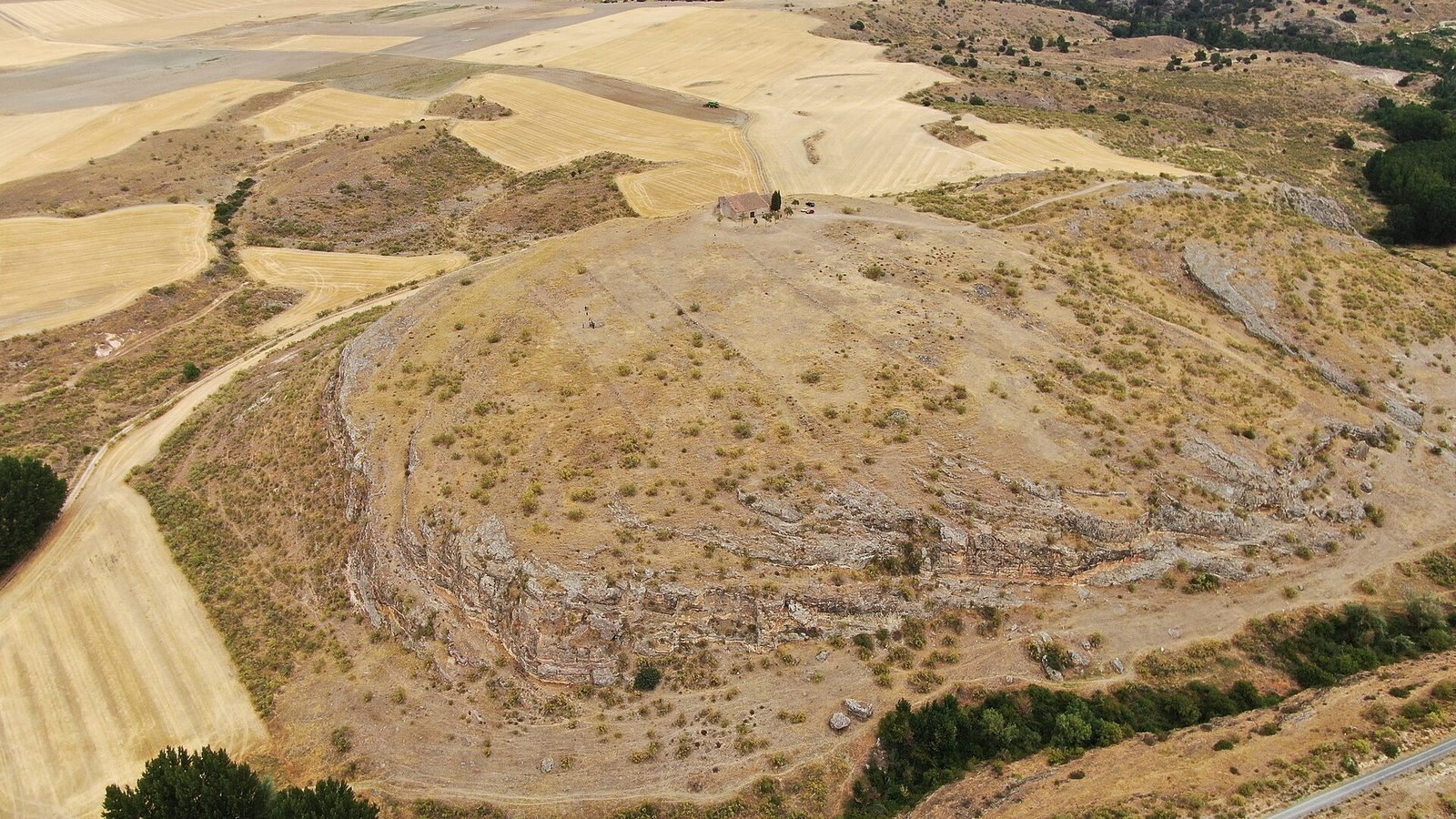
The settlement occupies a limestone crag of Cretaceous sedimentary rock, formed during a geological period that ended about 66 million years ago. Its inhabited area covered about six hectares. The western sector accounted for roughly 4.5 hectares, while a separate occupied area lay to the east. Steep slopes on the western, northern, and southern sides formed natural defenses.
Access
From the west, a ramp cut into the rock runs beside the cliff and climbs toward the upper settlement. Known as the Camino Romano or Las Escalerillas, it turns sharply near the top.
Domestic buildings
Western-sector houses
Excavations in 2019 and 2020 revealed houses built on limestone plinths, the supporting bases of walls. Finds from inside included two large storage vessels and granite querns, or stones used to grind grain.
Two-room house
A rectangular Vaccean house in the western sector retains two rooms. Its construction began with a prepared base of slate slabs. Adobe blocks, made from sun-dried earth, were bonded with mud, and a wooden post reinforced the structure.
Southeastern dwellings
On a limestone outcrop in the southeastern part of the fortified settlement, rectangular house plans cut into the rock and postholes, holes that held posts, form a terraced group. Some elongated pits and channels may have carried away rainwater. Others may have held the foundations of mud walls that no longer survive.
Defensive wall
The Vaccean wall follows the eastern side of the settlement, running northwest to southeast toward the cliff above the Tormejón stream. Its position corresponds to the side with less pronounced natural defenses. Sections of the inner face retain carefully dressed limestone blocks. Much of the visible structure consists of collapsed stone on both sides of the enclosure. Excavation has measured a surviving width of seven metres and a height of 1.6 metres.
Pottery
Vaccean ceramics
Wheel-made Vaccean vessels, made from pale and orange clay, date from the late fifth to the first century BC. Many carry painted geometric designs, including concentric semicircles, filled diamonds, lines, and horizontal bands. The assemblage also includes handmade pottery, a tradition established in the region by the seventh century BC.
Visigothic ceramics
Visigothic pottery from the surface and excavations bears stamped patterns such as rosettes, arches, circles, squares, triangles, and lozenges. One vessel carries an animal figure identified as a deer.
Burial and other excavated remains
Infant burial and animal deposit
The 2020 excavation found an infant, no more than six months old, in an oval pit beneath a house’s earthen floor. The child had been placed on its side. Less than 30 centimetres to the child’s right, a separate pit held a small sheep or goat.
One-course wall
A trench excavated in 1977 exposed a wall built one course high from limestone and slate blocks bonded with earth. A small jug with a pouring spout and stamped arch decoration was found in association with it.
La Veguilla cemetery
The settlement’s Visigothic-period cemetery is thought to have lain west of the site at La Veguilla. Its rectangular graves had varied orientations and were built with slate slabs and solid bricks.