Catacombs of San Gennaro: An Early Christian Burial Complex in Naples
Site at a Glance
- Popularity
- High
- Country
- Italy
- Primary era
- Classical
- Eras represented
- Classical, Medieval
- Civilizations
- Ostrogothic, Roman
- Site type
- Religious
- Remains
- Tomb
On this page19 sections
History
Origins and early Christian burials
The Catacombs of San Gennaro are an early Christian burial complex in Naples, Italy, whose origins lie in Roman Neapolis during the second or third century. The earliest burial area developed around the tomb of a wealthy Roman family. Its name is unknown because the inscribed material linked to the family was dispersed. Christian burials began between the late second and early third centuries, first for elite families and later for the wider community. Separate burial areas were also associated with Saints Gaudiosus, Severus, and Januarius. The lower level, the oldest part of the complex, dates to the third or fourth century and may have begun as a pre-Christian cemetery.
By the end of the third century, the remains of Agrippinus, a bishop of Naples revered as an early local patron saint, had been placed in a lower-level vestibule. The chamber became a place of veneration, and a cemetery basilica was later built above his tomb.
Sanctuary and expansion
Around 430, Bishop John I moved the remains of Januarius, also known as Gennaro, from the Agro Marciano burial area to a chamber in the catacombs and dedicated the burial place to him. Januarius was a Christian martyr venerated as Naples’s patron saint. The catacombs became a center of devotion and pilgrimage, prompting the addition of longer passageways, burial chambers, and worship spaces.
In 432, the Crypt of the Bishops was established for the burial of Neapolitan bishops. A place of worship known as the Basilica of the Bishops followed in the early sixth century. As worshippers outgrew its space, the complex expanded to include the Added Basilica, more than 50 metres long and 12 metres wide, and the Shrine of the Cross.
Between 762 and 764, Bishop Paul II took refuge near the catacombs after a faction supporting Byzantine religious policy drove him from Naples. The emperor’s policy opposed the veneration of religious images. Paul established an emergency episcopal residence in the lower vestibule and installed a baptismal font there.
Withdrawal and later history
In 831, during his siege of Naples, the Lombard prince Sicone I seized Januarius’s remains and carried them to Benevento. They were recovered in 1491 and transferred to Naples Cathedral. By the middle of the ninth century, Bishop John IV had also moved the remains of bishops buried in the catacombs to the urban Basilica of Stefania. Neapolitan dukes continued to be buried there during the ninth and tenth centuries, including Cesario in 878. The removal of revered remains and the bishops’ burials was followed by a decline in use and eventual abandonment.
The catacombs were extensively looted between the thirteenth and eighteenth centuries. Interest grew again in the eighteenth century, when they became a stop for Grand Tour travellers, undertaking extended educational journeys. In 1839, Andrea de Jorio, an archaeologist and canon of Naples Cathedral, published a guide devoted to the site.
During the Second World War, local residents used the catacombs as an air-raid shelter, and the complex was damaged. In the 1960s, Cardinal Archbishop Corrado Ursi reorganized the site and moved its bones to a nearby ossuary. Excavations began in 1971 under Aldo Caserta and Umberto Maria Fasola of the Pontifical Commission for Sacred Archaeology. Their work brought the Crypt of the Bishops and the Tomb of San Gennaro to light.
Remains
Setting and layout
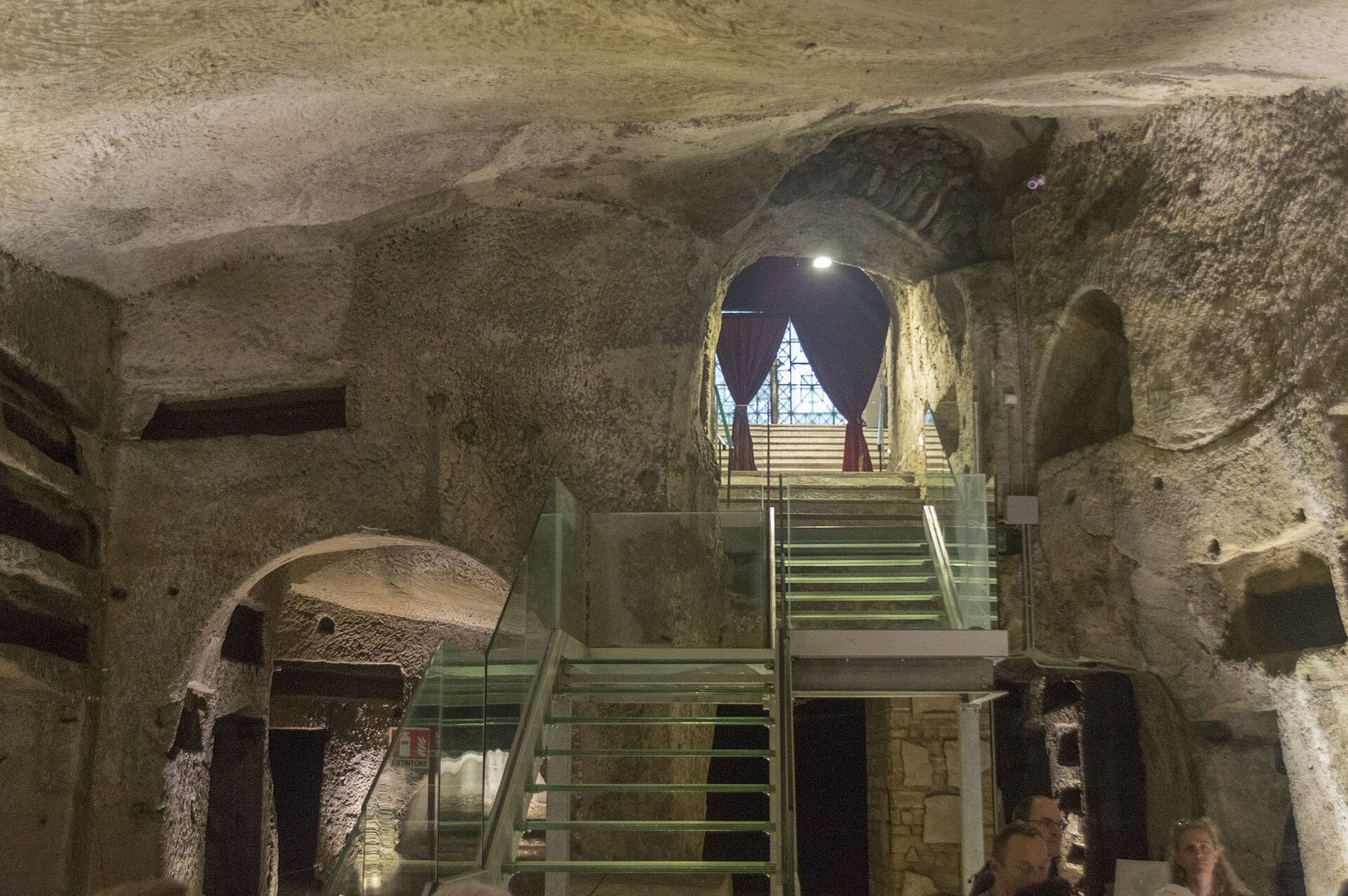
Cut into porous volcanic rock called tuff, the catacombs occupy a hillside in northern Naples, beneath the Sanità neighborhood and on the slope toward Capodimonte. The underground complex covers about 5,600 square metres and consists of two partly overlapping levels, San Gennaro Superiore and San Gennaro Inferiore. It is associated with the Basilica of San Gennaro outside the walls; the church of Madre del Buon Consiglio is another landmark in the surrounding landscape. Near the church of the Incoronata at Capodimonte, a staircase leads directly to the upper level. The passageways are more spacious than those in Roman examples, and the upper level was enlarged to incorporate two neighboring burial areas.
Lower-level chambers
Vestibule and Small Basilica of Saint Agrippinus
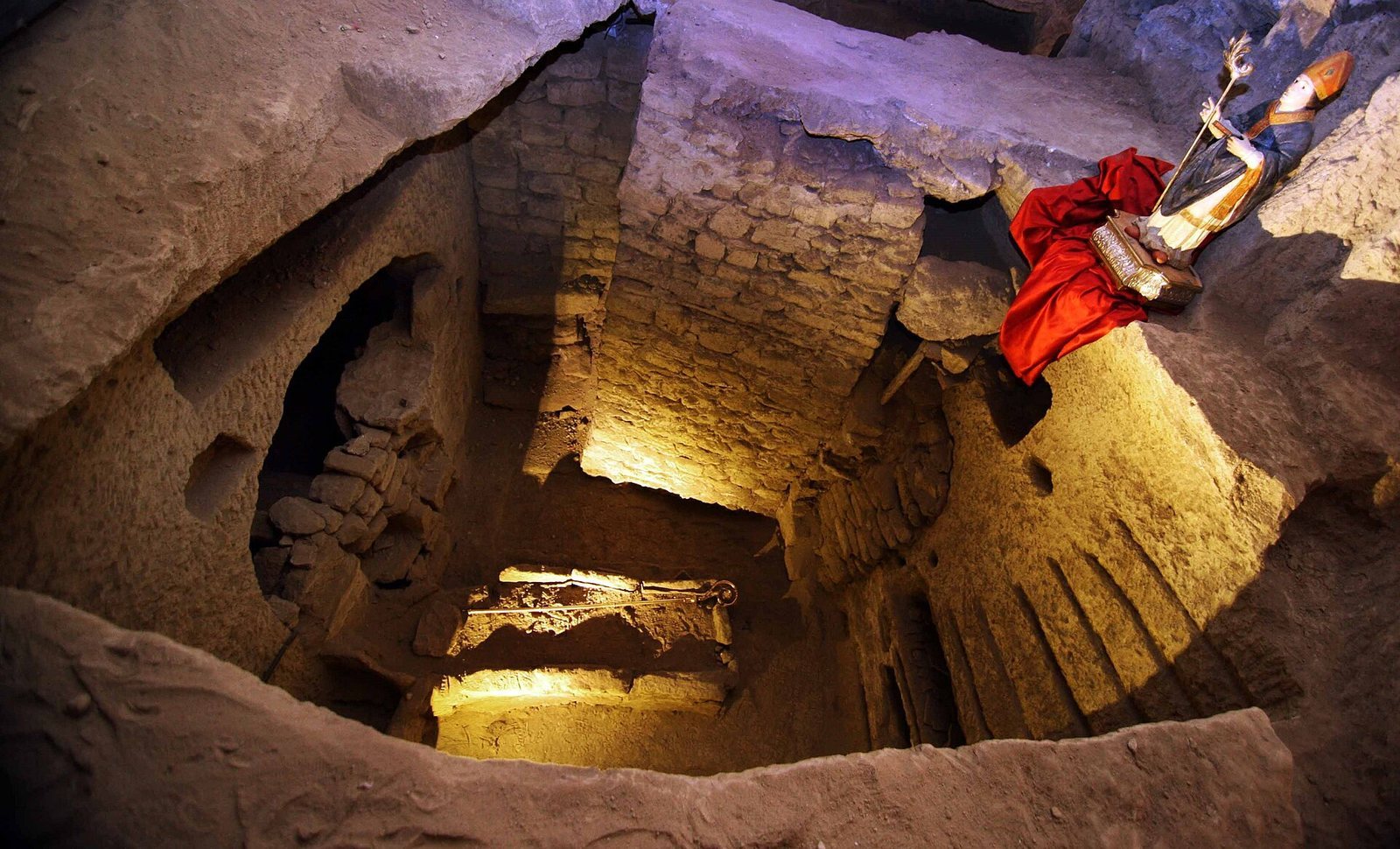
Four complete sarcophagi carved from tuff remain in the lower-level vestibule. Paintings on its ceiling follow a style associated with Pompeii in the second and third centuries, and a circular marble basin stands at the center. On the eastern side of the lower level’s main hall is the Small Basilica of Saint Agrippinus. Its altar and bishop’s chair are carved from tuff. Medieval frescoes show Agrippinus healing a sick person and a bishop accompanied by an eastern monk.
Hall and galleries
The lower level includes a trapezoidal hall about 6 metres high and 16 metres long. It is 6 metres wide at the entrance and broadens to 11 metres at the far end. Three monumental galleries extend from the hall. Smaller branches have lower ceilings, while graves occupy both the walls and the floors of the passages.
Burial forms
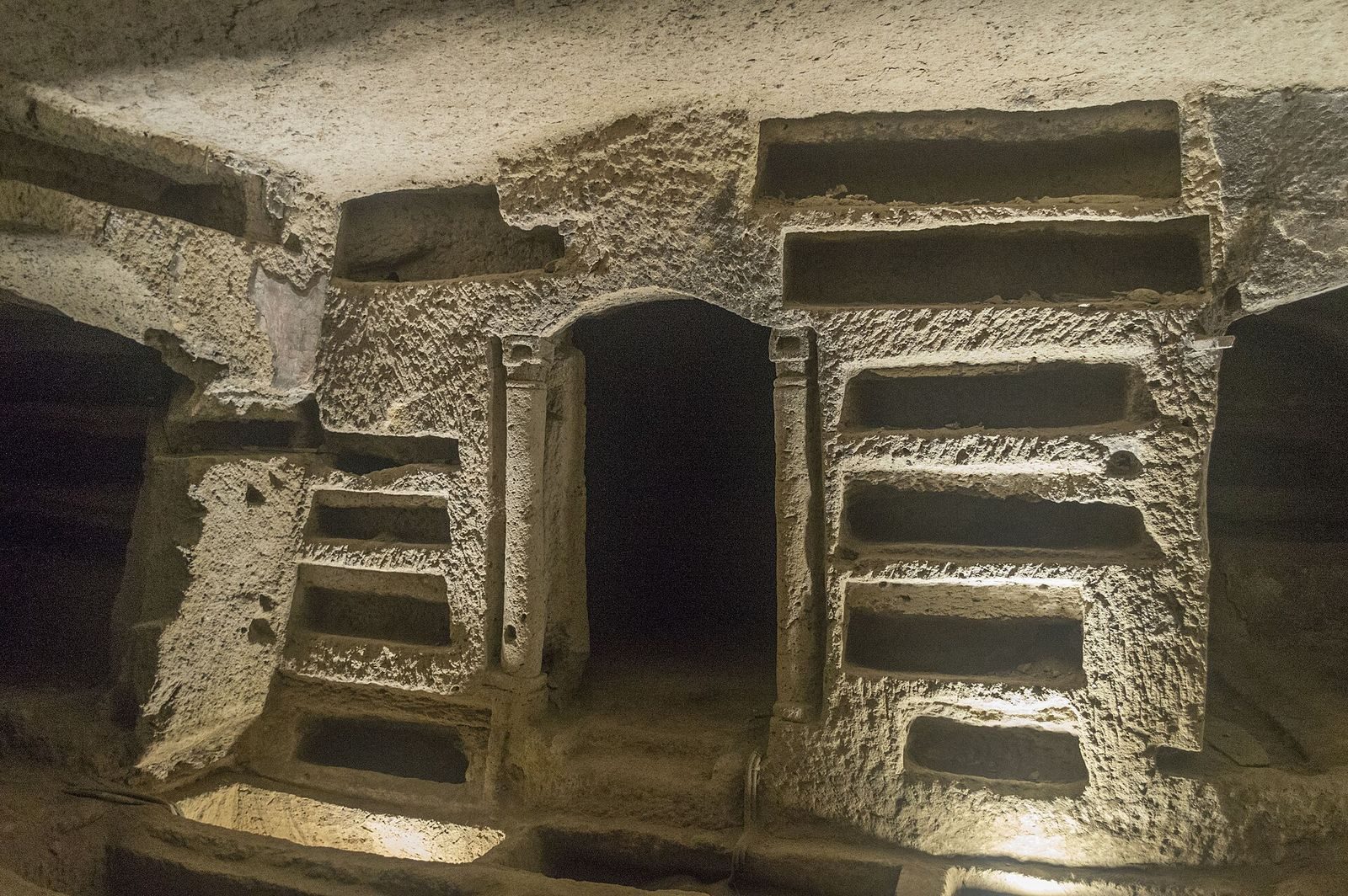
The complex contains more than 2,000 burials and about 500 wall niches. Burials include vertically arranged wall niches, pits in the ground, and arcosolia, arched recesses often used for family tombs, built into galleries and chambers. Some have domed or crescent-shaped forms and fresco or mosaic decoration; burials could be placed in several horizontal tiers. This multi-tiered arrangement, also found in Sicily and Greek catacombs, is known as a Siracusa burial. Some deeper niches hold multiple burials, and child burials occur along the lower wall of a curved recess. Other interments used tuff sarcophagi or reused marble and stone from older tombs. Ground burials could be covered with flat tiles or marble slabs. Simple niches do not indicate the deceased’s social standing.
Upper-level episcopal spaces
Crypt of the Bishops
The Crypt of the Bishops contains mosaics from the fifth and sixth centuries depicting bishops buried there. The oldest, dated to 432, portrays Bishop John. A mosaic of Quodvultdeus, the bishop of Carthage who died in exile in Naples, is on the north wall; an unidentified bishop appears on the south wall. Other mosaic fragments are scattered across the upper level.
Basilicas and episcopal portraits
The Added Basilica measured more than 50 metres by 12 metres. In a sixth-century basilical space, remnants on a barrel vault depict the first fourteen bishops of Naples. Their portraits have individually rendered facial features, and their style has been compared with African portrait-making of the fourth to sixth centuries.
Painted shrines and chambers
Confessio of San Gennaro
Near the tomb of San Gennaro, the confessio, a space associated with a saint’s tomb or relics, is cut into the lower level. It once had three layers of frescoes. The sixth-century decoration shows Januarius between Vesuvius and Mount Somma; a ninth-century layer portrays him with companions from the story of his martyrdom.
Underground basilica
A large basilica carved from tuff is an unusual feature within a catacomb. A passage with three arches leads to it. Beyond a second passage with three arches, a chamber on the right contains images associating birds with the deceased and a cross formed from combined letters with resurrection.
Entrance and main passage
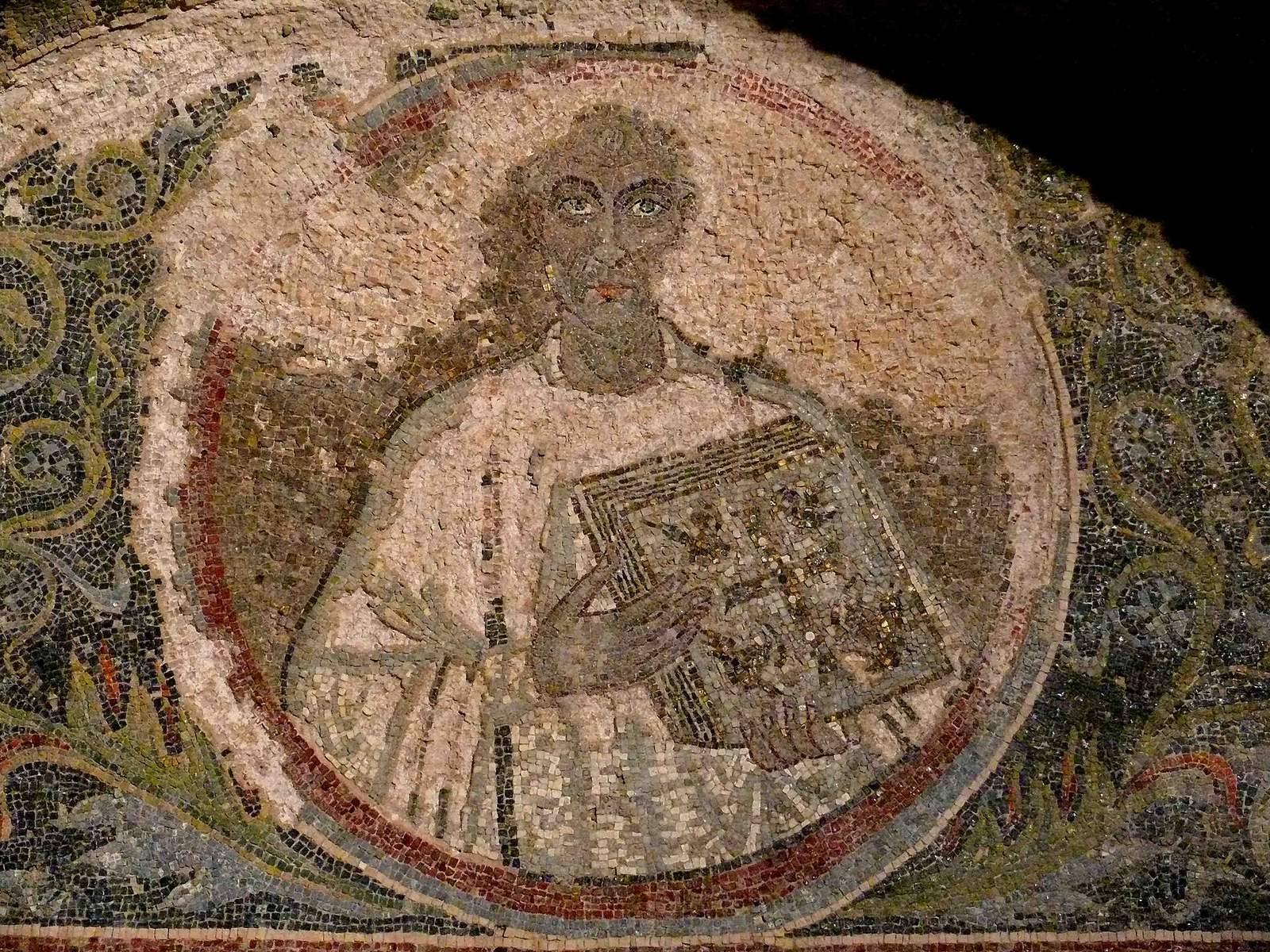
The upper-level entrance area holds a fifth-century portrait of Januarius, the oldest known portrait of the martyr. He appears between a girl and a woman, with an inscription identifying him as Saint Januarius the Martyr. A nearby passage has fifth- or sixth-century frescoes of the deceased Bitalia praying and the deceased Cerula with Saints Peter and Paul. Two further frescoes, from the early sixth century, show Paul with the deceased Lorenzo and Peter with Januarius and a crown. In the main passage, a well-preserved chamber was originally painted throughout. Its surviving decoration includes a figure that may represent Moses, Christ, or Peter, and a medallion with vine branches.
Cubicle of Theotecnus
In the upper-level cubicle of Theotecnus, a rear wall was opened between the late fifth and early sixth centuries to make room for the burial of Proculus, who came from Africa. Marta, another deceased person identified in the catacombs, also had African origins.
Oil lamps
About 200 oil lamps dating from late antiquity to the Middle Ages have been found in the catacombs. Fifty-four were African red-slip lamps, made from red-coated pottery produced in Roman North Africa. The oldest recovered lamps date to the second half of the third century and were made in Naples.